The Drum · Weekly AI news, freeSubscribe →

Share
Retro tech enthusiast Benj Edwards distilled GPT-OSS-120b into a model small enough for 1990s Super Nintendo hardware, proving edge deployment can go absurdly far if you're willing to sacrifice nearly everything the original model knew.
Model compression research usually aims for something practical: a chatbot that fits on a phone, an LLM that runs on a Raspberry Pi, that kind of thing. Benj Edwards took the concept somewhere stranger. He built a working ChatGPT clone that runs on a Super Nintendo Entertainment System, a console that shipped in 1990 with a CPU clocked around 3.58MHz and no concept of a neural network.
The project is called ChatGPT for SNES, and you can try it right now in a browser emulator or download it as an actual ROM file from Edwards' site. It even comes with period-appropriate SNES chiptune music and sound effects while it "thinks," because apparently nailing the vibe matters as much as nailing the inference.
Here's the technical core of it: the model is a 2.2 million-parameter network distilled from OpenAI's open-weight GPT-OSS-120b, which was used to generate the synthetic training conversations fed into the tiny model. Distillation, for anyone who needs the refresher, is the process of training a small "student" model to mimic the outputs of a much larger "teacher" model, compressing most of the useful behavior into a fraction of the parameter count. Going from 120 billion parameters down to 2.2 million is a compression ratio north of 50,000x. That's not trimming fat off a model; that's reducing it to a skeleton and hoping it can still walk.
Edwards built two versions, and the difference between them says a lot about where small models actually fail:
Ask both the same question and the gap is dramatic. The pure model is working from a vocabulary of about 8,000 words and whatever patterns survived distillation. Edwards doesn't sugarcoat its limits: "It is not a useful assistant: the model is millions of times smaller than the models behind ChatGPT, knows about 8,000 words, and often gets things wrong, sometimes confidently."
Running any neural network on SNES hardware means working inside genuinely tight memory and compute budgets, which is why the engineering choices here matter beyond the novelty factor.
The factbook version needs a cartridge supporting Nintendo's Super FX graphics coprocessor, an add-on chip originally built to accelerate 3D rendering (think Star Fox) that Edwards is instead repurposing to handle inference math the base SNES CPU can't manage alone. Modern flash carts like the FXPak Pro and SD2SNES support Super FX emulation, which is how hobbyists can load custom ROMs onto real hardware without tracking down original cartridge silicon.
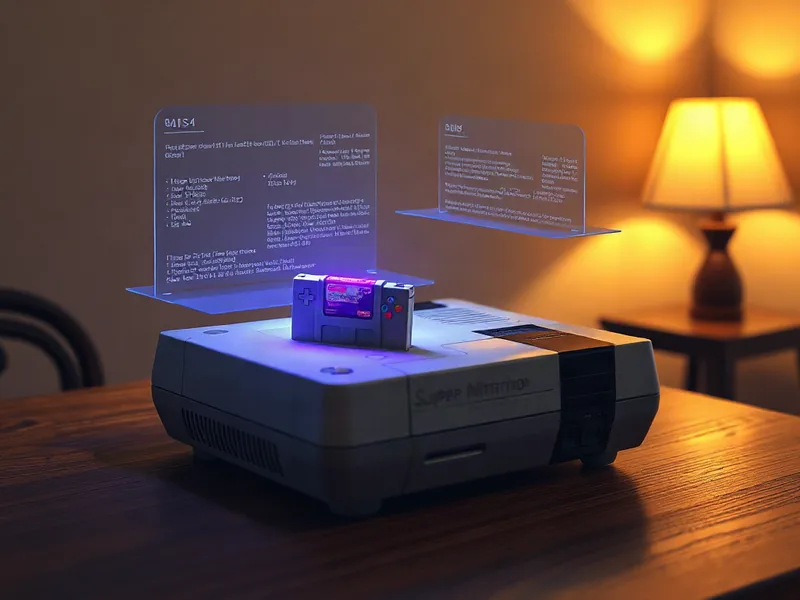
The factbook build adds another requirement: the aftermarket MSU-1 chip, which bolts CD-ROM-like storage and streaming audio onto the SNES, something the console never had natively. Without it, there's nowhere to stash 150,000 Wikipedia snippets.
Interestingly, the pure model doesn't actually need the Super FX chip at all. "I do have a version of ChatGPT for SNES that can run without the Super FX chip, but without the extra processing power the answers are not as good," Edwards told The Register. That's a clean illustration of a tradeoff every edge deployment engineer recognizes: shrink the compute budget and either accept worse output quality or add specialized silicon to compensate. At 2.2 million parameters there's no slack left to hide the difference.
What makes the project notable from an engineering standpoint isn't the chatbot itself. It's genuinely limited, and Edwards is upfront that the coding agents he used to build it believe they've hit a ceiling on how coherent a model this small can get. It's the demonstration that distillation pipelines designed for frontier models scale down far more aggressively than most practitioners would assume reasonable, even if the result is more curiosity than tool.
Edwards isn't new to this space. He's been "theorizing about what I call 'tiny talking machines'" for roughly a year, and he's used coding agents to actually implement those ideas rather than leaving them as thought experiments. ChatGPT for SNES is the second release in that line. The first, called Séance, runs an even smaller model on an original NES, framed as a haunted cartridge simulating a conversation with a ghost.
The human/AI division of labor here is worth noting too: Edwards designed the scope, chip selection, interface, and sound design, while coding agents handled implementation. "I designed the scope of what the software should be, how it should work broadly, what chip it should use, how the interface should look and work, and the sounds it makes when it types responses," he said, describing it as the kind of human-AI collaboration he thinks works best, direction from a person, execution from the model.
ChatGPT for SNES won't replace anything you're using for actual work, and it's not meant to. But it's a genuinely useful data point on how far distillation and retrieval tricks can push a model's practical footprint before coherence collapses entirely.
Whether he's right remains to be seen, but it's a reminder that assumptions about hardware limits are often softer than the tools telling you about them.
Tags
Original Sources
ChatGPT shrunk down to run on a Super Nintendo
↗ https://www.theregister.com/offbeat/2026/11/21/chatgpt-shrunk-down-to-run-on-a-super-nintendo/5311418
About the author
Kai built ML infrastructure at a Bay Area startup before developing an obsession with transformer architectures and inference optimisation that eventually pulled him out of product work entirely. A stint at a compute research lab sharpened his instinct for what actually matters in a model release versus what is marketing. He writes from the inside — from the perspective of someone who has debugged the systems he is describing at three in the morning. He is allergic to hype and instinctively drawn to the unglamorous plumbing questions that everyone else skips over.
More from The Engineer →This Week's Edition
22 November 2026
10 articles
Related Articles
Related Articles
More Stories
© 2026 Cedar & Bloom. All rights reserved.