The Drum · Weekly AI news, freeSubscribe →

Share
A major device maker just put Apple's mixed-reality headset in the operating room. Here's what the clearance actually covers, why Stryker chose consumer hardware over custom rigs, and what it signals for surgical visualization tech.
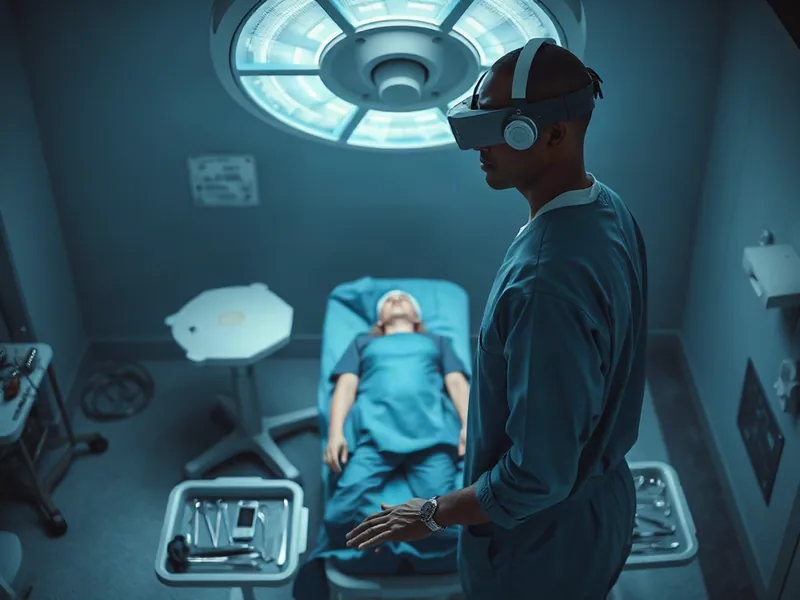
Stryker just got FDA clearance for a surgical visualization system that runs on Apple's Vision Pro headset, marking one of the more notable crossovers between consumer XR hardware and cleared medical devices. The system, which STAT describes as a kind of "surgical cockpit," lets surgeons view imaging and navigation data through the headset during procedures rather than glancing at a separate monitor across the room.
That framing matters. Anyone who's watched an OR in action knows the awkward choreography of surgeons craning their necks toward wall-mounted screens to check imaging while their hands stay busy at the table. Head-worn displays have been pitched as a fix for that for years, but most attempts relied on bespoke, expensive AR/VR hardware built specifically for medical use. Stryker's approach instead leans on a mass-market device that already has a mature software stack, a polished spatial computing interface, and (relatively) known supply chains.
Why Vision Pro, specifically?
Apple's headset was never marketed as medical equipment. It launched as a premium spatial computing device for productivity and media, with a hefty price tag and a developer ecosystem built around visionOS. But it has some properties that make it attractive for clinical repurposing:
Repurposing consumer-grade hardware for regulated clinical use isn't new. Pulse oximeters have shown up in smartwatches, and ultrasound probes have shrunk down to phone-attachable form factors. But a general-purpose XR headset entering the sterile field for real-time surgical guidance is a bigger leap, both technically and regulatory-wise.
FDA clearance for a device like this usually comes through the 510(k) pathway, which requires showing the new device is "substantially equivalent" to something already on the market rather than proving safety and efficacy from scratch, the way a de novo or PMA submission would. That's a faster, cheaper route, and it's the one most surgical navigation and visualization tools use when they're incremental improvements on existing display or guidance systems.
The catch is that "substantially equivalent" claims get scrutinized hardest when the underlying hardware is unusual, and running clinical-grade software on top of a consumer device raises questions that don't come up with purpose-built medical hardware:
None of this is disqualifying, obviously, since the clearance already happened. But it's a preview of the kind of scrutiny we'll likely see more of as device makers keep eyeing consumer XR and AI hardware as a shortcut to building clinical tools, rather than engineering custom rigs from the ground up.
There's also a broader trend worth flagging here. Big device companies have been increasingly willing to build on top of consumer tech stacks rather than treating medical hardware as a fully separate universe. It's the same logic that's driven AI vendors to build clinical tools on top of general-purpose large language models instead of training bespoke clinical models from scratch. The tradeoff is speed and lower upfront R&D cost against less control over the underlying platform's roadmap.
For surgeons, the practical pitch is straightforward: less time looking away from the patient, faster access to imaging or navigation cues, and a lighter footprint in the OR compared to bulky monitor arrays. Whether that translates into measurably better outcomes, or just a more comfortable surgeon, is the kind of question that tends to get answered slowly, through post-market surveillance and adoption data rather than the clearance announcement itself.
It's also worth noting this isn't Stryker's first foray into mixed reality. The company, along with rivals in the surgical robotics and navigation space, has been experimenting with AR overlays for joint replacement and spine procedures for a while. What's new here is the specific choice to build on Apple's headset rather than a proprietary or industrial AR device, which suggests Stryker sees enough stability and capability in Vision Pro's platform to bet a cleared product on it.
Stryker's FDA clearance shows that consumer XR hardware has crossed a credibility threshold serious enough for regulated surgical use, not just consumer gaming or productivity. The 510(k) pathway made this a faster process than a from-scratch approval, but it also means the underlying claims rest on equivalence to prior visualization tech rather than fresh clinical trial data. Expect more device makers to test this build-on-consumer-hardware model, especially as AI and spatial computing platforms mature faster than dedicated medical hardware cycles ever could. The bigger question for the next few years is how the industry handles platform dependency: what happens to a cleared surgical device when Apple ships a new headset generation, deprecates an API, or changes its update cadence in ways a hospital's procurement cycle wasn't built to absorb.
Tags
Original Sources
FDA clears Stryker's ‘surgical cockpit’ that uses Apple's VR headset, Vision Pro
↗ https://www.statnews.com/2026/09/01/fda-stryker-surgical-cockpit-apple-vr-headset-health-tech
About the author
Kai built ML infrastructure at a Bay Area startup before developing an obsession with transformer architectures and inference optimisation that eventually pulled him out of product work entirely. A stint at a compute research lab sharpened his instinct for what actually matters in a model release versus what is marketing. He writes from the inside — from the perspective of someone who has debugged the systems he is describing at three in the morning. He is allergic to hype and instinctively drawn to the unglamorous plumbing questions that everyone else skips over.
More from The Engineer →This Week's Edition
1 September 2026
29 articles
Related Articles

Rosarium Health Partners With Anthem Medi-Cal to Fund Home Modifications for Older Californians
Products & Applications · 5 min

Meta's new open-weight model runs on Macs, if you have 1TB of RAM to spare
Products & Applications · 5 min

Persona AI Bets on Calm Execution in a Noisy Humanoid Robotics Market
Products & Applications · 5 min
Related Articles
Rosarium Health Partners With Anthem Medi-Cal to Fund Home Modifications for Older Californians
Products & Applications · 5 min
Meta's new open-weight model runs on Macs, if you have 1TB of RAM to spare
Products & Applications · 5 min
Persona AI Bets on Calm Execution in a Noisy Humanoid Robotics Market
Products & Applications · 5 min
More Stories
© 2026 Cedar & Bloom. All rights reserved.
