The Drum · Weekly AI news, freeSubscribe →

Share
After parliament rejected measures meant to ease evictions and soaring rents, Spaniards flooded streets nationwide, far-right agitators clashed with riot police in Madrid, and unions now weigh a general strike.
For a lot of Spaniards, the question is no longer whether rent will go up this year. It's whether they'll still have a home when it does.
That frustration spilled into the streets on Saturday, when tens of thousands of people marched across Spain demanding real action on a housing crisis that has left ordinary families priced out of their own cities. In Madrid alone, the government said roughly 70,000 people turned out. Demonstrations unfolded peacefully in about 50 cities. But the night in the capital took a darker turn.
Police arrested three members of a far-right group and fired rubber bullets after those activists, some performing Nazi salutes, tried to force their way toward demonstrators camped in Puerta del Sol, the central square that has become a symbolic home base for the protest movement. The Spanish government confirmed the clash. In Valencia, police used rubber bullets and tear gas to break up protesters, and about 30 people briefly occupied the City of Arts and Sciences, a landmark cultural complex, before being removed.
Think of Puerta del Sol right now as a pressure valve. People aren't just angry about one bill failing in parliament. They're camping out because they feel like the normal channels, voting, petitioning, waiting for reform, have stopped working for them.
That anger has a specific trigger. Lawmakers on Friday rejected a package of measures designed to address an eviction crisis that had already captured national attention after an 87-year-old woman in Madrid was forced from her home. Her case became a flashpoint, a human face on a statistic that otherwise can feel abstract. When the parliamentary fix collapsed a day before the marches, it didn't just disappoint housing advocates. It confirmed, for many, a suspicion that the political system is unwilling or unable to move fast enough to match the scale of the problem.
"It's a shame," said Nando de Anguulo, 26, who joined Saturday's protest in Madrid. "It only proves that it is us, the people, who have to adapt to the political parties, and not the politicians to what the people want, and this can't go on like that."
That single quote captures something larger than one failed vote. It speaks to a growing gap between what citizens expect from their government and what that government is actually delivering, a gap that shows up in housing markets from Madrid to Lisbon to Los Angeles, wherever rents have outpaced wages for long enough that an entire generation starts to wonder if homeownership, or even stable renting, is realistic at all.
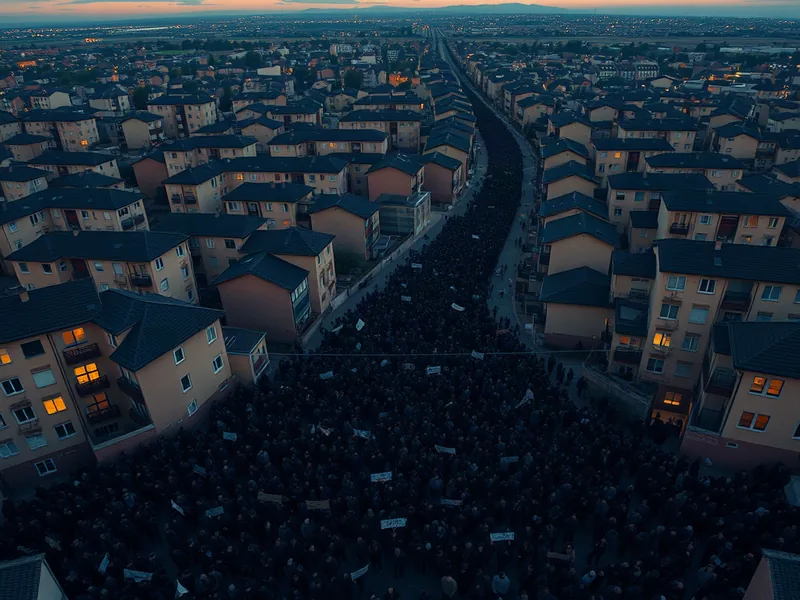
Spanish Prime Minister Pedro Sanchez is reportedly weighing a snap election for November, according to Spanish media, with the size and intensity of Saturday's protests expected to factor into that decision. Sanchez's office declined to comment on those reports, which leaves the country in a holding pattern: watching the streets to see whether this moment fades or builds into something that reshapes the political calendar.
Meanwhile, the labor movement is circling closer to direct action. Valeria Racu, spokesperson for the Tenants Union, told reporters in Madrid that a general strike would be called following talks with labor unions. A general strike is a blunt instrument, essentially a coordinated work stoppage meant to apply economic pressure until demands are met. It's the kind of tool unions reserve for moments when they believe normal negotiation has run its course. The fact that it's even on the table signals how far trust has eroded between housing advocates and the government they're trying to move.
Not every planned demonstration happened as scheduled. Protests slated for Barcelona and nearby Hospitalet de Llobregat were canceled because of heavy rain, a reminder that even mass mobilization runs into mundane obstacles. But the cancellations didn't dent turnout elsewhere, and organizers seem to view Saturday as a floor rather than a ceiling.
It's worth sitting with the contrast between the peaceful majority and the violent minority here. Most of the tens of thousands who marched Saturday did so without incident, across dozens of cities, making a collective case for policy change through sheer numbers. The clashes in Madrid and Valencia involved a much smaller group: far-right agitators trying to disrupt the demonstration, and police responding with force to prevent confrontation. Conflating the two risks obscuring what this movement is actually about, which is housing affordability, not street violence.
The eviction of the 87-year-old woman that helped trigger this wave of protest illustrates a pattern researchers have documented across much of Europe: older residents on fixed incomes, often having lived in the same home for decades, increasingly squeezed out by rising costs or property owners looking to convert units for higher-paying tenants. When that kind of case becomes public, it tends to crystallize abstract economic pressure into something people can see and react to.
Spain now sits at a genuine fork. Sanchez can call elections and let voters render judgment directly, a move that carries real risk given how visibly his government's housing measures just failed. Or the government can return to the negotiating table, try to craft a package that can actually pass parliament, and hope that satisfies enough of the public anger to avoid a strike.
Either path carries consequences that extend beyond Spain's borders. Housing affordability has become one of the defining pocketbook issues across wealthy democracies, and how Spain's government responds, through concession, through election, or through continued stalemate, will be watched closely by policymakers elsewhere grappling with the same math: wages that aren't rising fast enough to keep pace with the cost of simply having a place to live.
Tags
Original Sources
Tens of thousands protest across Spain over housing crisis
↗ https://www.reuters.com/world/tens-thousands-protest-across-spain-over-housing-crisis-2026-10-03
About the author
Amara's entry point into AI was an epidemiology role at a London research hospital, where she spent five years studying how digital health tools reached — or conspicuously failed to reach — underserved communities. Watching early algorithmic systems in healthcare quietly entrench existing inequalities, she redirected her career toward the systemic consequences of AI at scale. She covers AI through an unflinching lens: who benefits, who bears the cost, and what evidence actually says versus what the press release claims. Her writing is calm and precise, but she doesn't mistake balance for neutrality.
More from The Steward →This Week's Edition
4 October 2026
25 articles
Related Articles
Related Articles
More Stories
© 2026 Cedar & Bloom. All rights reserved.