The Drum · Weekly AI news, freeSubscribe →

Share
As debate rages over whether AI will outsmart humans, a quieter question deserves more attention: what is the energy and carbon cost of building these systems, and who ultimately pays for it?
There's a question that tends to get lost in the noise around artificial intelligence. Everyone wants to know if machines will outthink us. Fewer people are asking what it costs the planet to find out.
Robotics pioneer Rodney Brooks has spent years pushing back on inflated claims about AI's trajectory, arguing that today's systems still fall well short of general human capability. His skepticism, aired in a widely discussed IEEE Spectrum piece, centers mostly on intelligence and capability gaps. Self-driving cars, he points out, have taken far longer to mature than hype cycles promised, and still haven't definitively beaten human drivers on safety. But embedded in that broader conversation about AI's limits is a harder truth that deserves its own spotlight: the physical infrastructure behind every chatbot response, every image generated, every model trained, runs on electricity, water, and increasingly scarce computing hardware. And that infrastructure has a climate footprint we can no longer treat as an afterthought.
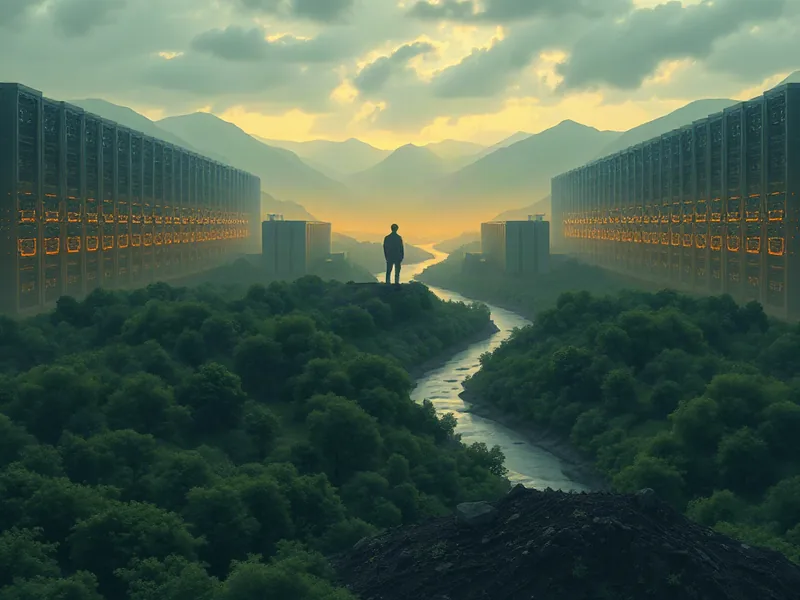
Think of it like this. A single AI model doesn't just think. It burns. Training a large language model requires running thousands of specialized chips, continuously, for weeks or months, inside data centers that need constant cooling to avoid overheating. That cooling often means water, lots of it, drawn from local supplies that communities also rely on for drinking and agriculture. The electricity powering those chips, meanwhile, still comes substantially from fossil fuel sources in many regions, meaning every query sent to a chatbot carries a small but real carbon cost.
Here's where the stakes become less abstract. Data centers are not a niche corner of the economy anymore. They're multiplying rapidly to keep pace with demand for AI tools, cloud storage, and streaming services, and each new facility represents a long-term commitment to energy consumption that will outlast whatever product hype justified building it. Once a data center goes up, it needs power for years, sometimes decades. That's not a short-term blip. It's infrastructure that locks in demand on the grid for a generation.
Brooks's broader argument, that AI capabilities are often overstated relative to reality, carries an environmental corollary worth sitting with. If systems are being oversold on what they can do, are we also oversizing the energy and resource commitments we're making to build them? Commenters responding to his piece debated whether self-driving technology has gotten "quite close" to viable, or whether the hype has outpaced the actual safety record. That same tension, between promised capability and delivered performance, applies directly to sustainability. We are pouring enormous resources into infrastructure for a technology whose ultimate ceiling remains genuinely uncertain.
This isn't an argument against AI itself. Plenty of AI applications hold real promise for climate work, from optimizing energy grids to improving weather prediction to helping scientists model emissions scenarios more precisely. The irony is sharp: a technology that could help us fight climate change is, in its current form, also contributing to the problem it might eventually help solve. That duality deserves honest treatment rather than either blind boosterism or blanket dismissal.
Communities near data center hubs are already living this trade-off. In parts of the United States, water-intensive cooling systems have drawn scrutiny from residents worried about strain on local aquifers, especially during drought years. Utility companies in some regions have flagged rising demand from data centers as a factor in long-term grid planning, sometimes raising questions about who bears the cost of new power plants or transmission lines needed to keep up. These are not hypothetical concerns dreamed up by critics. They are showing up in utility filings, local zoning fights, and community water-use reports right now.
None of this means AI development should halt. It means the conversation about AI's future, which Brooks and others have pushed toward realism rather than hype, needs an equally sober environmental companion. Just as we shouldn't assume machines will spontaneously become superintelligent next year, we shouldn't assume the energy and water demands of AI infrastructure will simply resolve themselves through efficiency gains alone. Chipmakers have made real strides in energy efficiency per computation. But those gains have been consistently outpaced by the sheer scale of AI deployment, a pattern familiar from other areas of computing history.
Responsible AI development, then, has to mean more than just safety guardrails on what a model says or does. It has to include transparency about what a model costs to build and run, measured in kilowatt-hours and gallons of water, not just in capability benchmarks. Some researchers and companies have started publishing energy-use estimates alongside model releases, a welcome if still inconsistent practice. Wider adoption of that kind of disclosure would give policymakers, investors, and the public a clearer picture of what they're actually signing up for when they cheer on the next AI breakthrough.
The debate over whether AI will someday rival or exceed human intelligence will likely continue for years, unresolved by any single article or expert opinion. But the environmental costs of building and running these systems are accumulating in the present tense, measurable today in utility bills, water tables, and grid strain. Treating sustainability as a secondary concern, something to address once the technology matures, risks locking in infrastructure choices that are expensive and difficult to reverse. The people living near data centers, drawing from the same water systems, and paying the same electricity rates deserve a seat at the table now, not after the next wave of hype has already poured the concrete.
Tags
Original Sources
An Inconvenient Truth About AI
↗ https://spectrum.ieee.org/rodney-brooks-ai/particle-5
About the author
Amara's entry point into AI was an epidemiology role at a London research hospital, where she spent five years studying how digital health tools reached — or conspicuously failed to reach — underserved communities. Watching early algorithmic systems in healthcare quietly entrench existing inequalities, she redirected her career toward the systemic consequences of AI at scale. She covers AI through an unflinching lens: who benefits, who bears the cost, and what evidence actually says versus what the press release claims. Her writing is calm and precise, but she doesn't mistake balance for neutrality.
More from The Steward →This Week's Edition
16 October 2026
29 articles
Related Articles

Nuclear Plants Are Squeezing Out More Power, But It Won't Be Enough to Meet AI's Demand
Environment & Climate · 5 min

Iambic Therapeutics Raises $150 Million in IPO to Fund AI-Designed Cancer Drugs
Finance & Markets · 5 min

Biotech's Summer Glow Fades as XBI Slips 11% From August Highs
Finance & Markets · 5 min
Related Articles
Nuclear Plants Are Squeezing Out More Power, But It Won't Be Enough to Meet AI's Demand
Environment & Climate · 5 min
Iambic Therapeutics Raises $150 Million in IPO to Fund AI-Designed Cancer Drugs
Finance & Markets · 5 min
Biotech's Summer Glow Fades as XBI Slips 11% From August Highs
Finance & Markets · 5 min
More Stories
© 2026 Cedar & Bloom. All rights reserved.
