The Drum · Weekly AI news, freeSubscribe →
Share
A heated MathOverflow post accusing mathematicians of insecurity over AI-generated proofs went viral for its tone, but it stumbles into a real question: what actually makes a mathematical proof valuable, and can a language model produce one?
A question posted on MathOverflow this week, titled "Why are mathematicians so insecure about AI," has stirred up more heat than light. The post, from a new contributor going by "ammo 45," accuses working mathematicians of hiding behind clichés like "math is about the journey, not just the destination" to dismiss AI-generated proofs. It's blunt, it's got exactly one upvote and three downvotes at time of writing, and one commenter has already asked, not unkindly, what the poster actually hopes to accomplish. But strip away the confrontational framing and there's a genuinely interesting technical question buried in there: when a model produces a step-by-step proof, does the "journey" objection even make sense?
The post's core argument runs like this. AI systems working on proofs, the poster claims, don't just output a true-or-false verdict. They generate the entire derivation, step by step. If mathematicians care so much about the reasoning process rather than just the answer, the argument goes, they should simply read the proof the model produced. The poster points to a "recent Navier-Stokes paper" as an example, describing it as "incredibly readable" and built from "pre-established mathematical ideas," not some opaque black box that brute-forced its way to an answer.
That claim didn't survive contact with the comments section. James E Hanson, a MathOverflow regular, pushed back directly: "incredibly readable" is not really how I've heard people describe that paper. It's a small pushback, but it matters, because it cuts right to the actual point of contention. The debate over AI and mathematics isn't really about whether models can produce long chains of symbolic steps. It's about whether those chains constitute understanding, whether they're checkable by a human in reasonable time, and whether "readable" is doing a lot of work to paper over what might actually be a dense, hard-to-verify slog.
Here's the thing about proof verification: length and structure aren't the same as clarity. A step-by-step derivation can be technically complete and still be brutal to check. Formal proof assistants like Lean or Coq produce exhaustive, machine-verifiable proofs all the time, and mathematicians have spent years building tooling specifically because raw verifiability doesn't equal comprehensibility. A proof that's "readable" in the sense of using standard notation and known lemmas isn't automatically readable in the sense of being quickly digestible by a human trying to understand why something is true.
This is where the "journey vs. destination" framing, mocked in the original post as a cliché borrowed from Terry Tao, actually has some substance underneath it, even if the post doesn't credit it. Mathematicians generally value proofs not just as certificates of truth but as sources of insight: new techniques, new connections between fields, new intuition that can be reused elsewhere. A proof that's technically valid but doesn't illuminate anything new, or that's so long and mechanical that no human can hold it in their head, delivers the destination without much of the journey's payoff. That's a legitimate distinction, not automatically insecurity dressed up as principle.
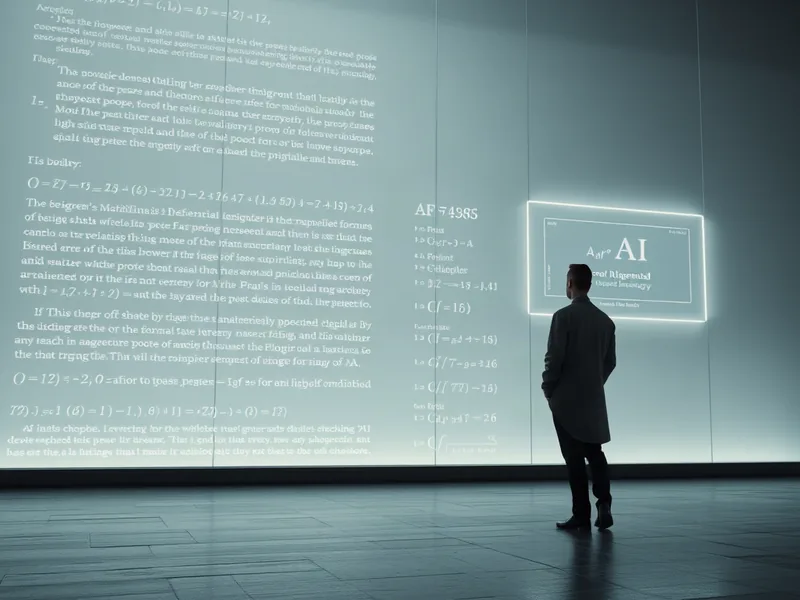
The poster does make one point that's harder to dismiss: today's AI proof systems are trained on human mathematical work and are typically steered by human prompting toward known techniques. That's a fair description of how large language models function; they're built on corpora of existing human writing, so their outputs will, structurally, tend to echo established approaches rather than emerge from nothing. Whether that's a permanent limitation or just a description of where the field is right now is exactly the kind of question serious researchers in AI-for-math are actively working on, through benchmarks that test not just final answers but the validity and novelty of intermediate reasoning steps.
That's also where the credibility gap in this particular post shows up. It cites "the recent Navier-Stokes paper" without a link, without an author, without enough detail for anyone to actually check the claim being made about its readability. Hanson's skepticism in the comments is the natural response to that kind of unsourced assertion; you can't evaluate a readability claim about a paper nobody can identify. For a discussion about the standards mathematicians should apply to AI-generated proofs, it's a little ironic that the post itself doesn't meet the basic sourcing standard mathematicians apply to each other's claims.
None of this means the underlying worry about professional displacement is baseless. The post's closing argument, framed through a quoted remark about people "who have their hands on the switch" going "batshit crazy" when their livelihoods are threatened, gestures at something real: any field facing automation of its core skill is going to produce defensive reactions, and not all of those reactions will be well-reasoned. But conflating every methodological concern about AI-generated proofs with pure job insecurity flattens a distinction that actually matters for evaluating these systems. Verifiability, insight, and correctness aren't the same axis, and a serious benchmark for mathematical AI needs to grapple with all three, not just whether the final answer checks out.
The MathOverflow post is short on evidence and long on rhetorical heat, and it got called out for both in its own comment section within minutes. But the question it gestures toward, whether a model that produces long, technically valid, human-legible-sounding proofs has actually closed the gap mathematicians care about, is worth taking seriously on its own terms. Recent AI results in competition math and formal proof verification suggest models are getting genuinely better at generating checkable derivations. Whether those derivations carry the kind of insight mathematicians associate with a "good" proof, versus just a correct one, remains an open and much harder question, and it's not going to get settled by accusing skeptics of insecurity. It's going to get settled by benchmarks that actually measure reasoning quality, not just final-answer accuracy, and by mathematicians doing the unglamorous work of reading the proofs closely enough to say whether "readable" was ever the right word to begin with.
Tags
Original Sources
Why are mathematicians so insecure about AI?
↗ https://mathoverflow.net/questions/515369/why-are-mathematicians-so-insecure-about-ai
About the author
Kai built ML infrastructure at a Bay Area startup before developing an obsession with transformer architectures and inference optimisation that eventually pulled him out of product work entirely. A stint at a compute research lab sharpened his instinct for what actually matters in a model release versus what is marketing. He writes from the inside — from the perspective of someone who has debugged the systems he is describing at three in the morning. He is allergic to hype and instinctively drawn to the unglamorous plumbing questions that everyone else skips over.
More from The Engineer →This Week's Edition
20 September 2026
20 articles
Related Articles
Stanford HAI's Fall 2026 Seminar Lineup Zeroes In On World Models, AI Measurement, and Workforce Anxiety
Models & Research · 5 min

The Uncanny Valley Isn't Going Away, and Maybe It Shouldn't
Models & Research · 5 min
Why a Disney Roboticist Traded Academic Research for Theme Park Robots
Models & Research · 5 min
Related Articles
Stanford HAI's Fall 2026 Seminar Lineup Zeroes In On World Models, AI Measurement, and Workforce Anxiety
Models & Research · 5 min
The Uncanny Valley Isn't Going Away, and Maybe It Shouldn't
Models & Research · 5 min
Why a Disney Roboticist Traded Academic Research for Theme Park Robots
Models & Research · 5 min
More Stories
© 2026 Cedar & Bloom. All rights reserved.
