The Drum · Weekly AI news, freeSubscribe →

Share
Hospitals keep buying AI tools hoping for relief, but many are simply bolting new software onto decades-old workflows. The result: more cost, more clicks, and clinicians left carrying the difference.
Picture a nurse at the end of a twelve-hour shift, still typing notes into a system that was designed when fax machines were cutting-edge. Now hand her a new AI tool meant to help. If that tool doesn't actually change how her workday flows, it just becomes one more thing she has to learn, click through, and work around. That's the quiet crisis playing out across American healthcare right now.
Artificial intelligence has arrived in medicine fast. Hospitals and health systems have poured money into it, hoping it would ease the load on overworked clinicians and tighten up costly operations. But the returns haven't matched the investment for many organizations. That gap isn't really about the technology failing to perform. It's about where and how that technology gets placed.
Think of it like renovating a house with a crumbling foundation. You can install a smart thermostat, upgrade the appliances, add solar panels. The house will look modern. But if the foundation underneath is still cracked, none of those additions fix the structural problem, they just sit on top of it, waiting for the next stress point to show up somewhere else.
That's roughly what's happening in healthcare IT. AI has shown real value in specific, narrow tasks: writing clinical documentation, assisting with medical coding, automating administrative paperwork. Those wins are genuine. But isolated improvements rarely add up to meaningful transformation when they're dropped into workflows that were never built to accommodate them.
It seems sensible, on the surface, to build on top of what's already there. Most electronic health record systems in use today trace their architecture back decades. Adding a new AI layer on top feels efficient, like upgrading a phone's operating system rather than buying a new device. But healthcare's underlying systems aren't a phone's operating system. They're closer to running 2026 software on hardware designed for a different era entirely.
When AI gets stacked onto these legacy workflows, it doesn't remove pressure from the system. It redistributes that pressure, usually onto the people at the end of the line: clinicians. Every extra administrative step, every additional screen to click through, pulls time away from patients. Automating a broken process doesn't fix the process. It just makes the broken version move faster and cost more.
That pattern isn't going away on its own. It will keep repeating until healthcare organizations stop treating AI as an add-on and start rethinking the workflows themselves from the ground up.
The costs of this layering approach rarely show up as one dramatic failure. There's no single moment when an executive can point and say, "that's when we layered too much." Instead, it accumulates gradually, through more platforms, more point solutions, each one trying to automate a small piece of healthcare in isolation. Beneath the rising expenses, three warning signs tend to show up.
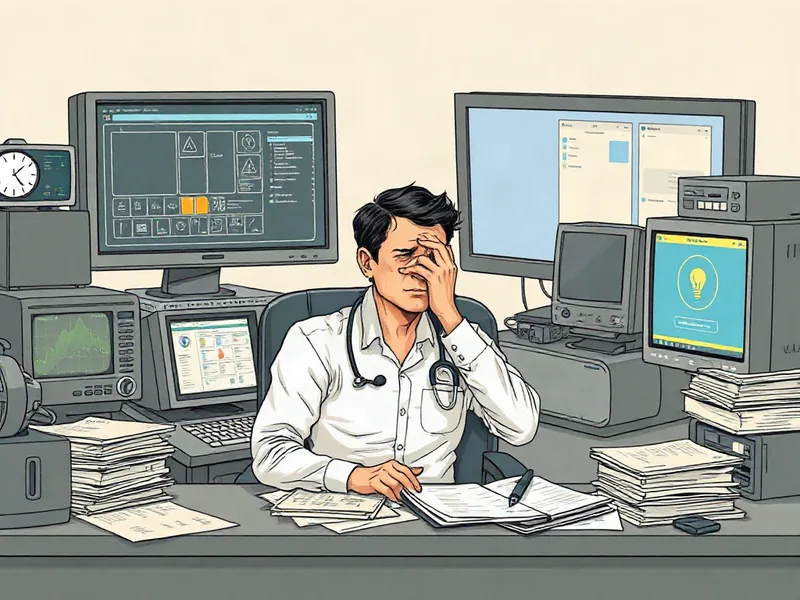
Clinician burnout is one of them. A recent study found that fewer than half of new AI tools introduced over the past two years actually made providers more productive, according to research cited by the Medical Group Management Association. When a tool adds friction rather than removing it, clinicians feel it directly. Enough friction, sustained long enough, pushes people out of the profession entirely.
Capacity strain is the second. Demand for care keeps climbing as the population ages, and clinicians already stretched thin have even less room to absorb tools that complicate their workflow instead of simplifying it.
Patient experience is the third, and arguably the one that matters most. Healthcare exists to serve patients. When the people delivering that care are overworked and buried in administrative tasks, the quality of the patient experience inevitably suffers too.
In medicine, treating a symptom while ignoring its underlying cause is considered bad practice. It's a basic principle taught early in clinical training. Yet many healthcare organizations are doing exactly that with their own operations, applying software patches to cover up workflow problems rather than addressing what's actually broken underneath.
Fixing that starts with rethinking which metrics actually matter. Adoption rates, the number of clinicians using a new tool, sound reassuring on a slide deck. But they don't capture whether that tool is actually making anyone's job easier. Real value shows up somewhere else: in reduced friction within core clinical workflows, in work eliminated rather than work added, in reclaimed time that clinicians can spend with patients instead of screens. Provider satisfaction and patient engagement deserve far more weight in these evaluations than they currently get.
Healthcare has reached a genuine inflection point, and this moment carries real weight for anyone who relies on the system, which is to say, all of us. The organizations that come out ahead won't be the ones with the flashiest technology stack. They'll be the ones that use AI to actually eliminate work rather than simply rearrange it. That distinction sounds subtle. It isn't.
This current wave of AI investment represents one of the more significant opportunities healthcare has had in years to fundamentally re-engineer how care gets delivered. That opportunity comes with a cost if missed. Layering more tools onto legacy systems will keep producing the same disappointing results: rising expenses, stretched clinicians, and patients caught in the middle.
The alternative requires more upfront work: redesigning workflows rather than simply adding to them. It's a harder path, and it asks more of healthcare leaders than approving another software purchase. But it's the only path that leads somewhere different. Rebuilding takes more courage than bolting on another tool ever will, and the clinicians and patients depending on this system deserve that courage now, not after another decade of patchwork fixes.
Tags
Original Sources
The Healthcare Inflection Point: AI Can’t Fix 1990s Technology - MedCity News
↗ https://medcitynews.com/2026/09/the-healthcare-inflection-point-ai-cant-fix-1990s-technology
About the author
Amara's entry point into AI was an epidemiology role at a London research hospital, where she spent five years studying how digital health tools reached — or conspicuously failed to reach — underserved communities. Watching early algorithmic systems in healthcare quietly entrench existing inequalities, she redirected her career toward the systemic consequences of AI at scale. She covers AI through an unflinching lens: who benefits, who bears the cost, and what evidence actually says versus what the press release claims. Her writing is calm and precise, but she doesn't mistake balance for neutrality.
More from The Steward →This Week's Edition
4 September 2026
24 articles
Related Articles

A Heart Without Friction: Maglev Technology Moves Into Cardiac Care
Health & Science · 6 min

How a Stubborn Hiss of Radio Noise Helped Confirm the Big Bang
Health & Science · 5 min

AI Can Predict Chemotherapy Response in Aggressive Breast Cancer, But Not Yet Reliably Enough for the Clinic
Health & Science · 5 min
Related Articles
A Heart Without Friction: Maglev Technology Moves Into Cardiac Care
Health & Science · 6 min
How a Stubborn Hiss of Radio Noise Helped Confirm the Big Bang
Health & Science · 5 min
AI Can Predict Chemotherapy Response in Aggressive Breast Cancer, But Not Yet Reliably Enough for the Clinic
Health & Science · 5 min
More Stories
© 2026 Cedar & Bloom. All rights reserved.
