The Drum · Weekly AI news, freeSubscribe →

Share
Two Bell Labs engineers set out to build a better antenna and stumbled onto evidence that reshaped our understanding of the universe's origins, a reminder that some of science's biggest answers arrive by accident.
Sometimes the biggest discoveries in science don't come from a hypothesis chasing proof. They come from two people trying to fix what they thought was a broken machine.
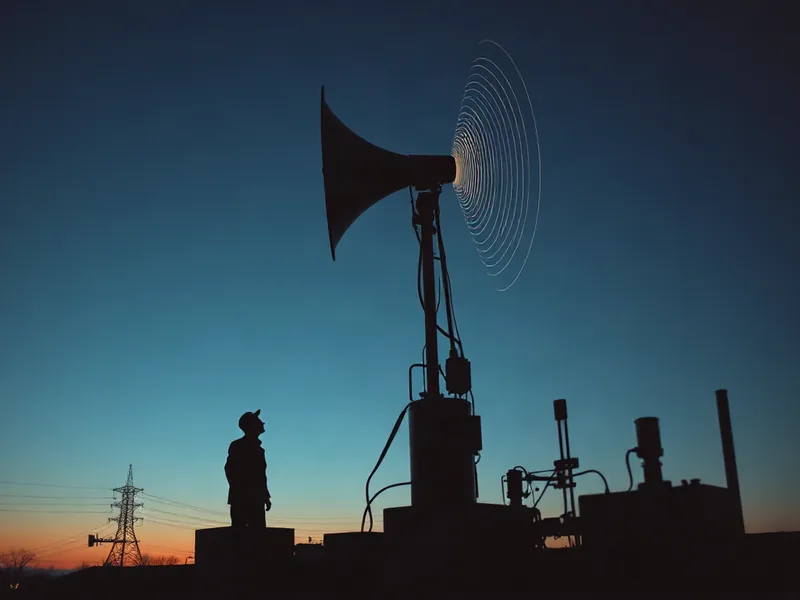
That's roughly what happened at Bell Labs in the early 1960s, when physicists Arno Penzias and Robert Wilson were working with a large horn antenna in Holmdel, New Jersey. The antenna had been built for satellite communication research, not cosmology. But when the pair pointed it at the sky, they kept picking up a persistent, low-level hum of microwave radiation. No matter where they aimed the antenna, the noise stayed the same. It didn't come from New York City, from the sun, or from military radar. It didn't even come from pigeon droppings, which the two scientists famously suspected and cleaned off the equipment, hoping that would solve the mystery.
It didn't. The signal remained, steady and uniform in every direction they looked.
What they'd found, without setting out to find it, was faint evidence of leftover heat from the universe's earliest moments, what scientists now call the cosmic microwave background. Think of it as a kind of afterglow. Just as embers keep radiating warmth long after a fire has burned down, the universe still carries a thin, cooled signature of the intense heat that filled it just after the Big Bang. That heat, stretched and cooled over roughly 13.8 billion years of cosmic expansion, now shows up as microwave radiation spread evenly across the entire sky.
Penzias and Wilson didn't initially know they were looking at confirmation of a major theoretical prediction. It took a conversation with researchers at nearby Princeton University, who were independently working on the theoretical case for exactly this kind of background radiation, to connect the dots. The Bell Labs antenna had picked up, by chance, the very signal the Princeton team was trying to calculate and search for themselves. The two groups published companion papers, and the finding became one of the most important pieces of experimental support for the Big Bang theory, the idea that the universe began in an extremely hot, dense state and has been expanding and cooling ever since.
It's worth sitting with how unusual this discovery process was. Before Penzias and Wilson's finding, the Big Bang theory was one of a few competing ideas about how the universe came to be, going up against alternatives like the steady-state theory, which held that the universe has no beginning and simply continues indefinitely in its current form. A uniform, leftover radiation signature was exactly the kind of evidence that could help settle the argument, because the steady-state model didn't predict anything like it.
The discovery earned Penzias and Wilson the Nobel Prize in Physics in 1978. That recognition reflects how significant the finding turned out to be, even though neither man set out looking for cosmological proof. They were engineers troubleshooting equipment noise. The science came afterward, once the signal refused to go away and other researchers supplied the theoretical framework to interpret it.
This is a pattern worth remembering in how we talk about scientific progress generally. Discovery doesn't always follow a straight line from hypothesis to experiment to confirmation. Sometimes it's messier, built on persistence, careful elimination of alternative explanations, and a willingness to take an inconvenient result seriously rather than dismiss it as a glitch.
That said, the story isn't free of debate, and it shouldn't be treated as if the matter is permanently closed. Some readers and researchers have pushed back on framing the discovery as definitive "proof" of the Big Bang theory. There's a meaningful difference between detecting a physical signal and interpreting that signal within a particular cosmological framework. Penzias and Wilson measured microwave radiation. The claim that this radiation is relic heat from a Big Bang event is an interpretation, albeit a remarkably well-supported one, built on decades of subsequent observation and refinement.
More recent observations have added complexity to the picture as well. Data from the James Webb Space Telescope has revealed surprisingly mature, well-formed galaxies dating to less than a billion years after the universe's earliest moments, earlier than some standard timelines suggested such structures should exist. Researchers are actively working through what this means. Some see it as a challenge to specific assumptions within Big Bang cosmology about how quickly galaxies could form, while others view it as a sign that current models need refinement rather than wholesale rejection. That's normal, healthy scientific debate, not evidence that the field is in crisis.
Understanding where the universe came from might seem like a question with no bearing on daily life. But the instruments, methods, and reasoning developed to answer it have real-world value. The same careful process of ruling out mundane explanations, which is what led Penzias and Wilson to clean antenna hardware and check for terrestrial interference, mirrors the diagnostic rigor used in fields from public health research to environmental monitoring. Getting it right means not jumping to conclusions, and not dismissing inconvenient data either.
There's also something genuinely grounding in this kind of story. It's a reminder that the universe is knowable, at least in part, through patient observation and honest acknowledgment of what we don't yet understand. Penzias and Wilson didn't claim they'd solved cosmology. They reported a signal they couldn't explain, and let other scientists help make sense of it. That kind of intellectual humility, paired with rigorous follow-through, is exactly how science is supposed to work, even when the breakthrough starts with something as unglamorous as pigeon droppings on an antenna.
Tags
Original Sources
The Accidental Discovery That Proved the Big Bang Theory
↗ https://spectrum.ieee.org/big-bang-theory-discovery/particle-1?itm_source=summaries&itm_medium=ieee-spectrum&itm_campaign=summary-particle-1&itm_content=summary-fix
About the author
Amara's entry point into AI was an epidemiology role at a London research hospital, where she spent five years studying how digital health tools reached — or conspicuously failed to reach — underserved communities. Watching early algorithmic systems in healthcare quietly entrench existing inequalities, she redirected her career toward the systemic consequences of AI at scale. She covers AI through an unflinching lens: who benefits, who bears the cost, and what evidence actually says versus what the press release claims. Her writing is calm and precise, but she doesn't mistake balance for neutrality.
More from The Steward →This Week's Edition
18 October 2026
24 articles
Related Articles
A Heart Without Friction: Maglev Technology Moves Into Cardiac Care
Health & Science · 6 min
AI Can Predict Chemotherapy Response in Aggressive Breast Cancer, But Not Yet Reliably Enough for the Clinic
Health & Science · 5 min
xAI Launches Grok Bot, an Autonomous Agent That Logs Into Your Tools and Does the Work
Products & Applications · 5 min
Related Articles
A Heart Without Friction: Maglev Technology Moves Into Cardiac Care
Health & Science · 6 min
AI Can Predict Chemotherapy Response in Aggressive Breast Cancer, But Not Yet Reliably Enough for the Clinic
Health & Science · 5 min
xAI Launches Grok Bot, an Autonomous Agent That Logs Into Your Tools and Does the Work
Products & Applications · 5 min
More Stories
© 2026 Cedar & Bloom. All rights reserved.
