The Drum · Weekly AI news, freeSubscribe →

Share
Hospitals keep bolting AI onto software built decades ago, hoping efficiency follows. Instead, clinicians are absorbing new administrative burdens, and the promised return on investment keeps slipping further out of reach.
Picture a nurse at the end of a twelve-hour shift, still typing notes into a computer system designed before smartphones existed. Now imagine handing her a shiny new AI assistant that's supposed to save her time, but instead asks her to learn another interface, double check another output, and reconcile it with the same clunky electronic health record underneath. That's not innovation. That's exhaustion with extra steps.
This is the quiet crisis unfolding across American healthcare right now. Artificial intelligence has arrived with real promise. It has already proven useful in documentation, medical coding, and administrative automation. But most healthcare organizations investing in these tools aren't seeing the financial or operational payoff they expected. The problem isn't the technology itself. It's what that technology is being built on top of.
Think of it like renovating a house with a cracked foundation. You can install granite countertops and smart thermostats, but if the foundation underneath is crumbling, those upgrades won't stop the walls from shifting. Healthcare's foundation, in this case, is a set of clinical workflows and IT systems largely designed in the 1990s. Layering 2026-era AI onto that structure doesn't relieve pressure. It redistributes it, usually onto the clinicians who can least afford to absorb more.
It makes intuitive sense to build on what already exists. Why tear something down when you can add to it? That's the logic driving most healthcare AI adoption today: new tools bolted onto existing electronic health record workflows, one vendor and one point solution at a time.
But intuition doesn't always match reality here. Every additional administrative task, no matter how automated, still takes time away from patient care. Automating a broken process doesn't fix the process. It just makes the same problem move faster, and cost more.
That pattern shows up in the numbers. A study cited by the Medical Group Management Association found that less than half of new AI tools introduced over the past two years actually made providers more productive. Less than half. That statistic alone should give healthcare leaders pause before signing off on the next big software purchase.
The deeper issue is that this pattern will keep repeating itself. It won't stop until organizations quit stacking artificial intelligence on top of legacy infrastructure and start redesigning the workflows underneath it. There's no shortcut around that work, and pretending otherwise only delays the reckoning.
Nobody experiences a single dramatic collapse when a healthcare system reaches its breaking point. There's no siren, no headline moment. Instead, the strain builds slowly: more platforms, more point solutions, each one promising to automate a sliver of the work, none of them talking to each other.
Three warning signs tend to surface as this strain accumulates. Clinicians grow more likely to leave the profession when new tools make their jobs harder rather than easier, a trend already visible in workforce data. Meanwhile, demand for care keeps climbing as the population ages, so any tool that adds friction to a clinician's day effectively shrinks the system's capacity to meet that demand. And when overworked clinicians have less bandwidth for patients, patient satisfaction inevitably slips too. These three forces feed each other. Burned out clinicians see fewer patients well. Frustrated patients generate more complaints and more work. The cycle tightens.
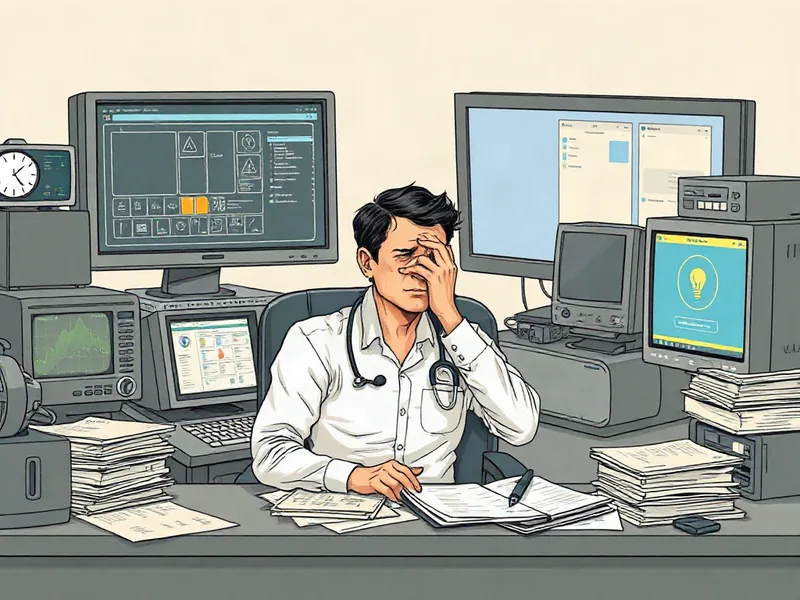
In medicine, treating a symptom while ignoring its cause is considered malpractice. Yet that's essentially what's happening at the organizational level across healthcare IT. Software band-aids get applied to workflow wounds that never actually get examined.
Healthcare leaders need better diagnostic tools of their own, not for patients this time, but for their own systems. Adoption rates, the metric most commonly cited when justifying new technology purchases, don't tell the full story. A tool can be widely adopted and still make everyone's day harder. What actually matters is whether friction gets removed from core workflows.
That means shifting the metrics that count. Reclaimed clinical capacity matters more than login statistics. Work eliminated matters more than features added. Provider satisfaction and patient engagement deserve more weight than they currently get in most vendor pitches. These are harder numbers to gather than simple usage stats, but they're the ones that actually reflect whether AI is helping or just adding noise.
None of this means AI lacks promise in healthcare. Quite the opposite. The technology has already shown it can lighten documentation burdens and speed up coding tasks when it's implemented thoughtfully. The problem arises when isolated wins get treated as proof that layering works everywhere, when really they succeeded because someone took the time to rethink the workflow around them, rather than just dropping software on top of the old one.
Healthcare is standing at a genuine inflection point, and the stakes go well beyond quarterly budgets. This moment will determine whether the next decade of clinical technology relieves the people doing the hardest work in the system, or simply piles more complexity onto their already full plates.
The organizations that succeed won't be the ones with the most software licenses or the flashiest AI features. They'll be the ones willing to rebuild workflows from the ground up, treating this as an architecture problem rather than a shopping list. That's harder work than bolting on another tool. It requires actually confronting what's broken instead of covering it over.
For clinicians already stretched thin, and for patients depending on their attention and judgment, this distinction isn't academic. It's the difference between a healthcare system that finally catches its breath and one that keeps sprinting on a treadmill someone forgot to turn off. The technology exists to make that difference real. Whether healthcare leaders choose to rebuild instead of bolt on is still an open question, and one worth watching closely in the years ahead.
Tags
Original Sources
The Healthcare Inflection Point: AI Can’t Fix 1990s Technology - MedCity News
↗ https://medcitynews.com/2026/09/the-healthcare-inflection-point-ai-cant-fix-1990s-technology
About the author
Amara's entry point into AI was an epidemiology role at a London research hospital, where she spent five years studying how digital health tools reached — or conspicuously failed to reach — underserved communities. Watching early algorithmic systems in healthcare quietly entrench existing inequalities, she redirected her career toward the systemic consequences of AI at scale. She covers AI through an unflinching lens: who benefits, who bears the cost, and what evidence actually says versus what the press release claims. Her writing is calm and precise, but she doesn't mistake balance for neutrality.
More from The Steward →This Week's Edition
3 September 2026
24 articles
Related Articles

A Heart Without Friction: Maglev Technology Moves Into Cardiac Care
Health & Science · 6 min

How a Stubborn Hiss of Radio Noise Helped Confirm the Big Bang
Health & Science · 5 min

AI Can Predict Chemotherapy Response in Aggressive Breast Cancer, But Not Yet Reliably Enough for the Clinic
Health & Science · 5 min
Related Articles
A Heart Without Friction: Maglev Technology Moves Into Cardiac Care
Health & Science · 6 min
How a Stubborn Hiss of Radio Noise Helped Confirm the Big Bang
Health & Science · 5 min
AI Can Predict Chemotherapy Response in Aggressive Breast Cancer, But Not Yet Reliably Enough for the Clinic
Health & Science · 5 min
More Stories
© 2026 Cedar & Bloom. All rights reserved.
