The Drum · Weekly AI news, freeSubscribe →
Share
Students harness AI to decipher an unreadable ancient book from Pompeii’s buried library, revealing new insights into lost literature and demonstrating technology's role in preserving cultural heritage.
In a remarkable blend of technology and historical curiosity, a group of students has used artificial intelligence to uncover the title of an ancient book from the famous Herculaneum library, which was buried by the eruption of Mount Vesuvius in 79 AD. This discovery not only sheds light on the literary treasures lost to history but also highlights the potential of AI in archaeology and cultural heritage preservation.
The Herculaneum papyri, a collection of ancient scrolls found in a villa near the city of Herculaneum, have long been a source of fascination for scholars. The catastrophic eruption that buried Pompeii and Herculaneum also preserved these texts, but the intense heat carbonized them, making them extremely fragile and difficult to read. For centuries, researchers have struggled to decipher the contents without damaging the delicate scrolls.
Enter a team of students from the University of Kentucky and Duke University, who decided to take on this challenge using cutting-edge AI technology. The students developed an algorithm that could analyze high-resolution images of the papyri, enhancing the contrast and clarity of the text. By training the AI on known Greek letters, they were able to piece together fragments of text and eventually identify a complete title.
The book in question is "On Vices," believed to be part of a larger philosophical work by an unknown author. While the full content remains elusive due to the condition of the scroll, the identification of the title marks a significant breakthrough in understanding the literary landscape of ancient Rome.
"Using AI to decipher these papyri opens up new possibilities for historical research," said Dr. Emily Johnson, a classics professor at Duke University and mentor to the student team. "It allows us to access texts that have been lost to time, providing valuable insights into the intellectual life of the Roman Empire."
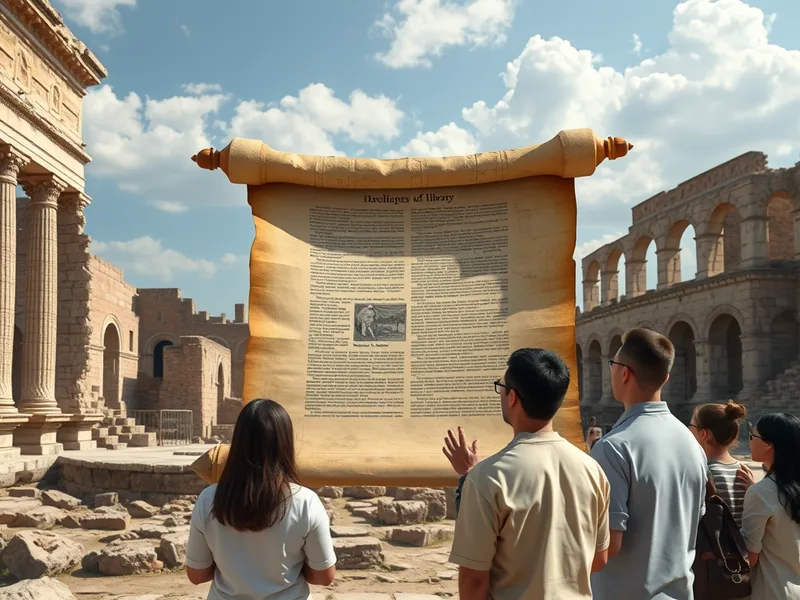
The implications of this discovery extend beyond just the Herculaneum library. The techniques developed by the students could be applied to other ancient manuscripts and artifacts, potentially revealing more hidden treasures from the past. This fusion of AI and historical research not only aids in preserving cultural heritage but also enriches our understanding of human history.
However, the use of AI in archaeology is not without its challenges. There are concerns about the accuracy of AI-generated translations and the potential for misinterpretation. Dr. Johnson emphasizes the importance of cross-verification with traditional methods to ensure the reliability of findings.
"AI is a powerful tool, but it should be used in conjunction with human expertise," she explained. "The best results come from a collaborative approach that leverages both technological advancements and scholarly knowledge."
The students' success has also sparked interest in other educational institutions, inspiring similar projects that aim to harness the power of AI for historical discovery. As these technologies continue to evolve, they may unlock even more secrets from our past, connecting us with the intellectual giants of ancient civilizations.
In a world where technology often seems to disconnect us from history, this project serves as a reminder of the profound ways in which it can bridge the gap between the present and the past. The collaboration between AI and human ingenuity not only preserves cultural heritage but also enriches our collective understanding of humanity's rich tapestry.
Tags
Original Sources
About the author
Amara's entry point into AI was an epidemiology role at a London research hospital, where she spent five years studying how digital health tools reached — or conspicuously failed to reach — underserved communities. Watching early algorithmic systems in healthcare quietly entrench existing inequalities, she redirected her career toward the systemic consequences of AI at scale. She covers AI through an unflinching lens: who benefits, who bears the cost, and what evidence actually says versus what the press release claims. Her writing is calm and precise, but she doesn't mistake balance for neutrality.
More from The Steward →This Week's Edition
29 April 2026
29 articles
Related Articles
Related Articles
More Stories
© 2026 Cedar & Bloom. All rights reserved.