The Drum · Weekly AI news, freeSubscribe →

Share
AI technology breathes life into a Pompeii victim, revealing intimate details about his final moments and sparking debate on the ethics of using historical data to recreate human faces from antiquity.
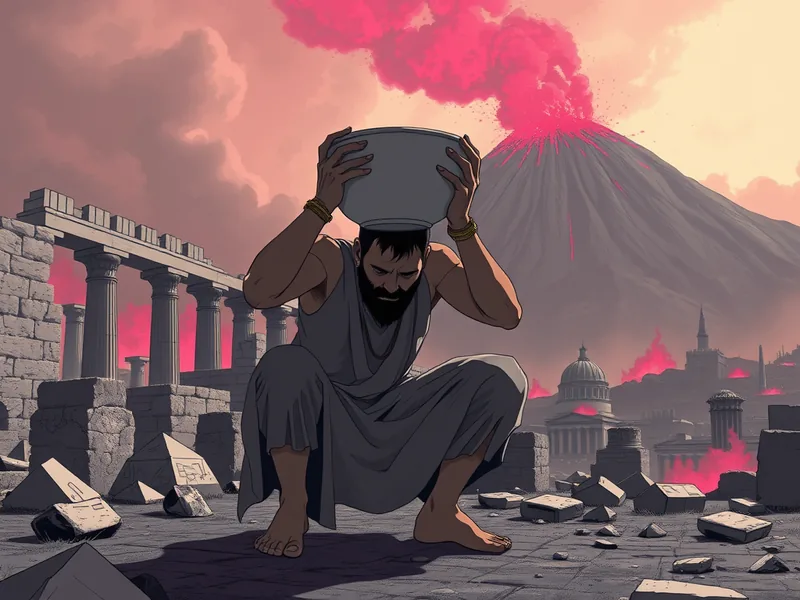
In a groundbreaking development, archaeologists at Italy's Pompeii have utilized artificial intelligence (AI) to reconstruct the appearance of one of the victims from the catastrophic volcanic eruption that buried the ancient Roman city nearly 2,000 years ago. The AI-generated image, released by the Pompeii Archaeological Park, offers a vivid and haunting glimpse into the final moments of a man who met his end during the devastating event.
The reconstruction shows a male adult crouching for cover while holding a large bowl over his head, with the fiery Mount Vesuvius looming ominously in the background. This image is based on the recent discovery of the victim's remains just outside one of Pompeii's southern gates. Archaeologists found the man lying next to a terracotta mortar, which they believe he used as protection against falling volcanic debris.
According to Gabriel Zuchtriegel, the head of the Pompeii Archaeological Park, "If used well, artificial intelligence can contribute to a renewal of classical studies, illustrating the classical world in a more immersive way." The victim was likely killed by a shower of volcanic rocks during the early hours of the second day of the eruption. He was also carrying a lamp and 10 bronze coins, suggesting he was attempting to flee towards the sea.
The use of AI in this reconstruction is part of a broader trend in archaeology where technology is being harnessed to bring historical events to life with unprecedented detail. However, as with any technological advancement, there are ethical considerations to be weighed. The vividness of the image can evoke strong emotions and raise questions about the appropriateness of using AI to visualize the final moments of individuals who lived centuries ago.
Pompeii, located about 25 kilometers (15 miles) southeast of Naples, was a thriving city before it was buried under meters of ash in AD 79. The eruption of Mount Vesuvius not only destroyed the city but also preserved its buildings, objects, and graffiti, making Pompeii one of the world's most significant archaeological sites. Today, it is also one of Italy's most popular tourist destinations, attracting 4.3 million visitors in 2024.
The use of AI in archaeology can offer valuable insights into ancient life and culture, but it also highlights the need for responsible and ethical practices. As Zuchtriegel noted, the potential of AI to enhance classical studies is significant, but it must be used thoughtfully to ensure that it respects the dignity of those who lived and died in places like Pompeii.
The image serves as a powerful reminder of the human toll of historical disasters and the ways in which modern technology can help us better understand and connect with the past. It also underscores the importance of balancing innovation with ethical considerations, ensuring that our pursuit of knowledge does not come at the expense of respect for those who came before us.
Tags
Original Sources
About the author
Amara's entry point into AI was an epidemiology role at a London research hospital, where she spent five years studying how digital health tools reached — or conspicuously failed to reach — underserved communities. Watching early algorithmic systems in healthcare quietly entrench existing inequalities, she redirected her career toward the systemic consequences of AI at scale. She covers AI through an unflinching lens: who benefits, who bears the cost, and what evidence actually says versus what the press release claims. Her writing is calm and precise, but she doesn't mistake balance for neutrality.
More from The Steward →This Week's Edition
30 April 2026
29 articles
Related Articles
Related Articles
More Stories
© 2026 Cedar & Bloom. All rights reserved.