The Drum · Weekly AI news, freeSubscribe →
Share
AI algorithms trained on Cold War-era spy satellite photos are revealing hidden underground aqueducts from millennia ago, offering fresh insights into ancient water management techniques and potential solutions for today's drought-stricken areas.
In a remarkable fusion of old and new, artificial intelligence (AI) trained on declassified Cold War spy satellite imagery is helping archaeologists uncover ancient underground aqueducts. These hidden water systems, some dating back thousands of years, hold critical clues to sustainable water management in regions facing modern environmental challenges.
The project, led by researchers at the University of Lincoln and the British Museum, combines cutting-edge AI with historical data to identify potential sites of ancient aqueducts. The technology is particularly useful in arid regions where water scarcity is a pressing issue. By understanding how ancient civilizations managed their water resources, modern societies can gain valuable insights into sustainable practices.
The AI system was trained on high-resolution images captured by U.S. spy satellites during the Cold War era. These satellites, originally used to monitor military activities, provided detailed views of the Earth's surface that are now invaluable for archaeological research. The team developed algorithms that can detect subtle changes in soil composition and vegetation patterns, which often indicate the presence of buried structures like aqueducts.
"By using AI, we can process vast amounts of satellite data quickly and accurately," said Dr. Emma Tetlow, a lead researcher on the project. "This not only speeds up our discovery process but also allows us to explore areas that would be difficult or impossible to survey on foot."
Ancient aqueducts were sophisticated engineering marvels designed to transport water over long distances, often from mountain springs to urban centers. These systems were crucial for the survival and prosperity of ancient civilizations, particularly in regions with limited rainfall.
In modern times, these structures can offer lessons on how to manage water resources efficiently. For example, the Roman aqueduct system, which supplied water to cities across Europe, North Africa, and the Middle East, was so well-engineered that some sections are still in use today.
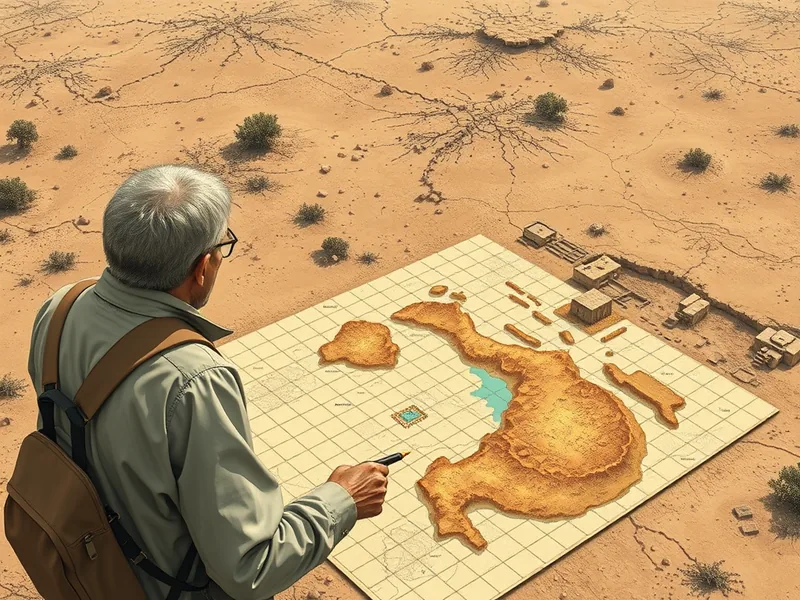
The discovery of ancient aqueducts is not just a matter of historical curiosity; it has significant implications for environmental archaeology and modern water conservation efforts. By studying these systems, researchers can identify sustainable practices that could be adapted to contemporary contexts.
"Understanding how past civilizations managed their water resources can provide us with valuable insights into how we can address current water scarcity issues," said Dr. David Mattingly, a co-researcher on the project. "This is especially important in regions like the Middle East and North Africa, where water stress is a major concern."
While the use of AI in archaeology holds great promise, it also presents challenges. One of the main hurdles is ensuring that the technology can accurately distinguish between natural features and man-made structures. The team is continuously refining their algorithms to improve detection accuracy.
Another challenge is the ethical consideration of using declassified military data for civilian purposes. However, the researchers emphasize that the benefits of uncovering historical water management systems far outweigh any potential concerns.
Looking ahead, the team plans to expand their research to other regions and collaborate with local communities to ensure that the findings are used to benefit modern water conservation efforts.
The integration of AI and Cold War-era satellite imagery is a powerful example of how technology can bridge the gap between past and present. By uncovering ancient aqueducts, researchers are not only enriching our understanding of history but also providing practical solutions for sustainable water management in today's world.
Tags
Original Sources
About the author
Amara's entry point into AI was an epidemiology role at a London research hospital, where she spent five years studying how digital health tools reached — or conspicuously failed to reach — underserved communities. Watching early algorithmic systems in healthcare quietly entrench existing inequalities, she redirected her career toward the systemic consequences of AI at scale. She covers AI through an unflinching lens: who benefits, who bears the cost, and what evidence actually says versus what the press release claims. Her writing is calm and precise, but she doesn't mistake balance for neutrality.
More from The Steward →This Week's Edition
29 April 2026
29 articles
Related Articles
Related Articles
More Stories
© 2026 Cedar & Bloom. All rights reserved.