The Drum · Weekly AI news, freeSubscribe →
Share
AI technology has cracked open carbonized scrolls from Herculaneum, offering a glimpse into Roman literature and philosophy long obscured by Vesuvius's fury, highlighting the tech’s role in resurrecting lost history.
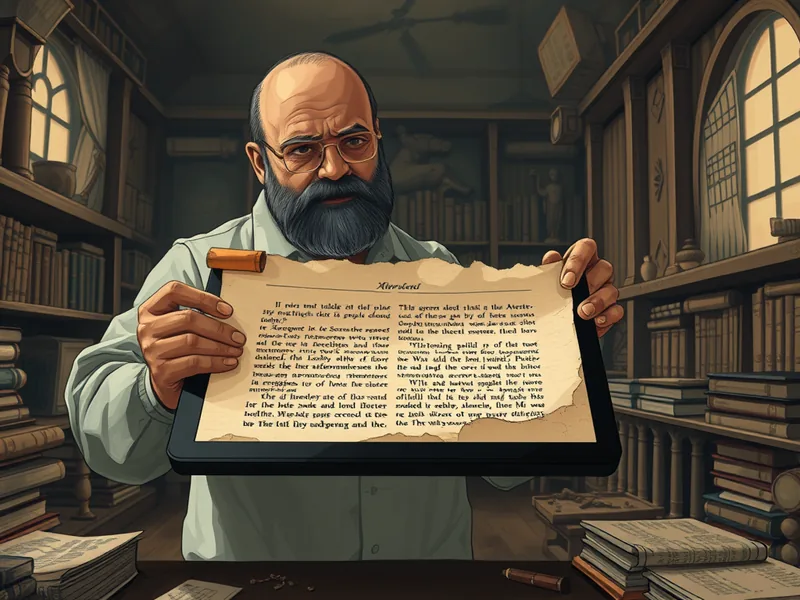
In a remarkable feat of modern technology and historical preservation, artificial intelligence (AI) has made it possible to read ancient scrolls that were long thought to be irreparably damaged by the catastrophic eruption of Mount Vesuvius in 79 AD. This breakthrough not only sheds light on the cultural heritage of ancient civilizations but also demonstrates the potential of AI in unlocking previously inaccessible historical records.
The eruption of Vesuvius is one of the most infamous natural disasters in history, burying the cities of Pompeii and Herculaneum under layers of ash and pumice. Among the ruins, archaeologists discovered a library in Herculaneum containing hundreds of papyrus scrolls. These scrolls, believed to have been part of an extensive personal collection, were carbonized by the intense heat of the volcanic eruption, rendering them unreadable for centuries.
The preservation of these scrolls has been a challenge since their discovery. Traditional methods of unrolling and reading the brittle, charred documents risked further damage or even complete destruction. However, recent advancements in AI technology have provided a non-invasive solution to this problem. Researchers from the University of Kentucky, along with experts from the European Laboratory for Non-Linear Spectroscopy (LENS) in Italy, have developed an innovative method that uses X-ray microtomography and machine learning algorithms to virtually unroll and read these ancient texts.
X-ray microtomography is a sophisticated imaging technique that creates detailed 3D images of objects without physically altering them. By scanning the scrolls with this technology, researchers can generate high-resolution images that show the layers of papyrus within the carbonized rolls. Machine learning algorithms then analyze these images to detect and enhance the ink traces, allowing scholars to read the texts for the first time in nearly 2,000 years.
The content of these scrolls is expected to provide valuable insights into ancient Greek and Roman literature, philosophy, and science. Preliminary readings have already revealed fragments of works by philosophers like Philodemus, a follower of Epicurus, whose writings on ethics, politics, and the nature of the universe were highly influential in the Hellenistic period.
The implications of this discovery are profound. For historians and scholars, these texts offer a window into the intellectual life of ancient societies, potentially filling gaps in our understanding of classical thought. For the broader public, the use of AI to preserve and interpret historical artifacts highlights the importance of technological innovation in safeguarding cultural heritage for future generations.
However, this breakthrough also raises important questions about the ethical and practical challenges of using advanced technologies in archaeological research. The cost and accessibility of such techniques may limit their application to only the most significant or well-funded projects. Additionally, there is a need for careful curation and interpretation of the data generated by these methods to ensure that they are used responsibly and accurately.
Despite these considerations, the successful reading of the Herculaneum scrolls represents a significant milestone in the intersection of technology and historical preservation. It underscores the potential for AI to revolutionize how we access and understand our past, opening new avenues for research and discovery.
As researchers continue to refine these methods, there is hope that more lost works from antiquity will be brought back to life, enriching our knowledge of human history and culture. The collaboration between technology and tradition in this endeavor serves as a powerful reminder of the enduring value of preserving our collective heritage.
Tags
Original Sources
About the author
Amara's entry point into AI was an epidemiology role at a London research hospital, where she spent five years studying how digital health tools reached — or conspicuously failed to reach — underserved communities. Watching early algorithmic systems in healthcare quietly entrench existing inequalities, she redirected her career toward the systemic consequences of AI at scale. She covers AI through an unflinching lens: who benefits, who bears the cost, and what evidence actually says versus what the press release claims. Her writing is calm and precise, but she doesn't mistake balance for neutrality.
More from The Steward →This Week's Edition
29 April 2026
29 articles
Related Articles
Related Articles
More Stories
© 2026 Cedar & Bloom. All rights reserved.