The Drum · Weekly AI news, freeSubscribe →

Share
A new paper from the Bank for International Settlements maps out how artificial intelligence could both ease and worsen the climate crisis, and why the answer hinges on choices we haven't made yet.
Picture a power grid straining to keep pace with a technology that promises to help us fight climate change while also burning through the electricity needed to run it. That tension sits at the heart of a new working paper from economists at the Bank for International Settlements, Leonardo Gambacorta and Salvatore Polizzi, who argue that artificial intelligence has become too significant a force on both sides of the climate ledger to ignore.
Their paper, published this month, doesn't pretend to have a tidy answer. Instead, it lays out a genuinely open question: will AI end up helping the planet or hurting it? The honest response, based on their analysis, is that nobody knows yet. It depends on choices still being made in boardrooms, power plants and policy offices around the world.
AI's potential upside for the climate is real and already visible in places. The technology can sharpen energy efficiency in buildings and factories, help utilities balance supply and demand more precisely, and speed up scientific work on everything from battery chemistry to carbon capture. It can also strengthen the models scientists use to forecast extreme weather and assess climate risk, giving communities and insurers better tools to prepare for what's coming. These aren't hypothetical benefits. They're the reason so many climate scientists and engineers have embraced machine learning over the past decade.
But every one of those gains comes with a cost attached, and that cost is electricity. Training and running AI systems requires enormous computing power, and that power has to come from somewhere. If the electricity feeding a data center comes from a coal plant, the emissions bill is steep. If it comes from a wind farm, far less so. The paper is careful to note that AI's climate impact isn't fixed. It bends depending on when and where that electricity is generated, what mix of fuels powers the grid at that moment, and how much energy the AI systems actually need to do their jobs.
The researchers frame the future using two scenarios, and the gap between them matters enormously.
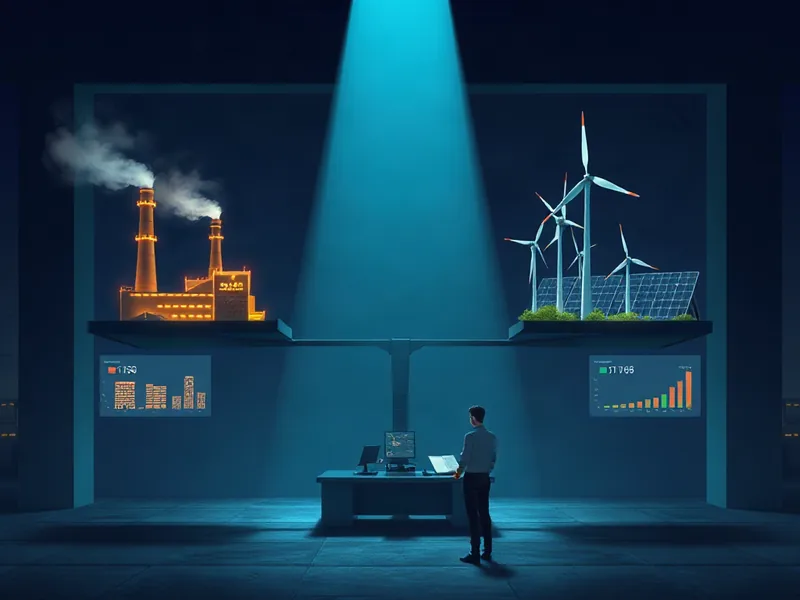
The first scenario, which they call the AI copilot path, imagines a world where AI continues evolving roughly as it has: a powerful assistant that boosts productivity and efficiency but remains, fundamentally, a tool that humans direct. Under this path, both the benefits and the environmental costs build up gradually rather than exploding overnight. Even so, the net effect on climate remains genuinely uncertain. Everything comes down to a kind of race: do efficiency improvements in AI technology outpace the sheer growth in how much AI gets used? If engineers keep making AI systems leaner and smarter per unit of energy, but the number of people and companies using AI grows even faster, the environmental savings can vanish. The carbon intensity of whatever new electricity gets built to power AI matters just as much. And so does a subtler effect: when AI makes some economic activity cheaper or more efficient, people and businesses often respond by doing more of it, not less. Economists call this a rebound effect. If AI makes shipping logistics twenty percent more efficient, companies might not bank that twenty percent as pure savings. They might use it to ship more goods, erasing some or all of the environmental gain.
The second scenario is far more dramatic. The paper considers what happens if AI development moves toward artificial general intelligence, AGI for short, meaning systems with cognitive abilities that rival humans across a wide range of tasks rather than excelling narrowly at one thing. Under this scenario, both the potential climate benefits and the potential environmental risks grow substantially larger, and far more unpredictable. A world with AGI could theoretically solve climate problems we've struggled with for decades, or it could demand energy infrastructure at a scale that strains our ability to decarbonize fast enough. The researchers are candid that this scenario involves much deeper uncertainty than the copilot path. Nobody can say with confidence how AGI would actually unfold, let alone what it would mean for energy systems worldwide.
This is the kind of fork in the road that deserves public attention well beyond economics departments. The direction AI capability takes over the coming decade will shape how much strain it places on power grids, and how much help it offers in return.
What makes this paper notable isn't just its subject matter but who wrote it. Central bank researchers don't typically spend their time on climate and technology policy, which signals that the AI-climate relationship has moved from a niche environmental concern into something that touches core economic stability. The authors point out that AI's effects on productivity, energy systems and climate risk can ripple into inflation and potential economic output, the kinds of indicators central banks watch closely. The sheer scale of investment pouring into AI data centers and the energy infrastructure needed to support them also raises financial stability questions, since a boom built on overoptimistic assumptions about energy supply or AI capability could leave investors and lenders exposed if reality falls short of the hype.
For the rest of us, the takeaway is less about financial markets and more about accountability. AI companies, utilities and regulators all have a role in determining whether this technology nudges the climate fight forward or backward. That means pushing for cleaner electricity to power data centers, being honest about rebound effects rather than assuming efficiency automatically equals sustainability, and keeping a close watch on how AI capabilities evolve. The paper doesn't offer a verdict on which future we're headed toward. It offers something arguably more useful: a clear-eyed map of what to watch for, and a reminder that the outcome is still very much up for grabs.
Tags
Original Sources
Artificial intelligence and climate change: balancing innovation and sustainability | Bank for International Settlements
↗ https://www.bis.org/publications/paper-174-artificial-intelligence-and-climate-change-balancing-innovation-and-sustainability
About the author
Amara's entry point into AI was an epidemiology role at a London research hospital, where she spent five years studying how digital health tools reached — or conspicuously failed to reach — underserved communities. Watching early algorithmic systems in healthcare quietly entrench existing inequalities, she redirected her career toward the systemic consequences of AI at scale. She covers AI through an unflinching lens: who benefits, who bears the cost, and what evidence actually says versus what the press release claims. Her writing is calm and precise, but she doesn't mistake balance for neutrality.
More from The Steward →This Week's Edition
9 October 2026
34 articles
Related Articles

Oracle Trucks In Natural Gas to Keep AI Data Centers Running Ahead of Pipelines
Environment & Climate · 5 min

MIT Technology Review's 2026 Climate Tech List Shows Where Capital Is Actually Flowing
Environment & Climate · 5 min

Corporate Carbon Pledges Face a Reckoning as Accountability Rules Tighten
Environment & Climate · 5 min
Related Articles
Oracle Trucks In Natural Gas to Keep AI Data Centers Running Ahead of Pipelines
Environment & Climate · 5 min
MIT Technology Review's 2026 Climate Tech List Shows Where Capital Is Actually Flowing
Environment & Climate · 5 min
Corporate Carbon Pledges Face a Reckoning as Accountability Rules Tighten
Environment & Climate · 5 min
More Stories
© 2026 Cedar & Bloom. All rights reserved.
