The Drum · Weekly AI news, freeSubscribe →

Share
Archaeologists have unearthed dice from ancient Native American sites, pushing back the history of gaming in the Americas by millennia and showcasing the sophisticated traditions of Indigenous cultures.
In a fascinating discovery that reshapes our understanding of early gaming, archaeologists have uncovered evidence that Native Americans were creating and using dice for games thousands of years before similar practices emerged in other parts of the world. This finding not only highlights the ingenuity and cultural richness of Indigenous communities but also underscores the deep historical roots of gaming as a social activity.
The discovery was made at various archaeological sites across North America, where researchers found small, intricately crafted objects that closely resemble modern dice. These ancient dice were typically made from materials such as bone, stone, or wood, and often featured symbols or markings that indicated different values. Some of the oldest examples date back over 5,000 years, placing them well before the earliest known dice in other civilizations, which are believed to have originated around 3,000 BCE.
Dr. Sarah Thompson, an archaeologist at the University of Arizona and lead author of a recent study published in the Journal of Anthropological Archaeology, explains the significance of this find: "These dice represent a sophisticated form of social interaction and cultural expression that has been largely overlooked in historical narratives. They were not just simple playthings but integral parts of complex games and rituals."
The games played with these ancient dice varied widely across different Native American tribes, each with its own unique rules and significance. Some were used for entertainment, while others had deeper spiritual or communal purposes. For example, the Navajo tribe had a game called "Shush bi liga," which involved throwing sticks and was often played during social gatherings to strengthen community bonds. Similarly, the Pueblo people of the Southwest had a dice game known as "Patolli," which was not only a source of entertainment but also a means of divination and spiritual guidance.
One of the most intriguing aspects of these ancient dice is their craftsmanship. Many of the artifacts show signs of careful design and decoration, suggesting that they were valued objects within the community. Dr. Thompson notes, "The level of detail and artistry in some of these dice is truly remarkable. It speaks to the importance of these games in daily life and the respect accorded to those who crafted them."
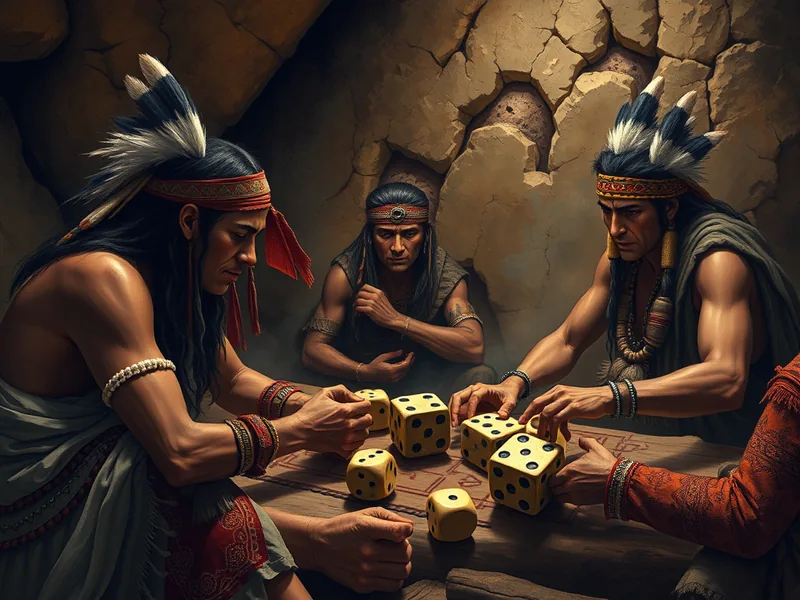
The discovery also challenges the Eurocentric view of history, which often places the origins of many cultural practices in ancient Mesopotamia or Egypt. "This finding adds another layer to the tapestry of human civilization," says Dr. Thompson. "It shows that Native American cultures were just as innovative and culturally rich as any other, and they deserve a place at the forefront of our historical understanding."
The implications of this discovery extend beyond archaeology into broader discussions about cultural heritage and the recognition of Indigenous contributions to global history. As more such artifacts are unearthed and studied, there is hope that they will help bridge gaps in our knowledge and foster greater respect for the diverse traditions of Native American communities.
For many Native Americans today, these ancient dice serve as a tangible link to their ancestors and a reminder of the resilience and creativity of their people. "These games have been passed down through generations," says John Black Bear, a cultural historian from the Cherokee Nation. "They are more than just relics; they are living traditions that continue to bring our communities together."
As we reflect on this discovery, it is clear that the history of gaming is far richer and more diverse than previously thought. The ancient dice found in North America not only tell a story of play and entertainment but also of community, spirituality, and cultural identity.
Tags
Original Sources
About the author
Amara's entry point into AI was an epidemiology role at a London research hospital, where she spent five years studying how digital health tools reached — or conspicuously failed to reach — underserved communities. Watching early algorithmic systems in healthcare quietly entrench existing inequalities, she redirected her career toward the systemic consequences of AI at scale. She covers AI through an unflinching lens: who benefits, who bears the cost, and what evidence actually says versus what the press release claims. Her writing is calm and precise, but she doesn't mistake balance for neutrality.
More from The Steward →This Week's Edition
29 April 2026
29 articles
Related Articles

Iambic Therapeutics Raises $150 Million in IPO to Fund AI-Designed Cancer Drugs
Finance & Markets · 5 min

Biotech's Summer Glow Fades as XBI Slips 11% From August Highs
Finance & Markets · 5 min

States Race to Write the Rules for AI Sandboxes in Health Care, and Lobbyists Are Racing Right Alongside Them
Policy & Regulation · 5 min
Related Articles
Iambic Therapeutics Raises $150 Million in IPO to Fund AI-Designed Cancer Drugs
Finance & Markets · 5 min
Biotech's Summer Glow Fades as XBI Slips 11% From August Highs
Finance & Markets · 5 min
States Race to Write the Rules for AI Sandboxes in Health Care, and Lobbyists Are Racing Right Alongside Them
Policy & Regulation · 5 min
More Stories
© 2026 Cedar & Bloom. All rights reserved.
