The Drum · Weekly AI news, freeSubscribe →
Share
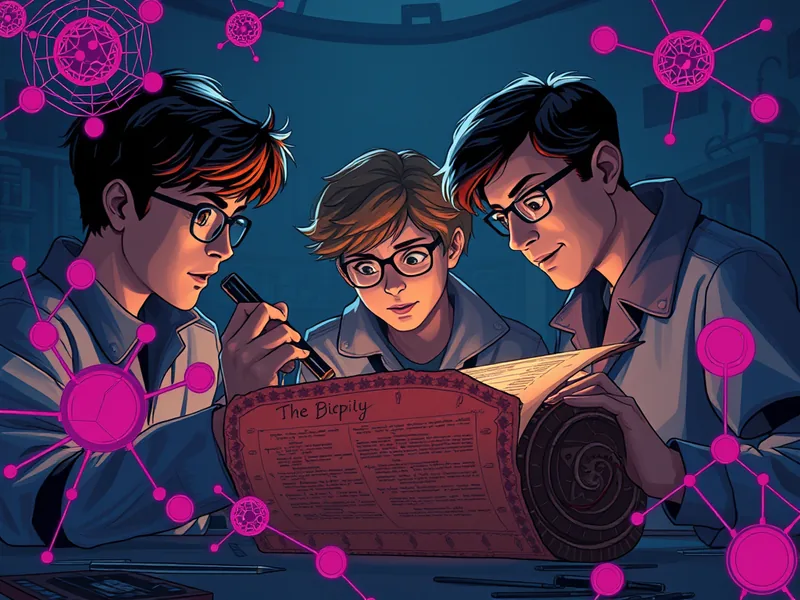
Three students cracked a carbonized Pompeii scroll, uncovering secrets about Roman life trapped within layers of ash and time, offering fresh perspectives on daily existence in antiquity.
In a remarkable feat of historical and scientific ingenuity, three brilliant students have successfully decoded a 2,000-year-old scroll that was charred in the catastrophic eruption of Mount Vesuvius in AD 79. The scroll, found among the ruins of Pompeii, has long been a tantalizing mystery, with its contents obscured by centuries of damage and decay. Now, thanks to the tireless efforts of these young researchers, we have new insights into the lives and interests of ancient Romans.
The discovery is not just a triumph for the students but also a significant contribution to our understanding of Roman culture and daily life. The scroll, which was part of a larger collection found in the ancient city's Villa dei Papiri, has revealed fascinating details about music, food, and pleasure in the Roman world. These topics are more than mere curiosities; they offer a window into the values and experiences that shaped one of history’s most influential civilizations.
To appreciate the magnitude of this achievement, it helps to understand the challenges involved. The scroll was badly damaged by the intense heat and ash from the volcanic eruption, making traditional reading methods impossible. Instead, the students-working under the guidance of experts at the University of Pisa-employed a combination of advanced imaging techniques and meticulous digital reconstruction. This process, which involved X-ray microtomography and multispectral imaging, allowed them to virtually unroll the scroll and decipher its contents without causing further damage.
The content of the scroll is as intriguing as the method used to decode it. It contains excerpts from a work by Philodemus, a Greek philosopher who lived in Rome during the first century BC. Philodemus was known for his writings on ethics, pleasure, and the good life, which were heavily influenced by Epicurean philosophy. The scroll discusses various aspects of music, food, and pleasure, providing a rich tapestry of Roman cultural practices.
For example, one section of the scroll delves into the importance of music in Roman society. It describes how music was not only a source of entertainment but also played a crucial role in religious ceremonies, social gatherings, and even military marches. Another part explores the culinary habits of Romans, detailing their preferences for certain dishes and ingredients. This information is valuable for historians and archaeologists who study ancient diets and food culture.
The scroll’s discussion of pleasure is particularly enlightening. It challenges the modern notion that pleasure was seen as a vice in ancient times. Instead, it suggests that pleasure, when pursued in moderation and with reason, was considered a fundamental aspect of a good life. This aligns with Epicurean philosophy, which emphasizes the pursuit of simple pleasures and the avoidance of pain.
The success of these students is not just a testament to their academic prowess but also to the collaborative spirit of modern research. Their work builds on decades of efforts by scholars and scientists who have been trying to unlock the secrets of ancient texts. It also highlights the importance of interdisciplinary approaches, combining expertise from fields such as archaeology, classics, and digital humanities.
The implications of this discovery extend beyond the academic realm. By shedding light on the lives of ordinary Romans, it helps us connect with our shared human past. It reminds us that despite the vast differences in time and technology, the fundamental desires for music, good food, and a fulfilling life are universal.
As we continue to unravel the mysteries of ancient texts, we gain valuable insights into how people lived, thought, and felt in different eras. This knowledge enriches our understanding of human history and can inform our decisions and values today.
Tags
Original Sources
About the author
Amara's entry point into AI was an epidemiology role at a London research hospital, where she spent five years studying how digital health tools reached — or conspicuously failed to reach — underserved communities. Watching early algorithmic systems in healthcare quietly entrench existing inequalities, she redirected her career toward the systemic consequences of AI at scale. She covers AI through an unflinching lens: who benefits, who bears the cost, and what evidence actually says versus what the press release claims. Her writing is calm and precise, but she doesn't mistake balance for neutrality.
More from The Steward →This Week's Edition
29 April 2026
29 articles
Related Articles
Related Articles
More Stories
© 2026 Cedar & Bloom. All rights reserved.