The Drum · Weekly AI news, freeSubscribe →

Share
Cash-strapped by drought and volatile markets, farmers are rethinking their opposition to renewables. Smaller solar and battery projects are winning trust, while wind farms and transmission lines still test the limits of that goodwill.
For years, the story on many Australian farms went like this: renewable energy companies show up wanting to plant turbines or panels on productive land, and farmers push back, worried about what it might do to their soil, their water, and their way of life. That story is starting to shift, not because the worries have vanished, but because the economics have started to make a compelling case of their own.
Think of it like crop insurance, except instead of protecting against a bad season, it protects against a bad market. That is roughly how Bridget Johnson, whose family breeds cattle across two properties in South Australia's Upper South East, describes the appeal of the wind project planned for the nearby Willalooka district. Her family has signed on, but only after treating the decision with the same seriousness they would give to buying new land or taking on debt.
"I think it's easy to make a decision based on perception or bias, and for us it was really important to have facts and information," Johnson said. The family needed to reach a consensus before moving forward, and the research they did along the way changed how they weighed the project's pros and cons.
What tipped the balance was compatibility. Wind infrastructure, unlike a housing development or a mine, can coexist with grazing cattle on the same paddock. "It is something that is compatible with beef farming and the program that we run," Johnson said. For her, the real prize is a second income stream that does not rise and fall with rainfall or the price cattle fetch at the sale yards.
"Most farmers will absolutely appreciate having a recurring income that's not tied to the rain or to the price at the sale yards or the price that you're receiving for your livestock," she said. In an industry where a dry summer or a soft market can wipe out a year's earnings, that kind of financial buffer is not a minor perk. It is, as Johnson put it, "an exceptionally important part of our business going forward."
Not every farmer is there yet, and the divide often comes down to scale. Md Alamgir Hossain, a senior lecturer in electrical and electronic engineering at the University of Southern Queensland, has watched interest grow steadily around smaller renewable installations, the kind where the benefits are obvious and the footprint on the land is modest. A rooftop solar system or a battery to run irrigation pumps is an easier sell than a sprawling wind farm or a high-voltage transmission corridor cutting across generations of family land.
"The majority of them probably are anti-renewable energy infrastructure such as the big transmission line or a commercial-scale wind farm," Hossain said. That resistance is not irrational. Big projects mean new roads, new power lines, and construction that can disrupt daily farm operations for months or years, all before a single dollar of extra income arrives.
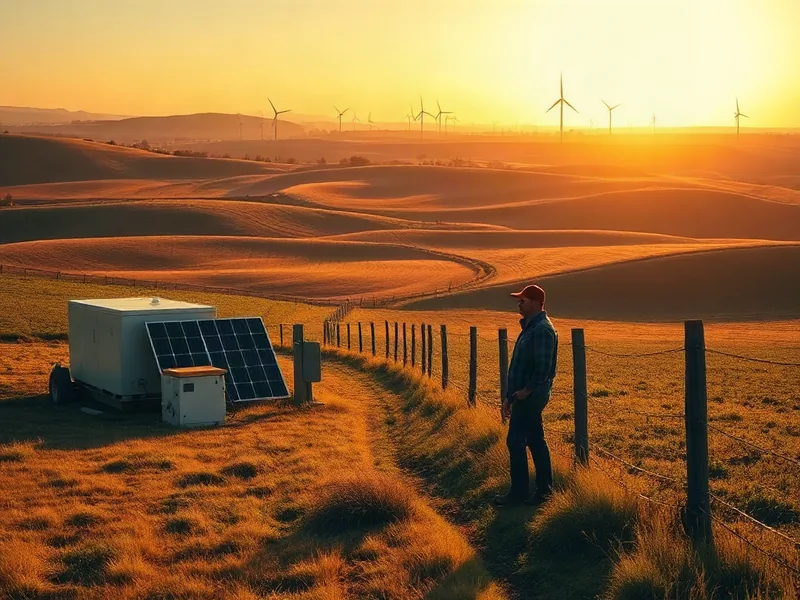
Voyager Renewables, the company behind the Willalooka wind project, is grappling with that timing problem directly. Before it moves ahead, it needs to run studies on how the project might affect land and groundwater, the very issues that tend to make farmers nervous in the first place. But those studies take time, and landholders often want answers before they will commit.
"It's a little bit of a chicken and egg," said Dean Smith, Voyager's development director. "Do we go very early with very little information, or do we go later in the process with lots of information?" There is no clean answer to that question, and it captures why trust-building in this space is slow, deliberate work rather than a quick sales pitch.
Hossain believes the fix lies less in new technology and more in better conversation. "There is a communication gap. We need transparency, and we need clear engagement with the farmer so that we can convey the evidence-based support," he said. That means laying out, honestly and early, what infrastructure will actually be built and how it might touch the rhythms of daily farm work. "We can consult with them so that daily operation of the farming is not hampered or less hampered," he added.
Policy is starting to nudge things along too. Earlier this year, the federal government expanded the Small-scale Renewable Energy Scheme, a program that offers financial incentives for smaller installations. Hossain sees this as a stepping stone rather than an endpoint, a way for medium-sized farms to get comfortable with renewables on a manageable scale before considering something larger. "For the medium farms, this is the opportunity for them to install or to observe how renewable energy can give benefits on their farm to electrifying the current machineries or stationary equipment," he said. In his view, that experience also builds toward something farmers have long wanted regardless of the climate debate: "they are going toward more energy independence."
What is happening on properties like the Johnsons' is not just a story about wind turbines and cattle paddocks. It is a preview of how the broader energy transition will actually play out in rural communities, one negotiation and one family decision at a time. Australia needs farmland to help host the infrastructure of a lower-carbon grid, but that land also has to keep producing food and supporting the people who work it.
The lesson from Willalooka and the research coming out of institutions like USQ is that farmers are not opposed to renewables on principle. They are opposed to being asked to shoulder risk and disruption without clear information or a fair financial return. Close that gap with transparency, patient engagement, and incentives that make sense at the kitchen table, and the shift Hossain describes, slow but steady, is likely to keep gathering pace.
Tags
Original Sources
Cautious farmers embrace renewable energy to boost income streams
↗ https://www.abc.net.au/news/2026-09-23/farmers-solar-wind-renewables-energy-rural/107180020
About the author
Amara's entry point into AI was an epidemiology role at a London research hospital, where she spent five years studying how digital health tools reached — or conspicuously failed to reach — underserved communities. Watching early algorithmic systems in healthcare quietly entrench existing inequalities, she redirected her career toward the systemic consequences of AI at scale. She covers AI through an unflinching lens: who benefits, who bears the cost, and what evidence actually says versus what the press release claims. Her writing is calm and precise, but she doesn't mistake balance for neutrality.
More from The Steward →This Week's Edition
23 September 2026
29 articles
Related Articles

Record-Shattering El Niño, AI's Energy Habit, and a Renewables Gap That Won't Close Itself
Environment & Climate · 6 min

Pentagon Energy Expo Highlights Push for Efficiency, Resilience and Space-Based Power
Environment & Climate · 6 min

Anthropic's Claude Opus 5.5 Ships as Five Models in One, Tuning Intelligence Against Cost
Models & Research · 5 min
Related Articles
Record-Shattering El Niño, AI's Energy Habit, and a Renewables Gap That Won't Close Itself
Environment & Climate · 6 min
Pentagon Energy Expo Highlights Push for Efficiency, Resilience and Space-Based Power
Environment & Climate · 6 min
Anthropic's Claude Opus 5.5 Ships as Five Models in One, Tuning Intelligence Against Cost
Models & Research · 5 min
More Stories
© 2026 Cedar & Bloom. All rights reserved.
