The Drum · Weekly AI news, freeSubscribe →

Share
Flush with capital from a record clean-energy IPO, Fervo is wagering that repeatable plant designs and deep-pocketed tech customers can push geothermal costs below natural gas. The next three years will tell us if that bet pays off.
Fervo Energy is attempting something that has eluded the geothermal industry for decades: taking a resource historically confined to a handful of geologically blessed locations and scaling it into a mainstream power source. The company's tool kit borrows directly from the oil and gas playbook. Horizontal drilling and hydraulic fracturing let Fervo carve its own pathways through underground rock, rather than waiting for nature to supply hot water in convenient spots. That matters because it widens the map of where geothermal can work.
The company proved the concept in 2023 at its Project Red facility in Nevada. It is now building something considerably larger: Cape Station, a plant in southwestern Utah slated for commercial operation in 2028. But the real story this year isn't the drilling technique. It's the balance sheet.
Fervo went public in May, raising roughly $2.2 billion in one of the largest clean-energy IPOs on record. That capital arrives at a convenient moment. Electricity demand is climbing fast, driven in large part by AI data centers that run around the clock and need firm, reliable power. Geothermal, unlike wind or solar, generates continuously, which makes it an attractive match for that load profile.
The clearest signal of where Fervo's growth will come from is its relationship with Google. In March, the two companies signed an agreement under which Fervo will propose at least 1 gigawatt of projects over two years, roughly the output of an average nuclear plant, with Google then selecting which ones it wants to buy power from. Taken together, the broader agreement maps out a path toward as much as 3 gigawatts of enhanced geothermal capacity through 2033. For context, that figure equals roughly three-fourths of all geothermal capacity currently operating in the United States.
In September, Google moved from framework to contract, agreeing to purchase at least 396 megawatts from Cape Station to power a potential data center in Utah. That deal gives Fervo revenue certainty for a meaningful chunk of its flagship project, and it gives Google a hedge against rising power costs tied to its AI infrastructure buildout.
Fervo's bet is that standardization will do what custom engineering cannot: drive costs down with each repetition. Instead of designing a bespoke facility for every site, the company has built what it calls a GeoBlock, a roughly 50-megawatt unit that can be replicated and combined into larger projects. The logic resembles assembly-line manufacturing more than traditional power plant construction, where each project has typically been treated as a one-off.
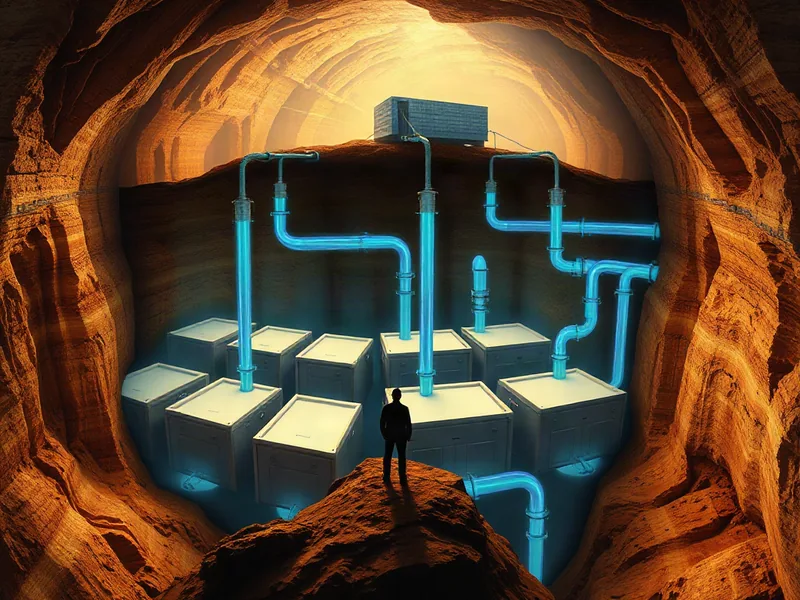
The company tracks progress through installed cost per kilowatt, a metric that captures how much capital is required to build each unit of generating capacity. Fervo is targeting approximately $7,000 per kilowatt for Cape Station's first 100 megawatts, falling to $5,500 for the next 400 megawatts. The long-term goal is $3,000 per kilowatt, a level Fervo says would let it match, and eventually beat, the cost of a new natural gas plant, without the recurring expense of buying fuel.
Those numbers are promising on paper. The catch, and it's a significant one, is that Cape Station's expansion is happening directly beside its first phase, in the same geological formation in Utah. Shuvajit Bhattacharya, a research associate professor at the University of Texas at Austin's Bureau of Economic Geology, points out that success there demonstrates Fervo can scale economically within a known reservoir. It says little about whether the same cost curve holds somewhere with different rock, different depth requirements, and different drilling economics.
That distinction is not a technicality. The Earth's subsurface varies enormously by location, and those variations dictate where drilling makes financial sense and how deep wells must go to reach usable heat. Fervo proved its concept in Nevada and is now proving its scale in Utah. The next test, replicating both in a third geological setting, remains ahead of it.
The company has set itself a demanding timeline to answer these questions. It needs to finish Cape Station on budget, convert its pipeline of data center conversations into signed, operating contracts, and show that its drilling and GeoBlock approach travels beyond the two states where it has so far worked. Each of those is a distinct execution risk, and they compound.
Fervo's near-term target is 1 gigawatt of operating capacity by the end of 2030, with a longer-range goal of 5 gigawatts by 2035, a figure that would exceed the entirety of today's US geothermal fleet. Those are ambitious numbers for a company that has yet to prove its cost model works outside a single reservoir.
The $2.2 billion IPO gives Fervo runway to pursue this plan without near-term financing risk, and the Google relationship provides a credible anchor customer with deep capital and an urgent need for firm power. Those are real advantages. But the core question for investors and policymakers watching this space is whether declining costs at Cape Station reflect a genuinely repeatable manufacturing process or simply favorable geology that happened to sit next to itself. Geothermal's appeal as a steady, always-on complement to intermittent renewables is well established. Whether Fervo can deliver it at scale, in new terrain, and at a price that undercuts gas, is still an open question the company has three to five years to answer.
Tags
Original Sources
Fervo Energy and its plan to streamline geothermal power
↗ https://www.technologyreview.com/2026/10/06/1145252/fervo-energy-geothermal-power-streamline-plan
About the author
Marcus began tracking AI's market implications in 2016, noticing AI-related patent filings accelerating ahead of earnings upgrades before most of the sell-side had caught on. A former fixed-income quantitative analyst, he spent two decades building models that priced risk across emerging markets before pivoting to cover the economic impact of AI full-time. His writing translates opaque technical developments into clear risk/reward terms — and he's rarely diplomatic about the gap between AI valuations and underlying fundamentals. He believes most market participants still underestimate AI's long-run deflationary effect on knowledge work.
More from The Analyst →This Week's Edition
7 October 2026
34 articles
Related Articles

Oracle Trucks In Natural Gas to Keep AI Data Centers Running Ahead of Pipelines
Environment & Climate · 5 min

MIT Technology Review's 2026 Climate Tech List Shows Where Capital Is Actually Flowing
Environment & Climate · 5 min

Corporate Carbon Pledges Face a Reckoning as Accountability Rules Tighten
Environment & Climate · 5 min
Related Articles
Oracle Trucks In Natural Gas to Keep AI Data Centers Running Ahead of Pipelines
Environment & Climate · 5 min
MIT Technology Review's 2026 Climate Tech List Shows Where Capital Is Actually Flowing
Environment & Climate · 5 min
Corporate Carbon Pledges Face a Reckoning as Accountability Rules Tighten
Environment & Climate · 5 min
More Stories
© 2026 Cedar & Bloom. All rights reserved.
