The Drum · Weekly AI news, freeSubscribe →

Share
New physical evidence from a dying ice cap in the Canadian Arctic suggests Earth was quietly sliding into its next glaciation two millennia ago, until human greenhouse gas emissions stopped it cold around 1960.
Imagine finding out that the planet had already started building the next ice age, brick by brick, for two thousand years, and that we stopped it without even realizing the project was underway. That is roughly what a new study in Science has uncovered on a shrinking patch of ice in the Canadian Arctic, and it reframes how we think about humanity's grip on the climate system.
The evidence comes from Barnes Ice Cap, a remnant sitting on the central plateau of Baffin Island. It is the last surviving fragment of the Laurentide Ice Sheet, the massive ice body that once buried most of Canada under two miles of ice and locked away roughly 80 meters of potential sea level rise. Today it is a shadow of that former giant, but it turns out this shadow has been keeping a careful diary.
Researchers led by Nicolás Young, a geologist at Columbia University's Lamont-Doherty Earth Observatory, found that the Laurentide reached its smallest size about 3,600 years ago. Then, roughly 2,000 years ago, it started growing again. The team argues this regrowth was the opening move of a new glaciation, one that was quietly building momentum until human-caused warming reversed it around 1960.
Most glaciers behave like rivers of slush, sliding over meltwater at their base and grinding up everything beneath them as they move. That sliding motion destroys any record of what came before. Barnes is different. It is what scientists call cold-based, meaning it is frozen directly onto the bedrock rather than floating on a slick of meltwater.
"If there is an ice event where you live and you have to go and scrape off your windshield, that ice that's plastered to the windshield of your car, that's a good example of how cold-based ice operates," Young says. "It's sort of just stuck to what it's on." That stillness is exactly why Barnes preserves its history instead of erasing it.
As the ice retreated across the plateau over thousands of years, tundra plants and mosses moved in and took root in the newly exposed ground. When the ice crept back later, it simply smothered those plants in place, holding them frozen and intact for two thousand years.
To nail down the timeline, Young's team used two independent dating methods. The first measures beryllium-10, an isotope that slowly accumulates in the top few centimeters of rock exposed to the sky. By sampling a boulder's surface and counting that isotope, researchers can estimate how long it has sat uncovered. That method showed the Laurentide had retreated to near today's ice margin by 3,600 years ago, shrinking further by around 3,000 years ago.
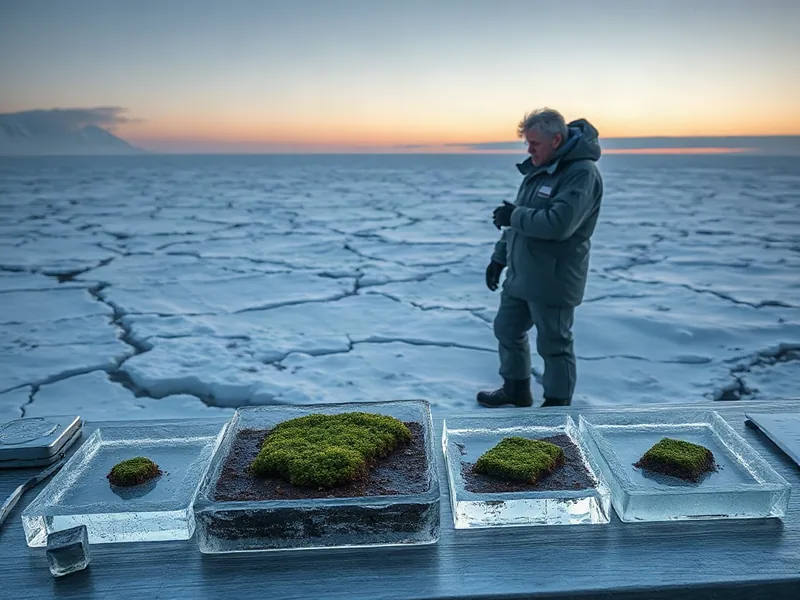
The second method dated the dead moss directly. "There were all these plants growing, just like today," Young says. "And eventually the Laurentide Ice Sheet starts to re-expand. And when that ice margin covers the moss, it literally kills it." Radiocarbon dating those remnants gave what glaciologists call a kill date, the precise moment the ice arrived at that spot. String enough kill dates together from different locations, and you get a map of an advancing ice margin over time.
About 70 percent of the dates cluster around 1800 CE, matching the peak of the Little Ice Age, when Northern Hemisphere glaciers reached their greatest recent extent. Young argues that moment was not a standalone event but one late pulse in an advance that had already been running for two thousand years.
The oldest evidence, plants that died when the ice first started its comeback, remains buried under Barnes itself. Since 1960 the ice cap's margin has retreated 200 to 800 meters, exposing mosses killed from about 1000 CE onward, but nothing older. To pin down the 2,000-year starting point, the team turned to nearby ice caps on the same plateau, which share the same climate. Earlier surveys collected almost 200 kill dates from beneath those neighboring caps, and none predates 2,000 years ago. "Since the Barnes Ice Cap is right next door, it's probably a good bet that it also started expanding 2,000 years ago," Young says, adding that continued melting may eventually expose the decisive samples directly.
Two competing global forces explain the timing. Solar energy reaching high northern latitudes peaked around 10,000 to 11,000 years ago and has been declining since, nudging the planet toward another ice age. At the same time, atmospheric carbon dioxide rose by about 20 parts per million between 8,000 and 2,000 years ago, adding a modest warming push in the other direction. "That drop in insolation and temperatures actually overwhelmed the small temperature forcing the little bit of carbon dioxide rise over the same time span," Young explains. Around 2,000 years ago, the cooling side won, and the ice began advancing again.
Then came us. Greenhouse gases rose about 12 parts per million between 1750 and 1850, another 50 ppm by 1960, and a further 138 ppm by 2024. "Once we hit the Industrial Revolution, we're now pumping way more carbon dioxide at a magnitude that has never occurred in the geologic record," Young says. By 1960, Barnes' mass balance turned negative, and its slow advance stopped for good.
The ice cap's decline since then has been stark. In the 1960s and '70s, roughly 35 percent of its surface sat above the snow line, the elevation where snow can accumulate year-round. By the early 2000s that figure had fallen to about 3 percent. Today it is zero. "This means in the summer, it's all melting. There's no more accumulation zone," Young says. Under any plausible emissions scenario, his models suggest Barnes will vanish entirely within a few centuries.
It is tempting to read this as a strange silver lining, as if warming the planet accidentally spared us from an ice age. Young rejects that framing outright. Reaching a true ice age with continent-spanning ice sheets would have taken tens of thousands more years, plenty of time for society to adapt or for natural cycles to shift again. "I would argue that the pumping of greenhouse gases into the atmosphere hasn't really saved us from anything," he says. Instead, what the research shows is that we interrupted one of the most dependable rhythms in Earth's history. "The pacing of ice ages over the last 2.5 million years has been one of the most consistent cycles in the Earth system that we have," Young says. "We have evidence now that humans, and specifically greenhouse gases, have actually terminated one of the most consistent cycles on Earth." That is not a reprieve. It is a reminder of just how far our influence now reaches, down into cycles that used to run on their own timescale, indifferent to anything happening on the surface below.
Tags
Original Sources
Ice sheet expansion may have started 2,000 years ago, but we canceled that
↗ https://arstechnica.com/science/2026/10/ice-sheet-expansion-may-have-started-2000-years-go-but-we-canceled-that
About the author
Amara's entry point into AI was an epidemiology role at a London research hospital, where she spent five years studying how digital health tools reached — or conspicuously failed to reach — underserved communities. Watching early algorithmic systems in healthcare quietly entrench existing inequalities, she redirected her career toward the systemic consequences of AI at scale. She covers AI through an unflinching lens: who benefits, who bears the cost, and what evidence actually says versus what the press release claims. Her writing is calm and precise, but she doesn't mistake balance for neutrality.
More from The Steward →This Week's Edition
25 October 2026
18 articles
Related Articles

The Navy's Carbon Problem: Why Electrifying Warships Matters for Climate Policy
Environment & Climate · 5 min

Zayed Sustainability Prize Names 2027 Finalists From Record 10,233 Submissions
Environment & Climate · 5 min

IEEE Expands Smart City Advisory Services as Municipal Tech Budgets Grow
Products & Applications · 5 min
Related Articles
The Navy's Carbon Problem: Why Electrifying Warships Matters for Climate Policy
Environment & Climate · 5 min
Zayed Sustainability Prize Names 2027 Finalists From Record 10,233 Submissions
Environment & Climate · 5 min
IEEE Expands Smart City Advisory Services as Municipal Tech Budgets Grow
Products & Applications · 5 min
More Stories
© 2026 Cedar & Bloom. All rights reserved.
