The Drum · Weekly AI news, freeSubscribe →

Share
Military fleets burn enormous quantities of fuel, yet defense emissions rarely enter climate accounting. As navies explore electric propulsion, the push raises questions about energy use, strategic readiness, and who bears responsibility for military carbon footprints.
Most of us picture climate action in terms of solar panels, electric cars, or wind farms. We rarely think about aircraft carriers, destroyers, or the diesel generators humming belowdecks on a guided-missile cruiser. Yet navies around the world are among the most fuel-hungry institutions on the planet, and that fact carries real consequences for global emissions, even when it stays out of the headlines.
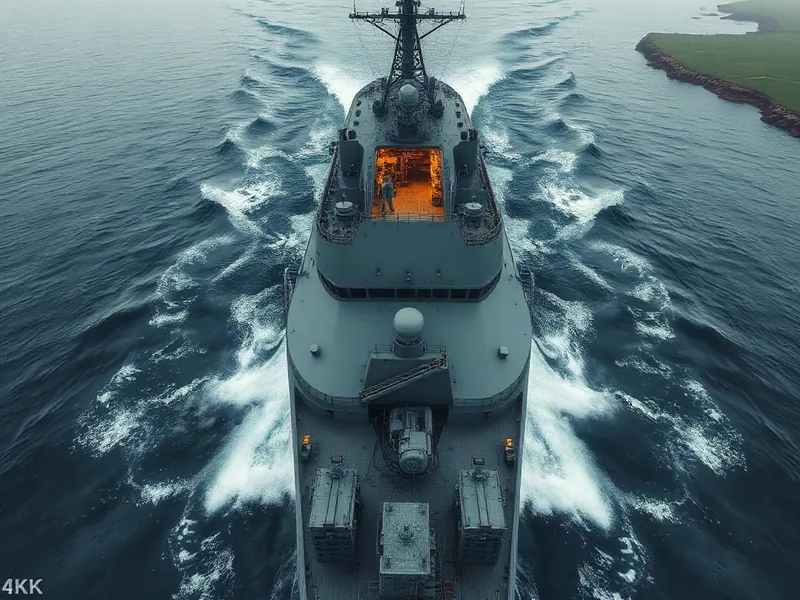
Warships are essentially floating power plants. They need energy not just to move through water, but to run radar systems, weapons, communications, and life support for hundreds of sailors. Traditionally, that energy has come from burning marine diesel or heavy fuel oil, the same carbon-intensive fuels that have powered naval fleets for a century. Switching a warship to electric propulsion means rethinking how that energy gets generated, stored, and distributed across the vessel, not unlike converting a small city's power grid while it's still running.
This is where the idea of the "electric warship" comes in. Engineers are exploring designs that use electric drive systems instead of traditional mechanical propulsion, allowing a ship's engines to generate electricity that then powers motors connected to the propellers. It's a bit like how a hybrid car's gasoline engine charges a battery that runs an electric motor, except here the stakes involve sustaining a ship at sea for months at a time, often in hostile or remote conditions.
The push toward electrification isn't primarily about climate goals, at least not yet. For militaries, the appeal lies in operational flexibility. Electric systems can redirect power more efficiently between propulsion, weapons, and sensors, giving commanders more tactical options in combat. But the climate implications are hard to ignore once you consider how much fuel modern navies consume.
Defense sustainability advocates have long pointed out that military institutions are exempted from many international climate reporting frameworks. The Kyoto Protocol and, for years, broader United Nations climate negotiations allowed countries to omit military emissions from national inventories, citing national security concerns. That carve-out means a huge slice of global fuel consumption, from naval vessels to fighter jets to armored vehicles, has operated largely outside the climate accounting that governs civilian industry.
Naval vessels are particularly significant in this picture because of how long they operate and how much fuel they burn relative to their size. A single aircraft carrier or destroyer can consume thousands of gallons of fuel per hour during high-speed operations. Multiply that across an entire fleet, sustained over decades, and the carbon footprint becomes substantial, even if it's rarely tallied alongside civilian transportation or energy sector emissions.
Electrification offers a potential path to reduce that footprint, though it comes with real engineering tradeoffs. Battery systems and electric drivetrains add weight and complexity to ships that already operate under extreme space and power constraints. Reliability matters enormously too. A civilian ferry can tolerate an unexpected mechanical issue far more easily than a warship engaged in active operations, where a propulsion failure could have life-or-death consequences for the crew.
There's also the question of what fuels power the electricity generation in the first place. An electric warship running on diesel generators isn't dramatically cleaner than one using mechanical diesel propulsion directly. The real climate benefit comes only if navies pair electrification with lower-carbon power sources, whether that's more efficient generation, hybrid systems, or eventually something like nuclear propulsion, which some larger vessels already use.
None of this happens in isolation from broader defense priorities. Military planners are driven primarily by strategic considerations: fuel logistics in contested environments, reduced dependence on vulnerable supply chains, and the tactical advantages of quieter, more efficient propulsion. Climate benefits, when they occur, tend to be a byproduct of these other goals rather than the central motivation. That's worth understanding honestly, because it shapes how much progress we should realistically expect and on what timeline.
Still, the overlap between military modernization and emissions reduction creates an opening worth paying attention to. If navies adopt more efficient electric systems for operational reasons, the climate benefits follow regardless of the original intent. Engineers working on these systems are essentially doing double duty: solving tactical problems while incidentally chipping away at one of the least scrutinized sources of global fuel consumption.
The challenge for policymakers and the public is visibility. Because military emissions often sit outside standard climate reporting, it's genuinely difficult to know how much progress, if any, this kind of technology is delivering at a global scale. Advocacy groups focused on defense sustainability have pushed for better transparency here, arguing that national security exemptions shouldn't mean a total blind spot in climate accounting. Without that data, it's hard to measure whether electric warship programs are making a meaningful dent or simply shifting where emissions occur within a complex, often opaque system.
This isn't a story about villains or easy fixes. Militaries have legitimate reasons to prioritize operational readiness over emissions reporting, and nobody expects a navy to make tactical decisions based primarily on carbon accounting. But the scale of military fuel consumption is too large to ignore if the world is serious about understanding and addressing its full climate impact.
Electric propulsion research in naval fleets shows that meaningful emissions reductions can sometimes come from unexpected places, driven by motives that have nothing to do with climate policy. That's a useful reminder for anyone tracking the broader energy transition: progress doesn't always arrive through the front door of climate advocacy. Sometimes it shows up quietly, in an engineering lab solving a tactical problem, long before anyone adds up what it means for the planet. Closing the transparency gap around military emissions remains essential, not to assign blame, but because we can't manage what we don't measure.
Tags
Original Sources
The Electric Warship
↗ https://spectrum.ieee.org/the-electric-warship/particle-4
About the author
Amara's entry point into AI was an epidemiology role at a London research hospital, where she spent five years studying how digital health tools reached — or conspicuously failed to reach — underserved communities. Watching early algorithmic systems in healthcare quietly entrench existing inequalities, she redirected her career toward the systemic consequences of AI at scale. She covers AI through an unflinching lens: who benefits, who bears the cost, and what evidence actually says versus what the press release claims. Her writing is calm and precise, but she doesn't mistake balance for neutrality.
More from The Steward →This Week's Edition
25 October 2026
18 articles
Related Articles

Frozen Moss on a Remote Arctic Ice Cap Reveals We Interrupted the Next Ice Age
Environment & Climate · 6 min

Zayed Sustainability Prize Names 2027 Finalists From Record 10,233 Submissions
Environment & Climate · 5 min

IEEE Expands Smart City Advisory Services as Municipal Tech Budgets Grow
Products & Applications · 5 min
Related Articles
Frozen Moss on a Remote Arctic Ice Cap Reveals We Interrupted the Next Ice Age
Environment & Climate · 6 min
Zayed Sustainability Prize Names 2027 Finalists From Record 10,233 Submissions
Environment & Climate · 5 min
IEEE Expands Smart City Advisory Services as Municipal Tech Budgets Grow
Products & Applications · 5 min
More Stories
© 2026 Cedar & Bloom. All rights reserved.
