The Drum · Weekly AI news, freeSubscribe →

Share
A nationwide analysis of 81,000 census tracts finds data centers cluster around Black, Hispanic, and Asian neighborhoods at far higher rates than white ones, echoing the redlining patterns that shaped American cities decades ago.
If you live near a data center, you already know the toll it takes. The humming turbines, the diesel generators kicking on when the grid strains, the water drawn down to cool server racks that never sleep. Now there's hard evidence that this burden isn't falling evenly across American communities. It's landing, disproportionately, on neighborhoods of color.
A new study from researchers at George Washington University and the Center for Security, Innovation & New Technology at American University puts numbers to a pattern many residents have long suspected. Majority-Black neighborhoods have 2.2 times the odds of hosting a data center compared to a white neighborhood in the same state. For majority-Hispanic neighborhoods, the figure climbs to 2.6. For majority-Asian neighborhoods, it jumps to 4.2 times. The researchers call the paper "Redlining in the Age of AI," and the title isn't just a hook. It's a direct line drawn from a decades-old housing policy to the infrastructure boom reshaping the country today.
Redlining was the practice of denying mortgages and investment to neighborhoods, mostly Black ones, that federal agencies marked as risky on color-coded maps back in the 1930s. The practice was outlawed decades ago, but its fingerprints remain on where power lines run, where highways cut through, and where industrial zoning took root. This study suggests those old lines are still shaping which neighborhoods get stuck hosting the newest generation of industrial infrastructure: the server farms powering the AI boom.
The researchers examined location data for 5,291 data centers against census tract demographics across the country. They controlled for population, household income, education levels, land costs, proximity to major transmission lines, and state-level differences. The disparity didn't disappear. It held up even in metropolitan areas, which tend to be more racially diverse to begin with.
"We really wanted to look at this on a nationwide scale to see: is this something that fits into this broader structural racism story?" said Samantha Bradshaw, CSINT's executive director, in an interview with 404 Media. "What we did find was yes... neighborhoods that have data centers tend to have a higher ratio of people of color."
Bradshaw and her co-author, Dhanaraj Thakur, told 404 Media the project grew out of reporting on data centers in Memphis, Tennessee, where xAI's facilities have drawn scrutiny for polluting Black and Brown neighborhoods with gas turbine emissions. A similar story played out in Taylor, Texas. A farming family there donated land to the city, intending it become a public park. The parcel sat next to a Black neighborhood. The park was never built. A data center is going up there instead.
Part of the explanation, the researchers argue, is mundane in a way that makes it even more troubling. Developers build near existing transmission lines because it's cheaper and faster than running new power infrastructure. But those transmission lines were often routed through majority-Black neighborhoods decades ago, back when zoning boards treated those communities as acceptable places to put the unsightly, noisy infrastructure that wealthier white neighborhoods didn't want in their backyards. Today's AI boom is inheriting that geography without anyone necessarily intending it to.
"It's just how embedded race is with all these other factors," Thakur said, noting he doubts developers are deliberately targeting communities of color.
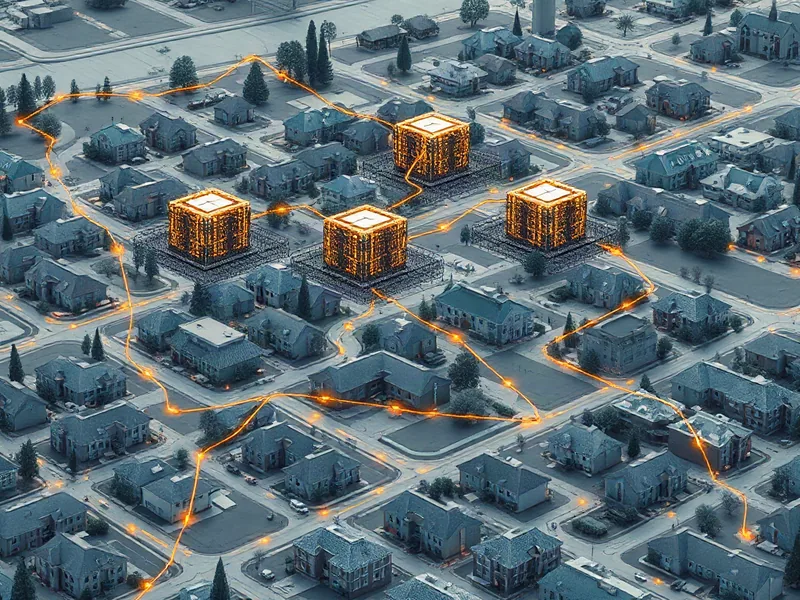
That distinction matters, but it doesn't make the outcome less real. Think of it like water finding the path of least resistance downhill. Nobody designed the slope maliciously, but once it's there, everything that flows through town ends up pooling in the same low-lying areas. Decades of discriminatory infrastructure decisions created the slope. Data center developers are simply building where the water already runs.
The study also draws an important line between types of facilities. Hyperscale data centers, the massive campuses built by companies like Meta, Google, and Elon Musk's xAI, often come bundled with promises of jobs and tax revenue. Smaller co-location facilities, which combine network transmission hubs with computing warehouses, carry no such promises and are more likely to land in communities of color. Meanwhile, the hyperscalers chasing economic development deals tend to choose white rural communities instead.
Louisiana offers a vivid example. Meta is building a $50 billion data center there, and local leaders say it will create 1,000 permanent jobs. Sales tax revenue has reportedly jumped 2,000 percent, enough to fund a $50,000 bonus for area teachers. It's a genuine economic windfall for that community. But the pattern of who gets the windfall and who gets the pollution isn't random, and it tracks closely with race.
The researchers offer a handful of practical fixes. Data center-specific zoning rules. Formal consideration of racial equity in permitting discussions. Required racial impact statements before construction begins, similar to environmental impact statements that already exist for many large projects.
Thakur argues the deeper problem is that tech policy rarely grapples with civil rights the way housing or health policy does. "We just don't see enough of that consideration in tech policy," he said, "and I think this kind of analysis shows why we should be thinking about that more."
Bradshaw points to who's in the room when these decisions get made. "If you look at who's represented in tech policy and who built these systems, who designs them, who engineers them, it's a very specific kind of white male Silicon Valley California ideology engineer, and that is not representative of the technology and its users," she said. Bringing different perspectives into those rooms, she argues, is how the country ends up with a tech future that works for everybody rather than one that quietly reproduces old inequities in new buildings.
Data centers are easy to think of as abstract, cloud-shaped things floating somewhere out there, powering your phone and your chatbot without any physical footprint. They are anything but. They draw real water, burn real fuel, and sit on real land next to real families. This study is a reminder that American voters have already pushed back hard against unchecked data center expansion at the ballot box this year. The AI boom has a geography, and that geography was drawn long before anyone typed a prompt into a chatbot. Ignoring that history doesn't erase it. It just lets the same old lines keep deciding who bears the cost of the newest technology.
Tags
Original Sources
Black Neighborhoods Are Twice as Likely To House a Data Center, Study Finds
↗ https://www.404media.co/redlining-ai-data-centers-and-race-study
About the author
Amara's entry point into AI was an epidemiology role at a London research hospital, where she spent five years studying how digital health tools reached — or conspicuously failed to reach — underserved communities. Watching early algorithmic systems in healthcare quietly entrench existing inequalities, she redirected her career toward the systemic consequences of AI at scale. She covers AI through an unflinching lens: who benefits, who bears the cost, and what evidence actually says versus what the press release claims. Her writing is calm and precise, but she doesn't mistake balance for neutrality.
More from The Steward →This Week's Edition
20 November 2026
29 articles
Related Articles

Patients Want AI to Simplify Healthcare, But Trust Lags Behind Enthusiasm
Job Market & Society · 5 min

Employer Benefits Market Rigged Against Better Options, Industry Panel Says
Job Market & Society · 5 min

Robot Babies Raise Real Questions About Who We're Building Machines For
Job Market & Society · 5 min
Related Articles
Patients Want AI to Simplify Healthcare, But Trust Lags Behind Enthusiasm
Job Market & Society · 5 min
Employer Benefits Market Rigged Against Better Options, Industry Panel Says
Job Market & Society · 5 min
Robot Babies Raise Real Questions About Who We're Building Machines For
Job Market & Society · 5 min
More Stories
© 2026 Cedar & Bloom. All rights reserved.
