The Drum · Weekly AI news, freeSubscribe →

Share
Nancy, paralyzed for over two decades, has found her voice again through a revolutionary talking avatar controlled by her brain signals, showcasing the life-changing potential of cutting-edge technology.
In a world where technology often feels like an impersonal force, the story of Nancy (a pseudonym to protect her privacy) stands as a powerful testament to how innovation can touch lives in profound ways. For over two decades, Nancy has been paralyzed and unable to speak due to a rare neurological condition. But now, thanks to groundbreaking research, she is communicating with the world once again-through a talking avatar powered by her brain signals.
The journey began at the University of California, San Francisco (UCSF), where a team of neuroscientists and engineers embarked on an ambitious project: to develop a system that could translate brain activity into speech. The researchers implanted electrodes directly into Nancy’s brain, focusing on regions responsible for language production. These electrodes capture the electrical signals generated when she thinks about speaking, even though her vocal cords remain silent.
Dr. Edward Chang, one of the lead researchers at UCSF, explained the process with a mix of scientific precision and human empathy. "Our goal was to create a way for Nancy to communicate naturally, without the need for laborious typing or other forms of assistance," he said. "We wanted her to be able to speak in real-time, just as she would if she were physically capable."
The technology behind this breakthrough is a sophisticated neural interface that decodes brain signals and translates them into words and phrases. These are then fed into an avatar-a digital representation of Nancy-that can move its lips and facial expressions to match the spoken content. The result is a seamless, natural-sounding conversation that allows Nancy to engage with her family, friends, and caregivers as never before.
For Nancy, this innovation means regaining a part of herself she thought was lost forever. "It’s like having my voice back," she said through her avatar, her words filled with a mix of relief and joy. "I can now tell my children I love them, ask for help when I need it, and even joke around with my friends."
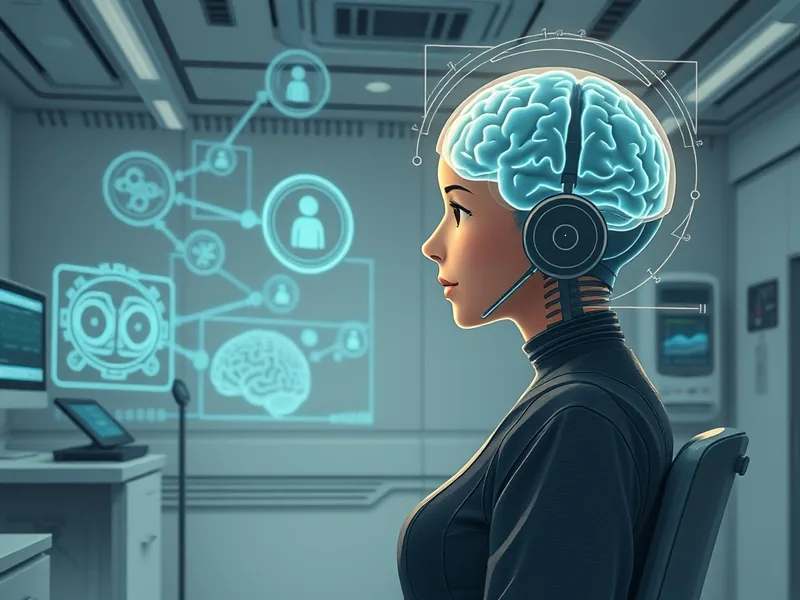
The impact extends beyond Nancy's immediate circle. Her story has inspired hope in the broader community of individuals living with similar conditions. Dr. Chang and his team are already working on refining the technology to make it more accessible and user-friendly. They envision a future where this kind of brain-computer interface (BCI) can be used by people around the world, opening up new possibilities for communication and independence.
One of the key challenges in developing this technology was ensuring that it could accurately interpret complex brain signals. The researchers spent years refining algorithms to improve the system's accuracy and speed. They also had to overcome the ethical considerations of implanting electrodes directly into a person's brain, a procedure that carries inherent risks but can offer life-changing benefits.
Despite these challenges, the team remains steadfast in their mission. "We are committed to pushing the boundaries of what is possible," Dr. Chang said. "Our ultimate goal is to create a world where everyone has the ability to communicate, regardless of physical limitations."
Nancy's story is not just about technology; it’s about human resilience and the power of collaboration. It’s about a community of scientists, engineers, and medical professionals coming together to make a difference in someone's life. And it’s about a woman who, against all odds, has found her voice once again.
As this technology continues to evolve, it holds the promise of transforming lives for countless others. For Nancy and those like her, the future is bright with possibilities. The day when communication barriers are no longer an obstacle is drawing closer, thanks to the tireless efforts of dedicated individuals who believe in a world where everyone can be heard.
Tags
Original Sources
About the author
Lena spent a decade working in international development before AI tools began showing up in the field programmes she was running — first as curiosity, then as something that genuinely changed outcomes. She writes about the moments where AI stops being a headline and starts being a lifeline: the early cancer detection in a rural clinic, the flood model that gave a village three extra days to evacuate, the translation tool that let a child speak to a doctor for the first time. She is not naive about the risks, but she believes the stories of AI doing real good deserve the same rigour and airtime as the cautionary ones.
More from The Optimist →This Week's Edition
30 April 2026
29 articles
Related Articles

Iambic Therapeutics Raises $150 Million in IPO to Fund AI-Designed Cancer Drugs
Finance & Markets · 5 min
Biotech's Summer Glow Fades as XBI Slips 11% From August Highs
Finance & Markets · 5 min
States Race to Write the Rules for AI Sandboxes in Health Care, and Lobbyists Are Racing Right Alongside Them
Policy & Regulation · 5 min
Related Articles
Iambic Therapeutics Raises $150 Million in IPO to Fund AI-Designed Cancer Drugs
Finance & Markets · 5 min
Biotech's Summer Glow Fades as XBI Slips 11% From August Highs
Finance & Markets · 5 min
States Race to Write the Rules for AI Sandboxes in Health Care, and Lobbyists Are Racing Right Alongside Them
Policy & Regulation · 5 min
More Stories
© 2026 Cedar & Bloom. All rights reserved.
