The Drum · Weekly AI news, freeSubscribe →

Share
The latest wave of automated bartending systems, like iCandy, signals a shift from novelty gimmick to genuine hospitality infrastructure, raising real questions about reliability, throughput, and where humans still fit behind the bar.
Robot bartenders have been a trade-show curiosity for years now: a robotic arm swirling a shaker, a crowd taking photos, a drink that's fine but not great. The pitch has always been more spectacle than substance. That's starting to change. Systems like iCandy are pushing robot bartending from a demo booth stunt toward something closer to actual hospitality infrastructure, and the shift is less about the hardware doing the pouring and more about the software stack coordinating everything around it.
That distinction matters if you've worked anywhere near industrial automation. A robotic arm that can pour a drink is a solved problem, and has been for a while. The hard part is everything else: order queuing, inventory tracking, drink customization logic, and making sure the system doesn't grind to a halt when 40 people order variations on a margarita in the same five minutes. That's the layer where "tipsy tech" is actually improving, and it's the layer most coverage of robot bartenders tends to skip past in favor of the flashier arm-and-shaker visuals.
Think of a bar during a rush as a real-time scheduling problem with sticky, perishable inputs. You've got:
Earlier robot bartender attempts mostly optimized for the flashy part: the arm doing the pour. That's the equivalent of optimizing a web app's front-end animation while ignoring the database queries choking the backend. It looks impressive in a demo and falls apart under real load.
What's notable about the newer systems is that they're clearly built with the operational bottleneck in mind rather than the photo-op moment. That's a familiar pattern to anyone who's shipped automation into a real environment instead of a lab: the interesting engineering problem is rarely the actuator, it's the orchestration layer that has to handle messy, high-variance real-world input without falling over.
There's also a practical reliability angle here that shouldn't get lost. A drink-mixing robot that jams or misfires during a slow Tuesday afternoon is an annoyance. The same failure during a packed Saturday night service is a liability, both for the venue's revenue and for whatever human staff has to jump in to cover the gap. So uptime and graceful degradation, meaning the system fails in a contained, recoverable way rather than a catastrophic one, matter a lot more here than in most consumer robotics demos, where a glitch just means an awkward silence.
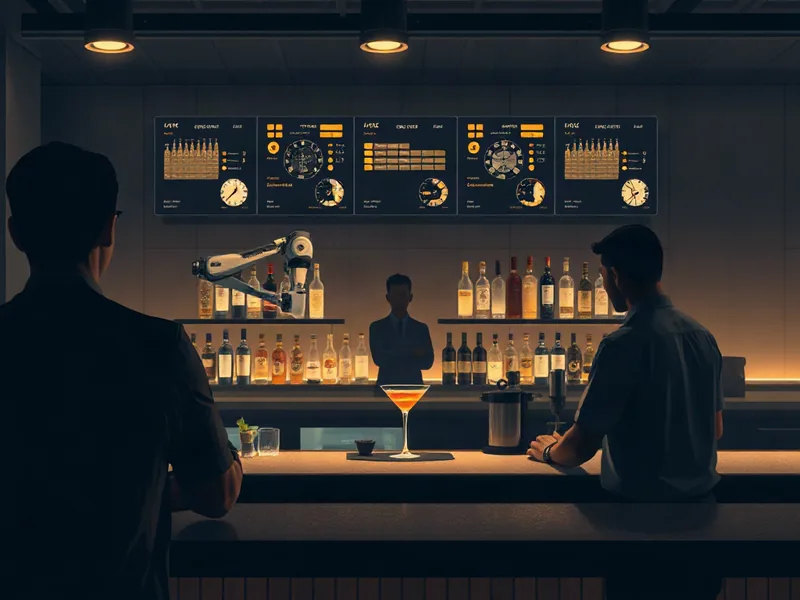
That's also where the "more tipsy tech" framing from the original coverage is worth taking seriously rather than treating as filler. Robot bartenders don't exist in isolation. They're part of a broader push into automated hospitality: self-pour beer walls, app-based ordering kiosks, inventory sensors on liquor bottles that track pour volume in real time. Individually, none of these are groundbreaking. Stacked together, they start to look like a genuinely different operating model for bars and restaurants, one where the human staff's job shifts from executing orders to managing exceptions and handling the parts of hospitality that are fundamentally social rather than transactional.
That reframing is important for anyone evaluating this space from an engineering or investment angle. The question isn't "can a robot make a drink," because the answer has been yes for a while. The question is whether the surrounding software can handle the messy, high-variance reality of a live venue: rush hours, substitution requests, inventory hiccups, and the occasional customer who wants something that's not on the menu. That's a systems integration problem, not a robotics problem, and it's a much harder one to get right.
It's also worth noting what this doesn't replace. Nobody's claiming these systems eliminate the need for human bartenders, and the framing in the source coverage doesn't pretend otherwise either. What they're aimed at is the repetitive, high-volume, low-judgment-call segment of the job: pouring standard drinks fast and consistently during peak load, freeing human staff for the parts of the job that actually require judgment, conversation, or improvisation. That's a pretty standard automation pattern, the kind you've seen play out in warehouses and call centers: automate the predictable slice, keep humans on the exceptions.
The real story with iCandy and similar systems isn't the robot arm, it's the orchestration software making that arm useful under real operational load. That's the part worth watching if you're tracking where service robotics is actually heading.
Worth keeping an eye on as these systems get more real-world deployment data: how they perform not in a controlled demo, but during an actual Friday night rush with unpredictable order volume and inventory surprises. That's the environment that'll separate genuine hospitality tech from another round of conference-floor novelty.
Tags
Original Sources
iCandy: Better Robot Bartenders and More Tipsy Tech
↗ https://spectrum.ieee.org/icandy-better-robot-bartenders-and-more-tipsy-tech/particle-1
About the author
Kai built ML infrastructure at a Bay Area startup before developing an obsession with transformer architectures and inference optimisation that eventually pulled him out of product work entirely. A stint at a compute research lab sharpened his instinct for what actually matters in a model release versus what is marketing. He writes from the inside — from the perspective of someone who has debugged the systems he is describing at three in the morning. He is allergic to hype and instinctively drawn to the unglamorous plumbing questions that everyone else skips over.
More from The Engineer →This Week's Edition
30 September 2026
28 articles
Related Articles

Payerset Bets on AI Research Assistant to Make Price Transparency Data Usable
Products & Applications · 6 min

Prime Therapeutics Links Medical and Pharmacy Benefits to Tame Specialty Drug Costs
Products & Applications · 5 min

Neighbours Goes Vertical: RoseBerry's Microdrama Bet Tests Whether Legacy TV Fits a Cheap New Format
Products & Applications · 5 min
Related Articles
Payerset Bets on AI Research Assistant to Make Price Transparency Data Usable
Products & Applications · 6 min
Prime Therapeutics Links Medical and Pharmacy Benefits to Tame Specialty Drug Costs
Products & Applications · 5 min
Neighbours Goes Vertical: RoseBerry's Microdrama Bet Tests Whether Legacy TV Fits a Cheap New Format
Products & Applications · 5 min
More Stories
© 2026 Cedar & Bloom. All rights reserved.
