The Drum · Weekly AI news, freeSubscribe →
Share
Tesla's "AI Day" reveal promised a general-purpose humanoid worker, but the roboticists who actually build these machines for a living weren't buying the hype. Here's what they flagged, and why it matters.
When Tesla rolled out its Optimus prototype at AI Day, the pitch was familiar: a humanoid robot that could eventually fold into factories and homes, built fast and cheap thanks to Tesla's manufacturing muscle. The problem, according to the robotics community that watched the demo closely, is that what showed up on stage looked less like a breakthrough and more like a robot that had been rushed out the door.
The prototype that walked, waved, and did a little dance was reportedly built in just 6 to 8 months, a timeline that drew a mix of admiration and skepticism depending on who you asked. One commenter on the original IEEE Spectrum piece put it plainly: impressive for the timeframe, but reserve judgment until there's a follow-up that shows real progress. That sentiment captures the split reaction pretty well. Nobody doubts Tesla can move fast. The question is whether moving fast gets you anywhere close to a genuinely useful humanoid robot.
That's the crux of the skepticism from people who've spent years in robotics labs rather than keynote stages. Humanoid robots are hard not because walking is hard (though it is), but because the whole stack, perception, planning, actuation, and power management, has to work together reliably in unstructured environments. A robot that can wave on a stage under controlled lighting with a curated task list is a very different animal from one that can safely operate a drill press or grab a box off an unpredictable shelf.
Strip away the showmanship and the Optimus reveal was fairly modest in technical terms. The robot walked onto stage, moved its arms, and performed a few simple, pre-choreographed actions. There was no live manipulation of unfamiliar objects, no demonstration of dexterous grasping, and no indication of the kind of closed-loop perception-to-action pipeline that would signal real autonomy. For a company that had spent months building hype around a robot meant to eventually replace human labor in dangerous or repetitive jobs, the gap between the marketing narrative and what was physically demonstrated was hard to ignore.
That gap matters because humanoid robotics is littered with examples of flashy demos that didn't translate into deployable products. Boston Dynamics' Atlas can do backflips, but it took years of dedicated hydraulic actuator design, whole-body control research, and iterative testing to get there, and even Atlas isn't doing general-purpose factory work today. Tesla's claim to fame is supposed to be its ability to compress that kind of timeline using in-house manufacturing expertise and the same Full Self-Driving computer stack it uses in its cars. But hardware for bipedal locomotion and dexterous manipulation doesn't necessarily benefit from the same economies of scale that help with car production. Actuators, joints, and grippers for a humanoid robot are a different engineering problem than battery packs and motor controllers.
There's also the software side. Tesla has leaned heavily on its self-driving neural network work as a proof point for Optimus's "brain," the idea being that a system trained to interpret camera feeds and make driving decisions can be repurposed for a robot navigating a room. That's a reasonable starting point conceptually, vision-based perception is vision-based perception, but driving on roads with lane markings and traffic rules is a much more constrained problem than general-purpose manipulation in a home or warehouse. Roads have conventions. A cluttered garage does not.
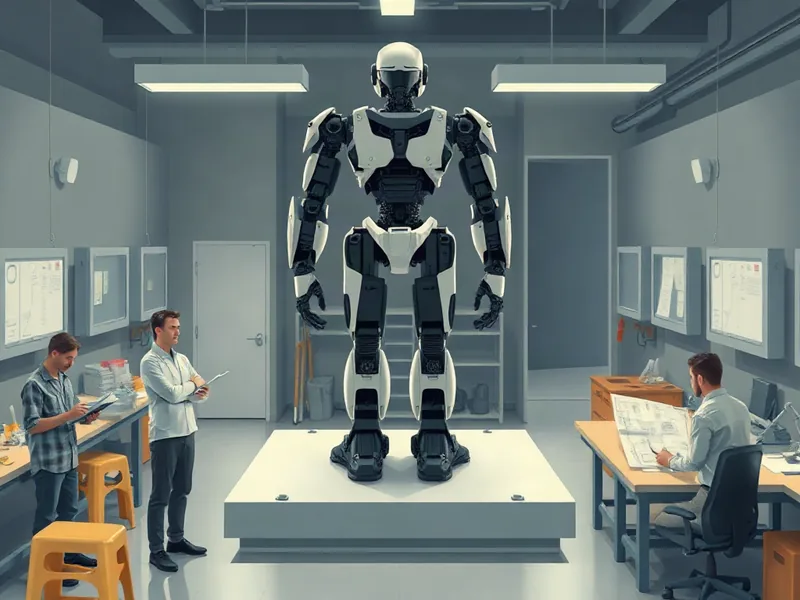
None of this is to say Optimus is doomed. Plenty of ambitious robotics projects look rough in their first public showing and mature significantly over subsequent iterations. The point raised by critics isn't that Tesla can't eventually build something impressive. It's that the AI Day presentation oversold the current state of the technology relative to what was actually demonstrated, and that kind of mismatch tends to set expectations that are hard to walk back later.
For engineers watching from the outside, the real signal to track isn't the stage demo. It's what comes in the following iterations: Can the robot handle unscripted manipulation tasks? What's the actual degrees of freedom and torque output on the hands? How does the battery and thermal management hold up under sustained operation rather than a few minutes of walking? Those are the metrics that separate a research prototype from something that could plausibly show up on a factory floor.
It's also worth remembering that Tesla isn't operating in a vacuum. Companies like Boston Dynamics, Agility Robotics, and a growing list of startups are all racing toward similar goals with varying degrees of transparency about their technical approach. Agility's Digit, for instance, has already been piloted in real warehouse settings handling tote-moving tasks, a far less flashy but arguably more meaningful proof point than a stage dance. The humanoid robotics field doesn't need another viral demo. It needs robots that can survive an eight-hour shift without faceplanting.
The core critique from robotics experts isn't that Tesla's engineers are incompetent. Building any bipedal humanoid prototype in under a year is a legitimate engineering feat, full stop. The issue is the disconnect between the marketing framing, a general-purpose worker robot ready to transform labor, and the narrow, choreographed demonstration that actually hit the stage.
If Tesla wants to be taken seriously by the robotics community rather than just its own investor base, the next milestones need to show substance: real manipulation tasks, measurable dexterity, and ideally some transparency on the actuator and sensor specs that the rest of the field relies on to gauge progress. Until then, the fair read is cautious optimism at best, and a healthy dose of "show me" from the people who've actually tried to build this stuff before.
Tags
Original Sources
What Robotics Experts Think of Tesla’s Optimus Robot
↗ https://spectrum.ieee.org/robotics-experts-tesla-bot-optimus/gary-marcus
About the author
Kai built ML infrastructure at a Bay Area startup before developing an obsession with transformer architectures and inference optimisation that eventually pulled him out of product work entirely. A stint at a compute research lab sharpened his instinct for what actually matters in a model release versus what is marketing. He writes from the inside — from the perspective of someone who has debugged the systems he is describing at three in the morning. He is allergic to hype and instinctively drawn to the unglamorous plumbing questions that everyone else skips over.
More from The Engineer →This Week's Edition
18 October 2026
24 articles
Related Articles
xAI Launches Grok Bot, an Autonomous Agent That Logs Into Your Tools and Does the Work
Products & Applications · 5 min

Replit Swaps Anthropic for OpenAI as Default Model, Muddying a Lucrative Partnership
Products & Applications · 5 min
Tesla's Flying Roadster: Engineering Spectacle, Unclear Financial Payoff
Products & Applications · 5 min
Related Articles
xAI Launches Grok Bot, an Autonomous Agent That Logs Into Your Tools and Does the Work
Products & Applications · 5 min
Replit Swaps Anthropic for OpenAI as Default Model, Muddying a Lucrative Partnership
Products & Applications · 5 min
Tesla's Flying Roadster: Engineering Spectacle, Unclear Financial Payoff
Products & Applications · 5 min
More Stories
© 2026 Cedar & Bloom. All rights reserved.
