The Drum · Weekly AI news, freeSubscribe →

Share
A new conference track pairs Nvidia's robotics chief with de-extinction pioneer Ben Lamm, signaling that investors and founders now view embodied AI, not just chatbots, as the sector's next major capital allocation decision.
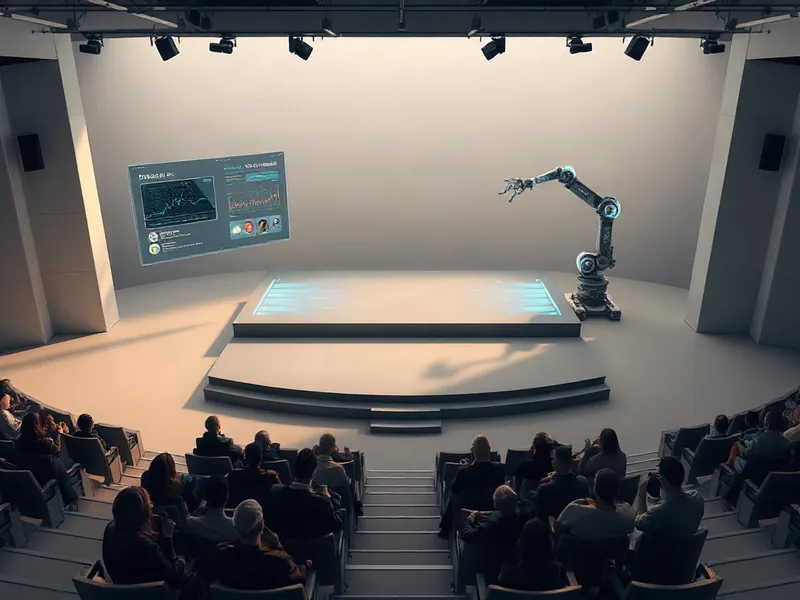
TechCrunch Disrupt 2026 is splitting its AI programming in two. The event, running October 13 to 15 at San Francisco's Moscone West, will keep its existing AI Stage and add a new Real World AI Stage dedicated to what happens when algorithms leave the browser and enter physical space. The organizers frame it simply: autonomous hardware is moving beyond self-driving cars into public infrastructure, defense, homes, and even efforts to bring back extinct species.
That framing matters for investors tracking where AI capital is actually flowing. Large language models built their advantage on internet-scale text data. Self-driving programs leaned on millions of hours of road footage. Robotics has no equivalent corpus. That gap, according to the session lineup, is the primary reason general-purpose robotic intelligence remains years out despite rapid progress elsewhere in AI. A cohort of startups is now building the data pipelines, simulation environments, and foundation models meant to close it. Nvidia's Les Karpas, Head of Physical AI, will open the stage addressing what a "ChatGPT moment" for physical AI would actually require.
Software failures are recoverable. A bad model output gets flagged, retrained, patched. Physical AI does not offer that luxury. A grounded aircraft, a vehicle crash, a compromised defense mission: these are the stakes when autonomy moves off the screen and into the world. Shield AI CTO Nate Michael will lead a session built entirely around one question that every hard tech founder eventually has to answer honestly: how do you know your system is safe enough to deploy?
That is not a rhetorical exercise. It gets at the core underwriting risk for anyone financing autonomous systems companies. Safety culture, validation testing, and regulatory navigation are not compliance checkboxes here, they are the difference between a viable business and a liability. Investors evaluating defense tech, autonomous vehicles, or industrial robotics should treat this session's themes as a diligence checklist, not conference filler.
A separate panel tackles a related but distinct problem: edge deployment. The most valuable AI systems, according to the session description, often operate where cloud connectivity simply does not reach. Dr. Ali Agha of FieldAI, Michelle Lee of Medra, and Aidan Madigan-Curtis of Eclipse Ventures will discuss architectural trade-offs for systems where latency is unforgiving and failure is not an option. This is the unglamorous infrastructure layer beneath every headline-grabbing robot demo, and it is where a lot of technical debt in this sector currently lives.
Then there is the prototype-to-production gap, arguably the most financially consequential theme on the stage. A working prototype is not a product. A shipped product is not a scaled business. John Mackey of MBRYONICS, Boris Sofman of Bedrock Robotics, and Adrian Macneil of Foxglove will walk through where deep tech startups actually die: the transition from lab conditions to supply chains and manufacturing realities. This is where capital gets burned fastest and where founder overconfidence tends to collide with physical constraints that no amount of engineering talent can shortcut.
The most attention-grabbing name on the roster is Ben Lamm, CEO of Colossal Biosciences, who has turned de-extinction from a science fiction premise into what the company describes as a billion-dollar business. His fireside chat will cover the technologies behind reviving extinct species and AI's growing role in modern biology. It will also address a legitimate debate: whether engineering long-gone species is a genuine conservation breakthrough or a costly distraction from protecting species that are still here and still declining. For a publication focused on capital allocation, that tension is worth watching. Biotech-adjacent AI ventures attract enormous valuations on the strength of narrative as much as near-term revenue, and de-extinction sits squarely in that category.
Taken together, the Real World AI Stage lineup reads less like a showcase and more like a risk map for an emerging asset class. Nvidia's presence signals where compute infrastructure providers are placing bets. Shield AI's defense angle signals where government contracting dollars are already flowing. Bedrock Robotics and MBRYONICS represent the harder, slower grind of manufacturing scale. Colossal represents the speculative, narrative-driven end of the spectrum.
Disrupt's other stages fill out the broader picture. The Disrupt Stage features speakers from Replit, Amazon, and Tether. The AI Stage will cover SaaS business model disruption and agent security gaps. The Smart Money Stage addresses stablecoins and AI's role in financial trust. The Smart Systems Stage focuses on fusion and grid strain tied to AI infrastructure demand. The Builders Stage keeps things tactical, covering fundraising and scaling mechanics for founders.
More than 10,000 startup, tech, and VC leaders are expected to attend across the three days, alongside the Startup Battlefield competition and full access to the exhibition floor.
The core signal from this new stage is not any single speaker but the sequencing. Nvidia opens with foundational infrastructure questions. Shield AI and the edge computing panel address deployment risk. Mackey, Sofman, and Macneil address the manufacturing chasm that kills most hardware startups before they ever reach scale. Lamm closes with the sector's most speculative, headline-friendly application.
For portfolio managers with exposure to robotics, defense tech, or biotech-AI crossovers, the practical takeaway is straightforward: the data scarcity problem in physical AI remains unsolved, safety and validation frameworks are still being built in real time rather than inherited from mature regulation, and the gap between a working prototype and a profitable production line continues to be where capital disappears fastest. Watch for which startups on this stage have already secured defense or industrial contracts versus those still operating on narrative and prototype demos. That distinction will separate durable businesses from conference-circuit hype well before the next funding cycle forces the issue.
Tags
Original Sources
TechCrunch Disrupt 2026’s new Real World AI Stage features Nvidia, robots, and extinct animals | TechCrunch
↗ https://techcrunch.com/2026/09/02/techcrunch-disrupt-2026s-new-real-world-ai-stage-features-nvidia-robots-and-extinct-animals
About the author
Marcus began tracking AI's market implications in 2016, noticing AI-related patent filings accelerating ahead of earnings upgrades before most of the sell-side had caught on. A former fixed-income quantitative analyst, he spent two decades building models that priced risk across emerging markets before pivoting to cover the economic impact of AI full-time. His writing translates opaque technical developments into clear risk/reward terms — and he's rarely diplomatic about the gap between AI valuations and underlying fundamentals. He believes most market participants still underestimate AI's long-run deflationary effect on knowledge work.
More from The Analyst →This Week's Edition
5 September 2026
24 articles
Related Articles

xAI Launches Grok Bot, an Autonomous Agent That Logs Into Your Tools and Does the Work
Products & Applications · 5 min

Robotics Experts Pour Cold Water on Tesla's Optimus Debut
Products & Applications · 5 min

Replit Swaps Anthropic for OpenAI as Default Model, Muddying a Lucrative Partnership
Products & Applications · 5 min
Related Articles
xAI Launches Grok Bot, an Autonomous Agent That Logs Into Your Tools and Does the Work
Products & Applications · 5 min
Robotics Experts Pour Cold Water on Tesla's Optimus Debut
Products & Applications · 5 min
Replit Swaps Anthropic for OpenAI as Default Model, Muddying a Lucrative Partnership
Products & Applications · 5 min
More Stories
© 2026 Cedar & Bloom. All rights reserved.
