The Drum · Weekly AI news, freeSubscribe →

Share
A sobering new UN assessment confirms the world will overshoot 1.5°C of warming. The question now isn't if we miss the target, but how far past it we go, and whether we can claw our way back.
For years, 1.5°C has been the number that anchored global climate ambition, a kind of red line we told ourselves we could still avoid crossing. That line has now been crossed in the models, if not yet in the atmosphere. A new UN Environment Programme report, with modelling support from the Netherlands' PBL Environmental Assessment Agency, delivers the clearest confirmation yet: limiting warming to 1.5°C with only a small overshoot is no longer achievable. The best realistic outcome now involves temperatures peaking around 1.7 to 1.8°C at mid-century before, hopefully, coming back down.
Think of it like a fever. Doctors would rather a patient's temperature never spike dangerously high at all. But if it does, the next best thing is to catch it quickly, treat it hard, and bring it back down before lasting damage sets in. That's essentially the scenario the Emissions Gap Report 2026, subtitled "The Point of Return," is describing. It's called the "lowest possible" 1.5°C overshoot pathway, and it gives the world a 50 percent chance of cooling back down to 1.5°C or below by the year 2100.
Getting there would require cuts to global greenhouse gas emissions that are almost hard to picture: an 18 percent reduction by 2030, 45 percent by 2035, and a staggering 69 percent by 2040, all measured against 2025 levels. For comparison, if every country fully delivers on its current climate pledges, known as Nationally Determined Contributions or NDCs, the world would only see emissions fall by 5 to 8 percent by 2030 and 11 to 15 percent by 2035. The gap between what's pledged and what's needed remains enormous. That gap has a name, fittingly: the emissions gap.
It would be easy to read those numbers and feel defeated. The report's lead author, Michel den Elzen of PBL, doesn't shy away from the hard truth, but he also points to real progress worth noting. "Unfortunately we find that the target of 1.5°C with limited overshoot is no longer possible," he said. "Our best scenario is now an overshoot of 1.7 or 1.8°C by midcentury. On the other hand we see success stories that give reasons for hope. The growth rate of renewable technologies has surprised many. It shows that more progress is possible if governments are willing to step up their efforts."
Those success stories are real. Since the Paris Agreement was signed, global renewable electricity capacity has grown three times faster than experts originally projected. Solar power, specifically, has expanded seven times faster than anticipated. Coal and oil use has also grown more slowly than earlier forecasts expected, partly thanks to climate policies already in place around the world. If these trends continue and get a boost from stronger policy support, the world could actually hit the goal of tripling renewable energy capacity by 2030, a target that lines up well with the lowest overshoot scenario.
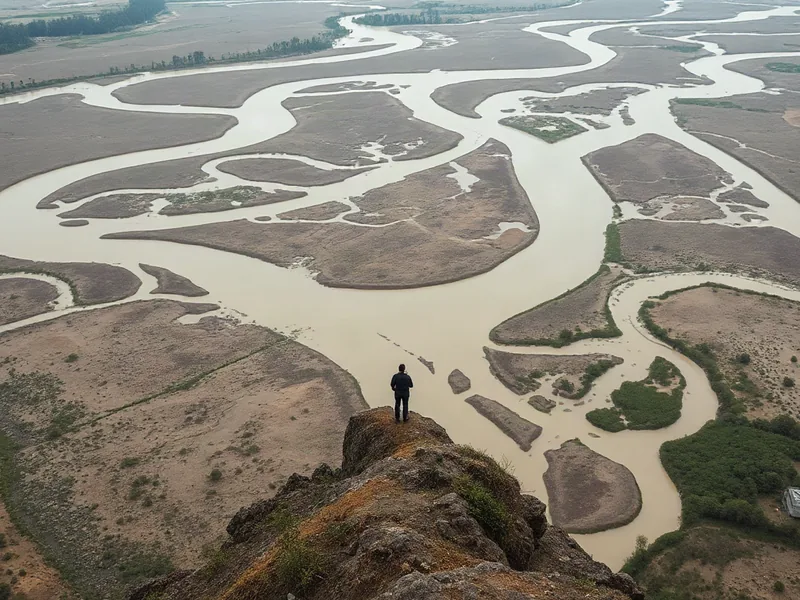
But good news on renewables doesn't cancel out bad news elsewhere. If countries simply continue on their current policy paths without new action, the report projects warming could reach 2.8°C by the end of this century, and keep climbing after that. Even if every nation fully delivers on its current NDC pledges, warming still lands around 2.6°C. Both figures are worse than what last year's report projected. Two factors are driving that decline: the withdrawal of the United States from the Paris Agreement, and revised calculations of historical emissions that paint a starker picture than previously understood. New pledges submitted since last year barely moved the needle.
Here's the part that should really give people pause. Even in the report's most optimistic scenario, one where every country not only meets its NDC but also achieves its longer-term net-zero target, global warming still only gets limited to 2.1°C. That's not a 1.5°C world. It's not even close. And the window for keeping peak warming near 1.7 to 1.8°C is shrinking fast. Every five years that emissions continue at today's levels adds roughly another 0.1°C to that peak. Delay has a price, and the meter is running.
There's another wrinkle buried in the math. The lowest possible overshoot scenario doesn't just require deep emissions cuts, it also requires actively pulling carbon back out of the atmosphere and storing it permanently. The report estimates this at around 320 gigatonnes of CO2 over the course of the century, equivalent to roughly eight years' worth of the entire world's current annual CO2 emissions. That's not a footnote. That's an industrial undertaking on a scale humanity has never attempted, requiring technologies that are still young, expensive, and unproven at anything close to that volume.
Numbers like 1.5°C or 2.8°C can feel abstract, disconnected from daily life. They shouldn't. Every fraction of a degree translates into real consequences: more intense heatwaves, stronger storms, faster sea level rise, disrupted agriculture, and public health strains that fall hardest on people who contributed least to the problem. Low-income communities and small island nations have the fewest resources to adapt, yet they face the steepest risks. An overshoot of 1.7 or 1.8°C isn't a rounding error. It's a meaningfully harsher world than the one climate scientists and negotiators have spent three decades trying to prevent.
Still, this report isn't just a eulogy for a missed target. It's also a reminder that the pace of renewable energy growth has consistently outrun expectations, proof that political will and smart policy can move faster than pessimists assume. The emissions gap is wide, but it is not fixed in stone. Closing it, or at least narrowing it, depends entirely on choices governments make in the next few years, not decades. The point of return, as the report's subtitle suggests, may still be reachable. But the margin for delay has nearly run out.
Tags
Original Sources
UNEP Emissions Gap report 2026
↗ https://www.pbl.nl/en/publications/unep-emissions-gap-report-2026
About the author
Amara's entry point into AI was an epidemiology role at a London research hospital, where she spent five years studying how digital health tools reached — or conspicuously failed to reach — underserved communities. Watching early algorithmic systems in healthcare quietly entrench existing inequalities, she redirected her career toward the systemic consequences of AI at scale. She covers AI through an unflinching lens: who benefits, who bears the cost, and what evidence actually says versus what the press release claims. Her writing is calm and precise, but she doesn't mistake balance for neutrality.
More from The Steward →This Week's Edition
21 October 2026
23 articles
Related Articles
Related Articles
More Stories
© 2026 Cedar & Bloom. All rights reserved.