The Drum · Weekly AI news, freeSubscribe →
Share
A colossal 19-meter prehistoric octopus upends our understanding of Cretaceous oceans, suggesting invertebrates could challenge even the mightiest mosasaurs and plesiosaurs as apex predators.
Some 80 million years ago, during the late Cretaceous period, the world's oceans were teeming with life. Among the most formidable creatures were 17-meter-long mosasaurs, long-necked plesiosaurs, and massive predatory sharks. For decades, scientists believed that these large vertebrates ruled the seas, while invertebrates like octopuses and squids were mere prey. However, a groundbreaking study published in Science challenges this view by revealing the existence of an enormous, boneless predator: a 19-meter-long ancient octopus.
“Before this study, Cretaceous marine ecosystems were generally understood as worlds dominated by large vertebrate predators,” explained Yasuhiro Iba, a paleontologist at Hokkaido University and co-author of the study. “Invertebrates were seen as prey that evolved protective structures like hard shells to survive predation. Octopuses, in particular, were difficult to study because they rarely fossilize.” This new research not only changes our understanding of the Cretaceous food web but also highlights the significant role invertebrates played in ancient marine ecosystems.
The reason it took so long to identify a giant octopus as an apex predator is simple: octopuses are mostly soft-bodied creatures. When they die, their tissues decay rapidly, leaving little behind for paleontologists to study. The only parts that do fossilize are their chitinous jaws, which resemble parrot beaks. These beaks, however, are incredibly difficult to spot when embedded in dense marine rock formations.
To overcome this challenge, Iba and his team developed a novel technique called Digital Fossil Mining. Instead of using traditional X-ray imaging, they employed high-resolution grinding tomography. This method involves physically shaving away microscopic layers of the rock, much like a destructive 3D printer working in reverse. The rocks were first embedded in resin to hold them together, then ground layer by layer, with each slice photographed. Thousands of images were compiled into full-color, 3D digital datasets, which were analyzed using an AI model.
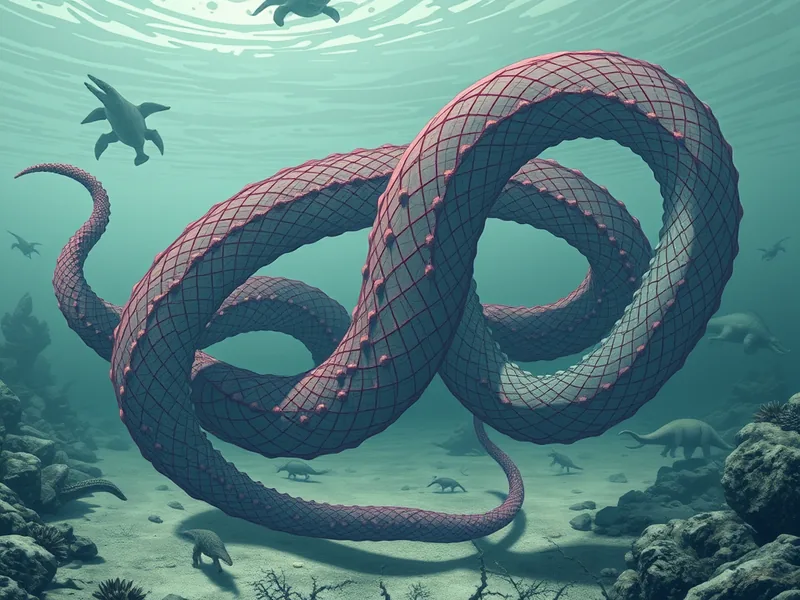
The results were astonishing. When Iba and his colleagues examined the digitally reconstructed beaks, they realized these creatures must have been massive and formidable. “We were very surprised,” Iba said. “We already knew that the Cretaceous seas were home to large predators, but finding evidence of a 19-meter-long octopus was unexpected.”
This discovery has significant implications for our understanding of ancient marine ecosystems. It suggests that invertebrates like giant octopuses played a crucial role in the food chain, possibly even rivaling or surpassing vertebrate predators in size and impact. “Our study changes the picture of Cretaceous marine life,” Iba emphasized. “It shows that invertebrates were not just passive prey but active participants in these ecosystems.”
The next steps for researchers include further exploration of other potential fossil sites using Digital Fossil Mining techniques. This could uncover more evidence of giant octopuses and other large invertebrates, providing a more complete picture of the Cretaceous marine environment.
The unearthing of this 19-meter-long ancient octopus not only expands our knowledge of prehistoric life but also underscores the complexity and diversity of ancient marine ecosystems. It serves as a reminder that nature is full of surprises, and there is always more to discover beneath the surface.
Tags
Original Sources
About the author
Amara's entry point into AI was an epidemiology role at a London research hospital, where she spent five years studying how digital health tools reached — or conspicuously failed to reach — underserved communities. Watching early algorithmic systems in healthcare quietly entrench existing inequalities, she redirected her career toward the systemic consequences of AI at scale. She covers AI through an unflinching lens: who benefits, who bears the cost, and what evidence actually says versus what the press release claims. Her writing is calm and precise, but she doesn't mistake balance for neutrality.
More from The Steward →This Week's Edition
30 April 2026
29 articles
Related Articles
Related Articles
More Stories
© 2026 Cedar & Bloom. All rights reserved.