The Drum · Weekly AI news, freeSubscribe →
Share
Restaurants and brands are flooding menus and ads with AI-generated food images full of worms, holes, and unidentifiable lumps. The reasons come down to diffusion architecture, training data, and how our brains process texture.
Scroll through enough restaurant marketing lately and you'll hit a wall of unsettling images: shrimp shaped like donuts, Reubens that look excavated from a bog, noodles that resemble worms, and burritos with a texture straight out of a trypophobia support group. Add construction-grade "ice cream," brain-textured desserts, and chicken with a stringy, almost organic wrongness to it, and you've got a genre unto itself. Social media has been cataloging this stuff for months, and it's not slowing down.
The mystery isn't really why brands are doing this. Cutting a photographer and a food stylist from the budget is an easy call for a marketing team on a deadline, even when the actual food is sitting right there to photograph. The more interesting question is technical: why does AI produce food images this specifically, viscerally wrong?
Part of the answer starts with how most modern image generators actually work. The dominant approach is diffusion. A diffusion model begins with a canvas of pure noise, essentially visual static, and then removes that noise in incremental steps, guided by a text prompt, until a coherent image emerges. It's an elegant process for generating broad shapes, lighting, and color palettes. It's much less reliable when the target output requires precise, continuous structure.
That's where food photography becomes an unusually hard test case for these models. Food is full of exactly the kind of visual elements diffusion architectures struggle with: thin strands, tapering edges, porous surfaces, and structures that need to terminate cleanly rather than blend into their surroundings.
Think about what a bowl of noodles or a slice of bread actually demands from a generator:
Diffusion models are, as one description of the problem puts it, notoriously weak at generating thin, continuous, terminating structures. That single limitation explains a huge share of the internet's AI food horror show. Noodles become worms because the model can produce something noodle-shaped and noodle-colored without ever nailing the structural logic of an actual noodle: where it starts, where it ends, how it behaves under gravity and light.
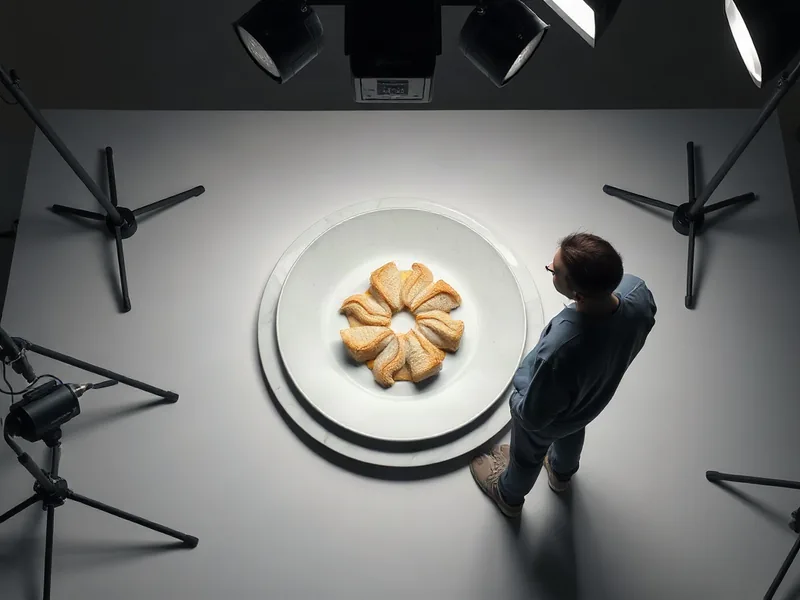
Holes and lumps show up for a related reason. When a model is uncertain about fine texture, denoising a rough approximation is often a safer bet than committing to a crisp, biologically plausible surface. The result is those trypophobia-triggering clusters of holes in burrito fillings or bread crusts, and the unidentifiable lumps that make ice cream look like drywall compound. The model isn't rendering a specific object; it's converging toward something that's statistically noodle-adjacent or bread-adjacent based on its training data, without ever verifying the internal consistency a real eye would demand.
Training data plays into this too. Image generators learn from enormous datasets of photos scraped from the internet, and food photography in that corpus skews heavily toward glossy, professionally lit, often heavily styled shots. That means the model has seen plenty of examples of what appetizing food is supposed to look like from the outside: warm tones, glistening surfaces, perfect plating. It's seen far less of the underlying physical logic of what makes a strand of pasta a strand of pasta rather than a tube-shaped blob. The model can mimic surface style effectively while missing the structural substance entirely.
There's also a perceptual layer that makes these errors land harder than similar glitches in other image categories. Humans are exceptionally attuned to food cues, for obvious evolutionary reasons: we need to spot spoilage, contamination, and inedibility fast. That same wiring that helps someone notice mold on bread also makes them hyper-sensitive to subtle wrongness in an AI-rendered burger. A slightly off proportion in a generated landscape might go unnoticed. A slightly off texture in a generated burrito registers instantly as something between unappetizing and outright disturbing, because our brains are built to flag exactly that kind of anomaly as a warning sign.
Put those three factors together, architectural weakness with thin continuous structures, training data that captures style without substance, and human perceptual systems tuned to catch food-related wrongness, and you get a near-perfect storm for bad AI food imagery. It's not one bug. It's a stack of separate limitations that all happen to converge on the same category of image.
None of this is unfixable in principle. Newer generation techniques, better training data curation focused on structural accuracy rather than just aesthetic style, and post-processing correction passes could all chip away at the problem over time. But for now, food remains one of the clearest public demonstrations of where current image generation architectures fall short, precisely because everyone has strong intuitions about what a noodle or a burger is supposed to look like. There's nowhere for the model to hide.
The recurring worms, holes, and lumps in AI-generated food images aren't random glitches; they trace back to a specific, well-documented weakness in diffusion models around rendering thin, continuous, terminating structures like noodles or shredded chicken. Training data that emphasizes surface style over structural physics compounds the problem, and human perceptual sensitivity to food cues makes the resulting errors especially jarring. For any brand considering swapping real food photography for generated images, the current generation of models simply isn't built to nail the structural details that make food look, and feel, real.
Tags
Original Sources
Why AI food looks like that
↗ https://www.theverge.com/ai-artificial-intelligence/989376/ai-generated-food-why-does-it-look-like-that
About the author
Kai built ML infrastructure at a Bay Area startup before developing an obsession with transformer architectures and inference optimisation that eventually pulled him out of product work entirely. A stint at a compute research lab sharpened his instinct for what actually matters in a model release versus what is marketing. He writes from the inside — from the perspective of someone who has debugged the systems he is describing at three in the morning. He is allergic to hype and instinctively drawn to the unglamorous plumbing questions that everyone else skips over.
More from The Engineer →This Week's Edition
6 September 2026
24 articles
Related Articles

xAI Launches Grok Bot, an Autonomous Agent That Logs Into Your Tools and Does the Work
Products & Applications · 5 min
Robotics Experts Pour Cold Water on Tesla's Optimus Debut
Products & Applications · 5 min

Replit Swaps Anthropic for OpenAI as Default Model, Muddying a Lucrative Partnership
Products & Applications · 5 min
Related Articles
xAI Launches Grok Bot, an Autonomous Agent That Logs Into Your Tools and Does the Work
Products & Applications · 5 min
Robotics Experts Pour Cold Water on Tesla's Optimus Debut
Products & Applications · 5 min
Replit Swaps Anthropic for OpenAI as Default Model, Muddying a Lucrative Partnership
Products & Applications · 5 min
More Stories
© 2026 Cedar & Bloom. All rights reserved.
