The Drum · Weekly AI news, freeSubscribe →

Share
Diners are noticing something off about the too-perfect burgers and shrimp on AI-illustrated menus. The unease is real, and it traces back to how these image models actually learn to "see" food.
You walk into a cafe. You look at the menu. The bagel sandwiches are all there, illustrated in bright, glossy detail. Something feels wrong, even though you can't quite say what. The cheese is too symmetrical. The bread is too smooth. Your gut tells you before your brain catches up.
You're not imagining it. Generative AI has quietly taken over menu illustration at a growing number of restaurants, and the images it produces carry a distinct, learned aesthetic that many people register as unappetizing, even unsettling, without immediately knowing why.
Sometimes the tell is obvious. A burrito shows up with cheese so bubbly and melty it looks like avant-garde sculpture rather than lunch. More often the wrongness is subtler: a menu that looks perfectly normal until you look twice, and then you can't stop noticing it. Alex Lisle, chief technology officer at the AI-detection startup Reality Defender, put it this way to TechCrunch: "It's almost like an alien trying to make a pizza without understanding its core principles." Reality Defender's entire business, building tools to spot AI-generated content, exists partly because problems like this one have become common enough to need solving.
The internet has plenty of receipts. One X user posted a photo of an AI-generated food ad she'd spotted around New York, joking that you can "throw a rock" in the city and hit one. Another pointed to shrimp that appear to have devoured their own tails, a detail so strange people have started calling these images "Lovecraftian food horrors."
To understand why this keeps happening, it helps to think about how these systems actually work. Large language models and diffusion models, the technology behind tools like ChatGPT and Midjourney, learn by studying enormous quantities of existing images and text. They don't understand food the way a chef or even a hungry person does. They identify statistical patterns in what they've seen and predict what a "good" answer should look like based on those patterns.
Ask one of these models to design a fast-food menu, and it doesn't invent something new. It reaches for what it already knows: Wendy's, Burger King, McDonald's, the visual language of chain restaurant advertising that has saturated decades of print and digital media. Lisle didn't mince words about the source material. "A lot of this stuff looks like a Chili's menu from 2015, and there's a reason for that," he told TechCrunch. "That was the corpus of work from which the models drew their function."
That borrowed style already leans toward an exaggerated kind of perfection. Real food advertising has always cheated a little. Think of a Big Mac in a commercial, each layer arranged by a prop stylist to look as tempting as possible on camera. AI models absorb that same impulse toward idealized presentation, but without a human's sense of when enough is enough. The result amplifies the artificiality rather than tempering it.
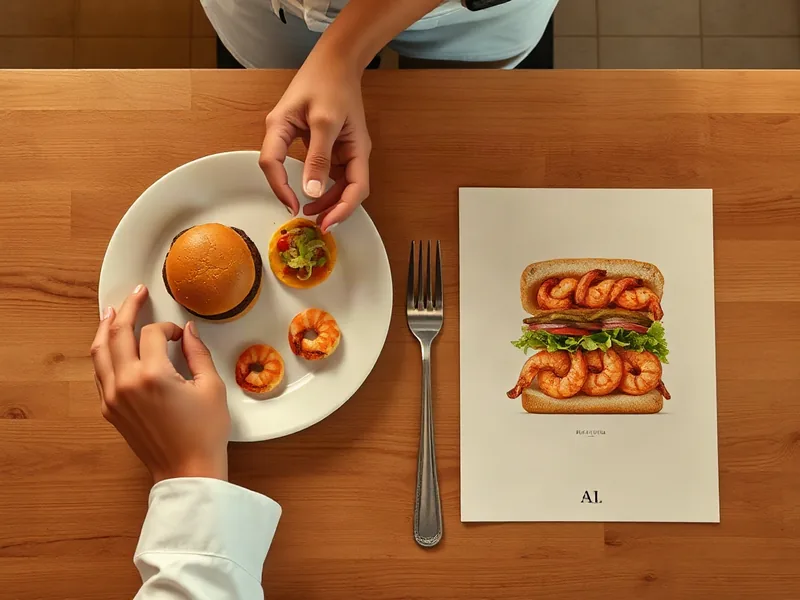
Lee Rainie, director of the Imagining the Digital Future Center at Elon University, described this as a kind of flattening. "The optimization of the data sets is for pleasingness, or you know, not being offensive, and so there's a way that turns into homogenization," he told TechCrunch. "What AI is known to do both in images and language is to shave off the edges." Every ice cream scoop becomes perfectly round. Every dish loses whatever texture or imperfection made it look real in the first place.
There's a longer-term risk lurking here too. New training data is valuable to the companies building these models, valuable enough that Amazon has reportedly scanned rare books for training purposes and then destroyed the physical copies once digitized. But as AI-generated images spread across the internet, some of that content inevitably ends up back in future training sets. When a model trains too heavily on its own outputs, researchers call the resulting degradation "model collapse."
Lisle offered a vivid analogy for what happens when a model feeds on itself repeatedly. "Model collapse is almost like a mad cow disease," he said. "When you feed the outputs from one model back into itself, eventually the inbreeding becomes too much, and the whole thing collapses." What's happening with menu images right now is milder than full collapse, he clarified. It's closer to what researchers call convergence: a narrowing of style and quality rather than a total breakdown.
Convergence still does real damage to the range of what these tools can produce. If a model already leans toward chain-restaurant aesthetics, and its outputs then get folded back into future training data, that same look gets reinforced again and again. The circle tightens instead of widening.
The pattern shows up even within a single editing session. An X user named Labtec ran an experiment: generate a restaurant menu in ChatGPT, then edit that same image 100 times in a row and watch what happens. The food degraded steadily with each pass, drifting further from anything recognizable. "The end result actually makes me uncomfortable," Labtec wrote. TechCrunch repeated the experiment independently and got similar results. Small errors compound. Each edit nudges the image a little further from reality, and after enough rounds, what's left barely resembles food at all.
None of this is really about menus. It's about what happens when a technology optimized to please everyone ends up satisfying no one, and what that says about the broader wave of AI-generated content flooding daily life. Restaurant owners see generative AI as a fast, cheap way to spruce up signage or menus without hiring a photographer or illustrator. That instinct makes sense on a budget line. But customers are picking up on something real when they feel unsettled by these images, a subtle mismatch between what looks technically polished and what actually reads as authentic and appetizing.
As more AI-generated content circulates and potentially loops back into training data, that gap may not close on its own. It could widen, nudging visual media further toward a narrow, homogenized look that technically works but never quite feels right. For an industry built on making people hungry, that's a problem worth taking seriously.
Tags
Original Sources
The sameness problem behind those unappetizing AI-generated menus | TechCrunch
↗ https://techcrunch.com/2026/09/03/the-sameness-problem-behind-those-unappetizing-ai-generated-menus
About the author
Amara's entry point into AI was an epidemiology role at a London research hospital, where she spent five years studying how digital health tools reached — or conspicuously failed to reach — underserved communities. Watching early algorithmic systems in healthcare quietly entrench existing inequalities, she redirected her career toward the systemic consequences of AI at scale. She covers AI through an unflinching lens: who benefits, who bears the cost, and what evidence actually says versus what the press release claims. Her writing is calm and precise, but she doesn't mistake balance for neutrality.
More from The Steward →This Week's Edition
6 September 2026
24 articles
Related Articles

xAI Launches Grok Bot, an Autonomous Agent That Logs Into Your Tools and Does the Work
Products & Applications · 5 min
Robotics Experts Pour Cold Water on Tesla's Optimus Debut
Products & Applications · 5 min

Replit Swaps Anthropic for OpenAI as Default Model, Muddying a Lucrative Partnership
Products & Applications · 5 min
Related Articles
xAI Launches Grok Bot, an Autonomous Agent That Logs Into Your Tools and Does the Work
Products & Applications · 5 min
Robotics Experts Pour Cold Water on Tesla's Optimus Debut
Products & Applications · 5 min
Replit Swaps Anthropic for OpenAI as Default Model, Muddying a Lucrative Partnership
Products & Applications · 5 min
More Stories
© 2026 Cedar & Bloom. All rights reserved.
