The Drum · Weekly AI news, freeSubscribe →

Share
In a cosmic twist, astronomers using the James Webb Space Telescope have discovered a gas giant that not only survived its star’s death but moved closer to it. This challenges our understanding of how stars and their planets evolve.
In a fascinating discovery that has left scientists scratching their heads, a Jupiter-size planet named WD 1856 b has been found orbiting a white dwarf-a remnant of a Sun-like star that has undergone the end stages of its life. The planet’s survival and unusual orbit challenge our current theories of stellar evolution and planetary dynamics.
WD 1856 b was discovered accidentally in 2020 when astronomers using the Transiting Exoplanet Survey Satellite (TESS) observed a sample of about 2,000 white dwarfs. These stars are the compact remnants left behind after Sun-like stars expand into red giants and then shed their outer layers, leaving behind an Earth-sized core composed primarily of carbon and oxygen.
Christopher O’Connor, a theoretical astrophysicist at Cornell University and co-author of a recent study published in Nature, explains the initial surprise: “As soon as they looked at it, they said, okay, that’s weird.” The planet is about seven times larger than its white dwarf host, which should cause significant dimming when it passes in front of the star. However, instead of nearly disappearing, the star's brightness only dips by about half.
The most plausible explanation for this phenomenon is a grazing transit, where only the edge of the planet’s disk clips the face of the white dwarf. “That’s a very unlikely viewing angle,” O’Connor notes, “but it’s the only way to explain what we actually see.” This peculiar alignment adds an extra layer of mystery to the already strange system.
What makes WD 1856 b even more intriguing is its close orbit around the white dwarf, at about 0.02 astronomical units (AU). According to our understanding of stellar evolution, when a star becomes a red giant, it consumes any inner planets and then loses about half its mass as it shrinks down to a white dwarf. This reduction in mass weakens the gravitational pull on outer planets, causing them to migrate outward by about a factor of two.
However, WD 1856 b seems to have defied this expectation. Instead of moving farther away, it has moved closer to its star. “The discovery immediately sent theoretical astrophysicists into a feeding frenzy,” O’Connor says. “When you find something that’s totally bizarre and unexpected, the Universe is inviting us to get creative.”
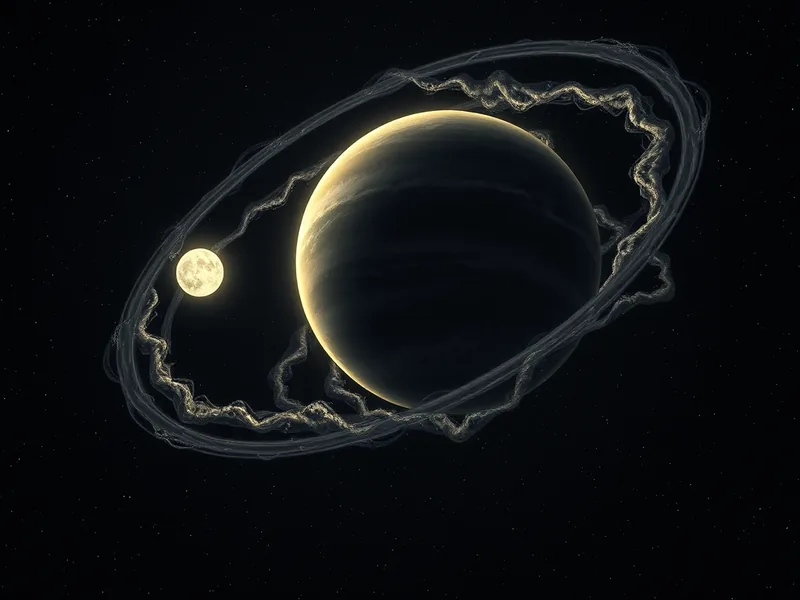
To gather more data and explore this anomaly, O’Connor’s team booked time on the James Webb Space Telescope (JWST). The JWST observations, conducted on April 27, 2023, provided crucial insights into the WD 1856 system. These high-resolution images and spectra are helping scientists piece together a more detailed picture of how this planet managed to survive and migrate inward.
The discovery of WD 1856 b not only challenges our current models of stellar evolution but also opens new avenues for understanding the dynamics of planetary systems. By studying such anomalies, scientists can refine their theories and develop more accurate predictions about what happens to planets when their stars die.
This research has broader implications for exoplanet studies and our search for habitable worlds. If gas giants like WD 1856 b can survive the death of their stars and even migrate closer, it suggests that planetary systems may be more resilient and dynamic than previously thought. This resilience could have significant consequences for the long-term survival of life on planets in similar circumstances.
Understanding these processes can help us better predict the future of our own solar system. As the Sun approaches its end stages billions of years from now, knowing how planets might respond to such dramatic changes can provide valuable insights into the fate of Earth and other planets in our cosmic neighborhood.
In a world where geological risks and environmental changes are increasingly on our minds, studying the distant past and future of planetary systems offers a unique perspective. Just as understanding Earth’s geology helps us prepare for future risks, exploring the dynamics of distant star systems can provide valuable lessons for our own survival and the long-term health of our planet.
Tags
Original Sources
A Jupiter-size planet that escaped its star's death
↗ https://arstechnica.com/science/2026/07/a-jupiter-size-planet-that-escaped-its-stars-death
About the author
Amara's entry point into AI was an epidemiology role at a London research hospital, where she spent five years studying how digital health tools reached — or conspicuously failed to reach — underserved communities. Watching early algorithmic systems in healthcare quietly entrench existing inequalities, she redirected her career toward the systemic consequences of AI at scale. She covers AI through an unflinching lens: who benefits, who bears the cost, and what evidence actually says versus what the press release claims. Her writing is calm and precise, but she doesn't mistake balance for neutrality.
More from The Steward →This Week's Edition
20 July 2026
29 articles
Related Articles

Nuclear Plants Are Squeezing Out More Power, But It Won't Be Enough to Meet AI's Demand
Environment & Climate · 5 min

The Hidden Environmental Price Tag of Artificial Intelligence
Environment & Climate · 5 min

Iambic Therapeutics Raises $150 Million in IPO to Fund AI-Designed Cancer Drugs
Finance & Markets · 5 min
Related Articles
Nuclear Plants Are Squeezing Out More Power, But It Won't Be Enough to Meet AI's Demand
Environment & Climate · 5 min
The Hidden Environmental Price Tag of Artificial Intelligence
Environment & Climate · 5 min
Iambic Therapeutics Raises $150 Million in IPO to Fund AI-Designed Cancer Drugs
Finance & Markets · 5 min
More Stories
© 2026 Cedar & Bloom. All rights reserved.
