The Drum · Weekly AI news, freeSubscribe →

Share
An AI-driven robot is aiding the recovery of the Great Barrier Reef by planting baby corals, offering a high-tech solution to restore damaged ecosystems and combat the reef's decline.
The Great Barrier Reef, one of the world's most iconic and biodiverse ecosystems, faces an existential threat from climate change, pollution, and overfishing. However, a new initiative is bringing hope to marine conservation efforts with the help of artificial intelligence (AI) and robotics. Scientists have developed an AI-guided robot that can plant baby corals across damaged areas of the reef, marking a significant step forward in coral restoration.
Coral reefs are often referred to as the "rainforests of the sea" due to their immense biodiversity and ecological importance. The Great Barrier Reef, located off the coast of Australia, is the world's largest coral reef system, spanning over 2,300 kilometers. It supports a vast array of marine life, including thousands of species of fish, sharks, rays, and other invertebrates. However, rising sea temperatures caused by climate change have led to widespread coral bleaching, where corals expel the algae (zooxanthellae) living in their tissues and turn white. This process can be fatal if the stress continues for too long.
To combat this crisis, researchers from Queensland University of Technology (QUT) have developed an innovative solution: a robot named "LarvalBot" that uses AI to plant baby corals in damaged areas of the reef. The project is part of a broader effort called the "Reef Restoration and Adaptation Program," which aims to develop and deploy technologies to help the Great Barrier Reef recover.
The process begins with collecting coral spawn, which are released into the water during annual spawning events. Scientists then use this spawn to grow baby corals in specialized nurseries on land. Once the baby corals reach a suitable size, they are loaded onto LarvalBot.
LarvalBot is equipped with AI algorithms that allow it to navigate and identify areas of the reef that need restoration. The robot can then precisely plant the baby corals in these locations, ensuring they have the best chance of survival. This method is more efficient and less invasive than traditional coral planting techniques, which often involve divers manually placing corals on the reef.
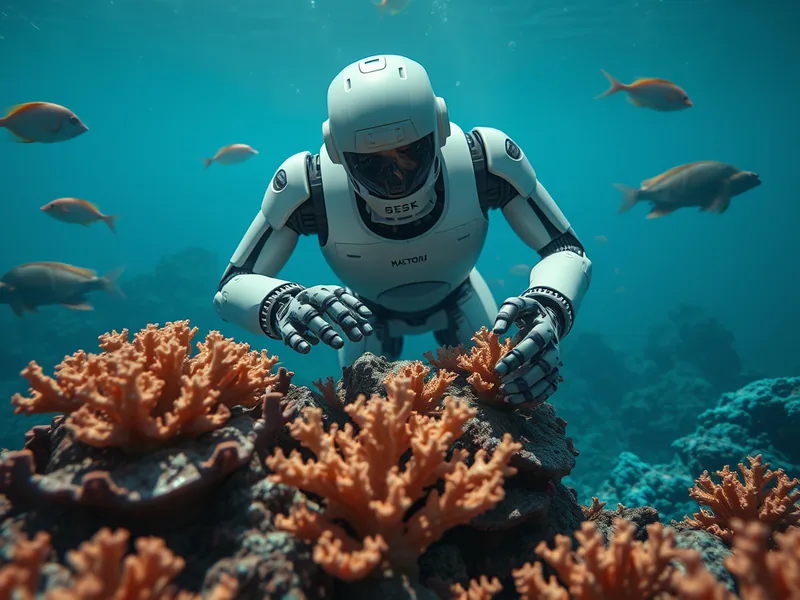
The use of AI and robotics in coral restoration offers several benefits. First, it significantly reduces the time and labor required to plant corals, making large-scale restoration projects more feasible. Second, the precision of the robot ensures that baby corals are placed in optimal locations, increasing their chances of survival and growth.
However, there are also challenges. The success of coral restoration depends on a range of factors, including water quality, temperature, and the presence of predators. Additionally, the long-term sustainability of these efforts will require ongoing monitoring and adaptation to changing environmental conditions.
The success of the LarvalBot project in Australia could serve as a model for coral restoration efforts around the world. Coral reefs are under threat globally, and similar technologies could be adapted to help restore other damaged reef systems. By combining cutting-edge AI with traditional conservation methods, scientists hope to create a more resilient future for these vital ecosystems.
While the use of AI-guided robots is an exciting development in marine conservation, it is just one part of a larger strategy to protect and restore coral reefs. Addressing the root causes of reef degradation, such as climate change and pollution, remains crucial. However, initiatives like LarvalBot offer hope that with innovation and collaboration, we can make significant strides in preserving these natural wonders for future generations.
Tags
Original Sources
About the author
Amara's entry point into AI was an epidemiology role at a London research hospital, where she spent five years studying how digital health tools reached — or conspicuously failed to reach — underserved communities. Watching early algorithmic systems in healthcare quietly entrench existing inequalities, she redirected her career toward the systemic consequences of AI at scale. She covers AI through an unflinching lens: who benefits, who bears the cost, and what evidence actually says versus what the press release claims. Her writing is calm and precise, but she doesn't mistake balance for neutrality.
More from The Steward →This Week's Edition
29 April 2026
29 articles
Related Articles

Nuclear Plants Are Squeezing Out More Power, But It Won't Be Enough to Meet AI's Demand
Environment & Climate · 5 min

The Hidden Environmental Price Tag of Artificial Intelligence
Environment & Climate · 5 min

Iambic Therapeutics Raises $150 Million in IPO to Fund AI-Designed Cancer Drugs
Finance & Markets · 5 min
Related Articles
Nuclear Plants Are Squeezing Out More Power, But It Won't Be Enough to Meet AI's Demand
Environment & Climate · 5 min
The Hidden Environmental Price Tag of Artificial Intelligence
Environment & Climate · 5 min
Iambic Therapeutics Raises $150 Million in IPO to Fund AI-Designed Cancer Drugs
Finance & Markets · 5 min
More Stories
© 2026 Cedar & Bloom. All rights reserved.
