The Drum · Weekly AI news, freeSubscribe →

Share
As electricity demand climbs and AI data centers strain grids worldwide, one of China's largest wind turbine makers is betting it can export clean power solutions from Brazil to the Australian outback.
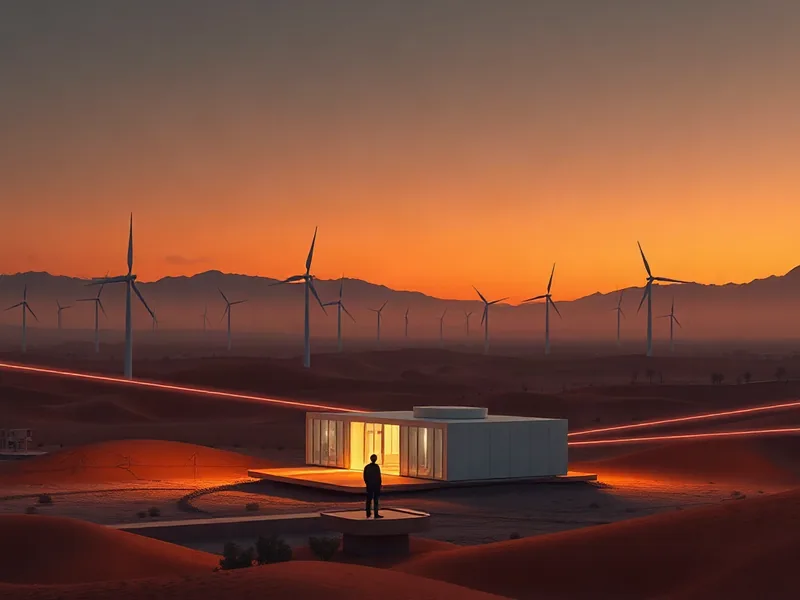
Somewhere in Inner Mongolia, wind turbines are quietly powering racks of servers that train and run artificial intelligence models, with no fossil fuel backup required. That facility, in the city of Chifeng, represents something new: the first data center run entirely on direct renewable power. The company behind it, Envision Energy, wants to replicate that model across deserts and arid regions worldwide by the end of the decade.
This matters because two massive trends are colliding right now. Global electricity demand is rising by 3.5% to 4% each year. At the same time, data centers, especially those built for AI, are becoming some of the hungriest consumers of power on the planet. Worldwide, these facilities could use up to 950 terawatt-hours of electricity annually by 2030, roughly what Japan's entire economy consumes in a year. Most of that demand today gets met by fossil fuels. Envision is trying to prove there's another way.
Founded in 2007 by entrepreneur Zhang Lei, Envision has grown into one of the largest renewable energy companies on Earth, with 103 gigawatts of wind power installed worldwide and more than 50 gigawatt-hours of battery storage capacity. It's China's second-largest wind turbine manufacturer by installed capacity, and the company says it has outpaced every competitor in new orders for four straight years running. China itself is installing wind turbines faster than any other nation, and Envision has ridden that wave to become a technical leader, testing smart turbines that adjust their performance based on real-time wind conditions and experimenting with two-blade designs that could undercut the cost of conventional three-blade machines.
Now Envision is looking well beyond its home market. The company has struck partnerships across Europe, Latin America, and Australia, treating international expansion not as a side project but as a central strategy.
In Germany, Envision is constructing battery energy storage systems designed to make the national grid more resilient and flexible, a useful hedge against the kind of supply swings that come with a bigger renewable mix. In Brazil, the company still plans to build a net-zero industrial park, first announced in May 2025, that would use wind power to produce sustainable aviation fuel, hydrogen, and ammonia. Think of it as a factory that runs entirely on breeze instead of coal or gas.
Australia offers perhaps the clearest glimpse of what Envision is trying to do at scale. The company has already installed 17 turbines there and deployed what it calls a physical AI system to optimize how energy flows from those turbines into the grid. At the Narrogin Wind Farm, the smart turbines Envision plans to build will eventually help power close to 100,000 homes. In Vietnam, Envision is scheduled to begin delivering a 200-megawatt wind project in the first half of 2027, its largest nearshore undertaking outside China.
None of this happens through technology alone. Building a wind farm requires working with local project teams, securing permits, meeting environmental standards, and engaging the communities who will live alongside the turbines. Envision says its goal is to build fully integrated energy systems in each new market it enters, not just sell equipment and leave. That ambition brings its own headaches: developing local partnerships, building operational know-how in unfamiliar regulatory environments, and earning trust with communities that may be skeptical of a foreign company showing up with big promises.
The payoff, if it works, could be significant. Wind power already prevents roughly 1.1 billion metric tons of carbon dioxide emissions every year, according to the International Energy Agency. That's comparable to the combined annual emissions of France, Germany, and Italy. If wind energy were built out to its full potential globally, including in hard-to-reach locations, it could supply a third of the world's electricity by 2050 and avoid around 6.3 billion metric tons of carbon emissions each year. Those are the kinds of numbers that make the difference between modest progress and genuine climate impact.
The data center push adds a new layer of urgency and complexity. AI facilities need a steady, uninterrupted flow of electricity, but wind and solar output rises and falls with the weather. It's a bit like trying to run a factory that needs constant power using a generator that only works when it's windy. Envision says it has developed large-scale predictive models to help balance generation, storage, and demand in real time, smoothing out those natural fluctuations. Even so, these facilities still require substantial backup capacity to guarantee they never go dark.
In June 2026, Envision announced Mission Gobi, an initiative aiming to build five gigawatts of power capacity generated entirely from renewable sources to support new data centers in deserts and other arid regions by 2030. Since these locations often lack ready access to water for cooling, Envision says it will rely on alternative coolants and dry coolers, systems that use air or liquid to pull heat away from server racks without draining local water supplies. The flagship project, Envision's Galaxy Campus in Ulanqab, Inner Mongolia, came online in August and will eventually reach two gigawatts of capacity, all of it powered directly by wind.
The stakes here extend well past one company's balance sheet. As AI computing demands grow, the choices made now about how to power that infrastructure will shape emissions trajectories for decades. If Envision's approach to coupling wind power directly with data centers proves reliable and cost-effective, it offers a template other companies and countries could follow, a way to satisfy the world's appetite for computing without locking in more fossil fuel dependence. If it falters, because of grid instability, cost overruns, or local resistance, it could reinforce the assumption that renewable energy simply can't keep pace with AI's growth. Either outcome will ripple far beyond Shanghai, where Envision is headquartered, touching grids and communities from rural Australia to the deserts Mission Gobi hopes to electrify.
Tags
Original Sources
Envision Energy and its global ambitions for wind power
↗ https://www.technologyreview.com/2026/10/06/1145226/2026-climate-tech-companies-to-watch-envision-energy-wind-power-global-ambitions
About the author
Amara's entry point into AI was an epidemiology role at a London research hospital, where she spent five years studying how digital health tools reached — or conspicuously failed to reach — underserved communities. Watching early algorithmic systems in healthcare quietly entrench existing inequalities, she redirected her career toward the systemic consequences of AI at scale. She covers AI through an unflinching lens: who benefits, who bears the cost, and what evidence actually says versus what the press release claims. Her writing is calm and precise, but she doesn't mistake balance for neutrality.
More from The Steward →This Week's Edition
7 October 2026
34 articles
Related Articles

Oracle Trucks In Natural Gas to Keep AI Data Centers Running Ahead of Pipelines
Environment & Climate · 5 min

MIT Technology Review's 2026 Climate Tech List Shows Where Capital Is Actually Flowing
Environment & Climate · 5 min

Corporate Carbon Pledges Face a Reckoning as Accountability Rules Tighten
Environment & Climate · 5 min
Related Articles
Oracle Trucks In Natural Gas to Keep AI Data Centers Running Ahead of Pipelines
Environment & Climate · 5 min
MIT Technology Review's 2026 Climate Tech List Shows Where Capital Is Actually Flowing
Environment & Climate · 5 min
Corporate Carbon Pledges Face a Reckoning as Accountability Rules Tighten
Environment & Climate · 5 min
More Stories
© 2026 Cedar & Bloom. All rights reserved.
