The Drum · Weekly AI news, freeSubscribe →

Share
Scientists have cracked the mystery surrounding ALH 84001, the oldest known Martian meteorite, tracing it back to a specific crater and shedding light on Mars' ancient geological conditions and potential for life.
In a groundbreaking discovery, scientists have traced the world's oldest known Martian meteorite back to its precise point of origin on the Red Planet. This meteorite, which is estimated to be 4.5 billion years old, has provided invaluable insights into Mars' early geological history and the planet’s potential for harboring life.
For decades, researchers have been studying Martian meteorites that have landed on Earth, but identifying their exact origins has proven challenging. These meteorites offer a unique window into Mars’ past, as they are fragments of the planet's crust that were ejected into space by asteroid impacts and eventually made their way to our planet. However, without knowing where these samples came from, scientists have had limited context for interpreting the data they provide.
The recent breakthrough was achieved through a combination of advanced imaging techniques and computer modeling. A team of international researchers used high-resolution images captured by NASA’s Mars Reconnaissance Orbiter (MRO) to identify a crater on Mars that matched the characteristics of the meteorite known as NWA 7533. This particular meteorite, discovered in Morocco in 2012, is not only one of the oldest Martian samples ever found but also contains minerals and textures that are distinct from other Martian rocks.
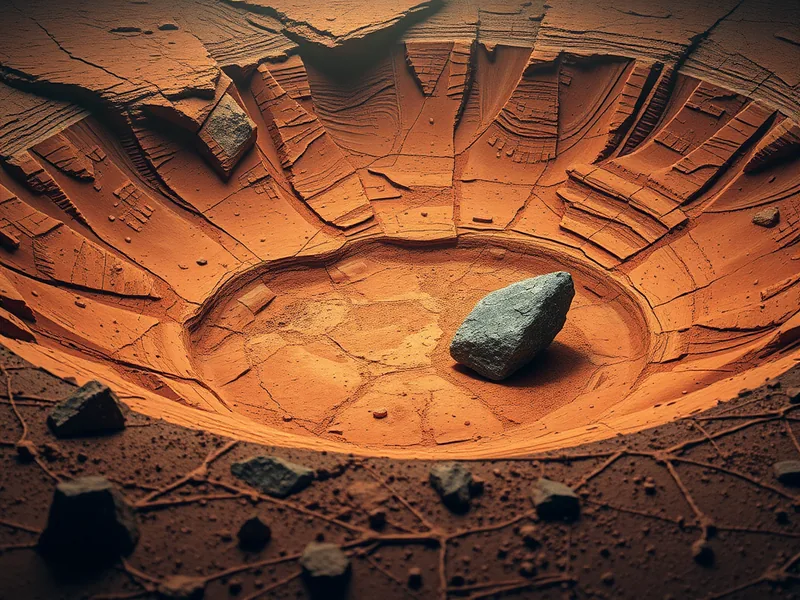
The team’s analysis revealed that the crater, named Karratha, is located in the southern highlands of Mars. The crater's age and composition align closely with those of NWA 7533, providing strong evidence that this meteorite originated from Karratha. Dr. Anthony Lagain, a planetary scientist at Curtin University in Australia and one of the lead researchers on the project, explained the significance of this discovery: "By pinpointing the origin of NWA 7533, we can now better understand the geological processes that shaped Mars billions of years ago. This information is crucial for future missions to Mars, as it helps us target specific areas for exploration."
The identification of Karratha as the source crater also has implications for our understanding of Mars’ potential habitability. The minerals found in NWA 7533 suggest that water was present on Mars during its early history, which is a key factor in assessing whether life could have existed there. Dr. Lagain added, "The presence of water and the ancient age of this meteorite make Karratha an excellent candidate for future exploration missions. It could provide further evidence of past or even current microbial life."
This discovery underscores the importance of continued space exploration and the collaboration between ground-based research and orbital observations. The Mars Reconnaissance Orbiter, which has been orbiting Mars since 2006, continues to play a crucial role in our understanding of the Red Planet. Its high-resolution cameras and other instruments have provided a wealth of data that is helping scientists piece together Mars' geological history.
While this breakthrough is significant, it also highlights the ongoing challenges in planetary science. The identification of Karratha as the source crater for NWA 7533 required years of research and sophisticated technology. Dr. Lagain emphasized that more work is needed to fully understand the implications of this discovery: "We are just beginning to scratch the surface of what we can learn from Martian meteorites. Each new piece of information brings us closer to unraveling the mysteries of Mars."
As space agencies around the world prepare for future missions to Mars, including sample return missions that will bring back more rocks and soil from the planet, the identification of Karratha as a key site adds another layer of excitement and anticipation. The potential for discovering evidence of past or present life on Mars is one of the most compelling drivers of these efforts.
In the meantime, researchers will continue to analyze NWA 7533 and other Martian meteorites, using them to refine our understanding of Mars’ geological history and its potential as a habitat for life. The journey to uncover the secrets of Mars is far from over, but with each new discovery, we take one step closer to answering some of humanity’s most profound questions.
Tags
Original Sources
About the author
Amara's entry point into AI was an epidemiology role at a London research hospital, where she spent five years studying how digital health tools reached — or conspicuously failed to reach — underserved communities. Watching early algorithmic systems in healthcare quietly entrench existing inequalities, she redirected her career toward the systemic consequences of AI at scale. She covers AI through an unflinching lens: who benefits, who bears the cost, and what evidence actually says versus what the press release claims. Her writing is calm and precise, but she doesn't mistake balance for neutrality.
More from The Steward →This Week's Edition
29 April 2026
29 articles
Related Articles
Related Articles
More Stories
© 2026 Cedar & Bloom. All rights reserved.