The Drum · Weekly AI news, freeSubscribe →

Share
Researchers have identified the exact Martian crater where NWA 7034 "Black Beauty" originated, offering unprecedented insights into the Red Planet's ancient past and the early solar system.
In a groundbreaking discovery that has thrilled planetary scientists and space enthusiasts alike, researchers have pinpointed the precise location on Mars from which the world’s oldest known meteorite originated. This ancient rock, known as NWA 7034 or "Black Beauty," is estimated to be about 4.5 billion years old, making it a crucial piece in understanding the early history of our solar system.
This discovery is not just a triumph for space exploration; it also has profound implications for environmental and climate research on Mars. By studying this meteorite, scientists can gain insights into how the Red Planet's environment has changed over billions of years. This knowledge could help us better understand Earth's own climate history and future, as well as inform our search for extraterrestrial life.
NWA 7034 was discovered in Morocco in 2011 and quickly caught the attention of scientists due to its unique composition. Unlike most Martian meteorites, which are primarily basaltic (volcanic) rocks, NWA 7034 is a breccia-a mix of different rock types fused together by heat or impact. This suggests that it formed from material ejected during a massive impact event on Mars.
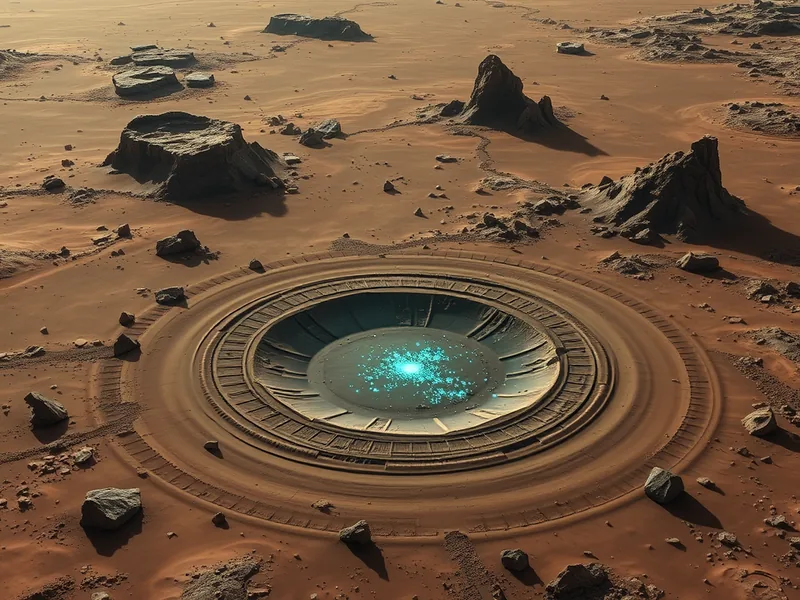
Using advanced imaging and analysis techniques, researchers at the French National Centre for Scientific Research (CNRS) and other institutions were able to match the meteorite's composition to specific geological features on Mars. They identified the Karratha crater in the planet's southern highlands as the most likely source. This crater is estimated to be about 4 billion years old, which aligns with the age of NWA 7034.
The detailed analysis of NWA 7034 has already revealed several important findings:
Understanding the environmental conditions on early Mars can offer valuable insights into Earth's own climate history. Both planets are believed to have had similar conditions in their early stages, but they evolved differently. By studying Martian meteorites like NWA 7034, researchers can piece together a more comprehensive picture of how planetary environments change over time.
The identification of the Karratha crater as the source of NWA 7034 opens up new avenues for exploration. Future Mars missions could target this region to gather more samples and conduct detailed in situ analyses. This would provide even more data to refine our understanding of Martian geology and climate.
The discovery of the origin of the world's oldest Martian meteorite is a significant step forward in planetary science. It not only enhances our knowledge of Mars but also has broader implications for environmental research on Earth. As we continue to explore the Red Planet, each new piece of information brings us closer to unraveling the mysteries of our solar system and potentially finding signs of life beyond our own planet.
Tags
Original Sources
About the author
Amara's entry point into AI was an epidemiology role at a London research hospital, where she spent five years studying how digital health tools reached — or conspicuously failed to reach — underserved communities. Watching early algorithmic systems in healthcare quietly entrench existing inequalities, she redirected her career toward the systemic consequences of AI at scale. She covers AI through an unflinching lens: who benefits, who bears the cost, and what evidence actually says versus what the press release claims. Her writing is calm and precise, but she doesn't mistake balance for neutrality.
More from The Steward →This Week's Edition
29 April 2026
29 articles
Related Articles

Nuclear Plants Are Squeezing Out More Power, But It Won't Be Enough to Meet AI's Demand
Environment & Climate · 5 min

The Hidden Environmental Price Tag of Artificial Intelligence
Environment & Climate · 5 min

Iambic Therapeutics Raises $150 Million in IPO to Fund AI-Designed Cancer Drugs
Finance & Markets · 5 min
Related Articles
Nuclear Plants Are Squeezing Out More Power, But It Won't Be Enough to Meet AI's Demand
Environment & Climate · 5 min
The Hidden Environmental Price Tag of Artificial Intelligence
Environment & Climate · 5 min
Iambic Therapeutics Raises $150 Million in IPO to Fund AI-Designed Cancer Drugs
Finance & Markets · 5 min
More Stories
© 2026 Cedar & Bloom. All rights reserved.
