The Drum · Weekly AI news, freeSubscribe →

Share
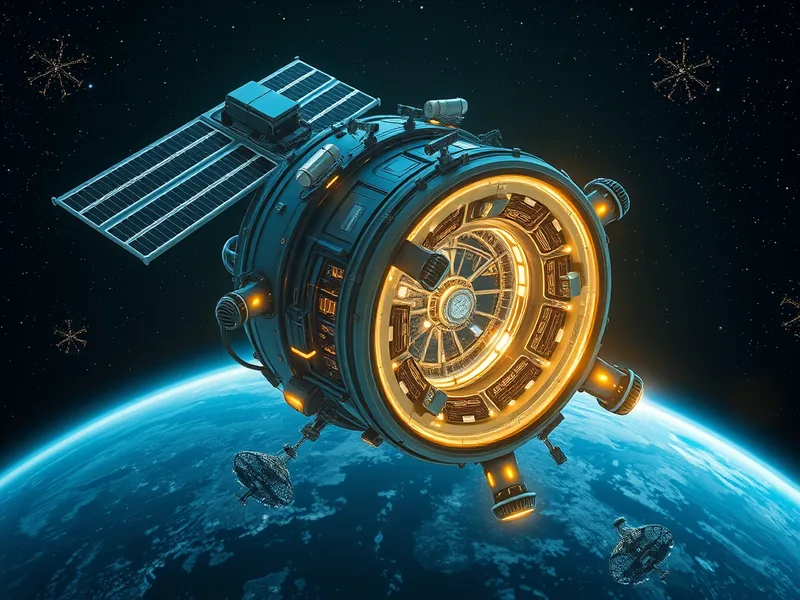
As earthbound data centers face mounting energy demands and limited space, entrepreneurs like Starcloud's Philip Johnston see a celestial solution: launching sustainable, off-planet facilities to handle AI computations.
In an era where data centers are rapidly becoming one of the most energy-intensive sectors, the idea of moving these facilities into space might sound like science fiction. However, Philip Johnston, founder and CEO of Starcloud, believes that within the next decade, this could become a reality-and not just a technological marvel, but a critical step towards sustainability.
The primary drivers pushing data centers into orbit are declining launch costs and increasing terrestrial constraints. As Philip explains, "The problem with building out on Earth is that the marginal cost of every additional data center goes up each time you add one, because we’re using all the easy places to build energy projects." In contrast, space offers a unique advantage: the marginal cost for adding new infrastructure actually decreases over time.
One of the most significant challenges in space is heat dissipation. Despite the common perception that space is cold, the vacuum makes it extremely difficult to dissipate heat. Philip highlights that "the vacuum makes heat dissipation extremely difficult, requiring novel radiator designs." Additionally, radiation poses a threat to chip reliability, necessitating extensive particle accelerator testing and innovative shielding solutions.
On the economic front, solar power in space has a distinct advantage. Without an atmosphere to filter sunlight, space-based data centers can harness solar energy more efficiently. Philip notes that "solar power without atmosphere means we can generate power 24/7, unlike on Earth where solar panels are limited by day and night cycles."
While the concept of space-based data centers is still in its infancy, certain applications will lead the way. Philip points out that "AI inference-not training-will dominate space-based compute early on." This is due to the latency and bandwidth realities of space communication. Space-based processing also offers unique benefits for satellite and government workloads with massive data collection needs.
The regulatory landscape for space-based data centers is still evolving. Currently, orbital slots are allocated on a first-come, first-served basis, but as space becomes more crowded, early movers will gain valuable, tradable positions. Filing with agencies like the FCC and ITU is crucial, and these rules may change as the space economy matures.
Philip's approach to driving innovation within his team is unconventional yet effective. He demands that engineers spend $10,000 monthly on tokens, using this extreme metric to eliminate hesitation around AI tool costs. "This cultural norm drives aggressive experimentation and ensures the team fully leverages AI capabilities rather than self-limiting based on perceived expense," he explains.
The potential economic impact of space-based data centers is staggering. Philip envisions a future where close to a trillion dollars per year in capital expenditure (CapEx) flows to space compute. This not only opens up new opportunities for technological advancement but also addresses the pressing issue of energy efficiency and sustainability.
As we face the growing challenges of climate change and environmental degradation, innovative solutions like space-based data centers offer a glimmer of hope. By leveraging the unique advantages of space-such as efficient solar power and reduced marginal costs-we can build a more sustainable future for our planet. The journey to this future may be complex, but with visionary leaders like Philip Johnston, it is within reach.
Tags
Original Sources
About the author
Amara's entry point into AI was an epidemiology role at a London research hospital, where she spent five years studying how digital health tools reached — or conspicuously failed to reach — underserved communities. Watching early algorithmic systems in healthcare quietly entrench existing inequalities, she redirected her career toward the systemic consequences of AI at scale. She covers AI through an unflinching lens: who benefits, who bears the cost, and what evidence actually says versus what the press release claims. Her writing is calm and precise, but she doesn't mistake balance for neutrality.
More from The Steward →This Week's Edition
19 March 2026
29 articles
Related Articles

Nuclear Plants Are Squeezing Out More Power, But It Won't Be Enough to Meet AI's Demand
Environment & Climate · 5 min

The Hidden Environmental Price Tag of Artificial Intelligence
Environment & Climate · 5 min

Iambic Therapeutics Raises $150 Million in IPO to Fund AI-Designed Cancer Drugs
Finance & Markets · 5 min
Related Articles
Nuclear Plants Are Squeezing Out More Power, But It Won't Be Enough to Meet AI's Demand
Environment & Climate · 5 min
The Hidden Environmental Price Tag of Artificial Intelligence
Environment & Climate · 5 min
Iambic Therapeutics Raises $150 Million in IPO to Fund AI-Designed Cancer Drugs
Finance & Markets · 5 min
More Stories
© 2026 Cedar & Bloom. All rights reserved.
