The Drum · Weekly AI news, freeSubscribe →

Share
Military fleets burn enormous amounts of fuel and answer to no climate treaty. As navies weigh electrification, the choices they make could shape both battlefield readiness and the planet's carbon math.
When we talk about decarbonizing transportation, most of the conversation centers on cars, trucks, and maybe the occasional cargo ship. Warships rarely come up. That silence is a problem, because navies are among the heaviest fuel consumers on the planet, and the vessels they build today will still be steaming through the water in 30 or 40 years.
Think of a warship like a small floating city that never stops needing power. It has to run radar, weapons systems, life support, propulsion, and communications, often simultaneously, often at sea for months without resupply. That kind of demand has traditionally been met with diesel and gas turbine engines, the same fossil fuel technology that has powered navies since the mid-20th century. The question now facing naval engineers is whether electrification, the same shift reshaping passenger cars and commercial shipping, can work on a hull built for combat rather than commuting.
The appeal is straightforward. Electric propulsion systems can be more efficient, quieter, and more flexible than mechanical drivetrains tied directly to a single engine. A quieter ship is harder to detect underwater, which matters enormously for stealth and survivability. Electric architectures also let engineers route power more freely across a vessel, powering weapons or sensors on demand rather than through a fixed mechanical chain. Some of this is already happening. Hybrid-electric drive systems have found their way into various naval vessels, letting ships switch between conventional engines and electric motors depending on speed and mission needs, not unlike how a hybrid car shifts between a gas engine and a battery pack for efficiency.
Full electrification, though, is a much bigger lift than adding a hybrid assist. Warships need to sustain high power output for weapons systems, sometimes in sudden bursts, and they need to do it reliably in combat conditions where failure isn't an option. Batteries capable of that kind of performance are heavy, and weight is not a trivial concern on a vessel where every ton affects speed, range, and stability. There's also the matter of charging infrastructure. A commercial ferry can plug in at a port between short trips. A destroyer on deployment might be at sea for months, far from any shore power connection, which makes battery-only propulsion a much harder sell for blue-water navies than for coastal patrol craft.
This is where the analogy to civilian electrification starts to break down. A city bus fleet can electrify gradually, swapping in new vehicles as old ones retire, backed by a growing charging network. A navy's fleet turnover is much slower, and the infrastructure question is not solved by adding more chargers to a marina. It requires rethinking how power gets generated, stored, and distributed on vessels designed to operate independently of land-based grids for extended periods.
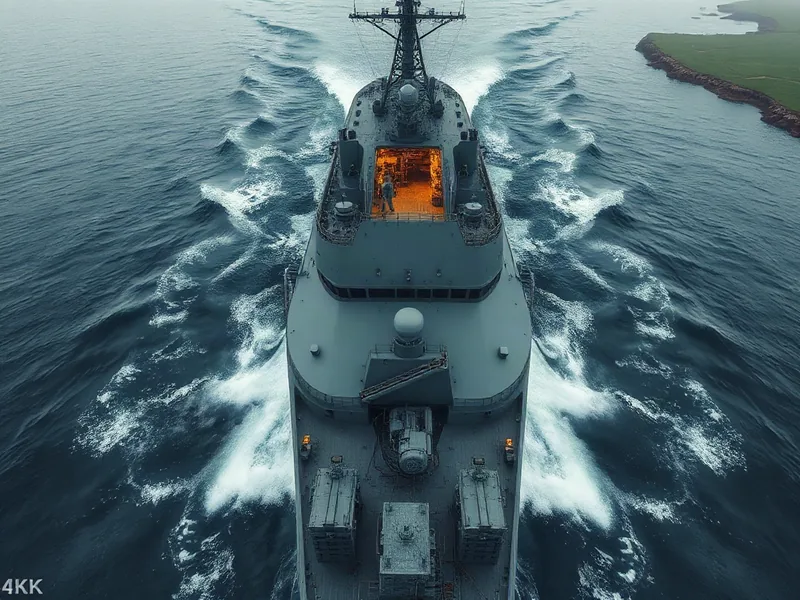
None of this makes electrification a dead end. It means the pace will likely be incremental rather than sweeping, with hybrid systems and targeted electrification of specific subsystems, like weapons or sensor arrays, arriving well before any navy commits to a fully electric surface fleet. That's a familiar pattern in defense technology adoption generally, where new capabilities tend to get proven on smaller platforms before scaling up to major surface combatants.
There's a broader emissions story here that deserves more attention than it gets. Militaries are among the largest institutional consumers of fossil fuels worldwide, and naval fuel use in particular represents a significant, often under-scrutinized share of that footprint. Unlike commercial shipping, which faces growing regulatory pressure from bodies like the International Maritime Organization to cut emissions, military vessels are generally exempt from international climate accounting frameworks. That exemption isn't a technicality without consequences. It means one of the more carbon-intensive sectors of transportation operates largely outside the pressure that's pushing decarbonization everywhere else.
That gap matters for anyone thinking seriously about global emissions reduction. Even if commercial fleets electrify and shipping emissions fall dramatically over the coming decades, military fleets could remain a stubborn source of fossil fuel demand unless navies pursue electrification for their own strategic reasons, namely stealth, efficiency, and reduced vulnerability to fuel supply disruptions during conflict. Strategic motivation is doing more work here than climate policy, and that's worth sitting with. It suggests that meaningful change in this sector may come from operational advantages rather than environmental mandates, which is a different kind of leverage than what's driving change in the commercial sector.
The path forward for naval electrification will likely be shaped less by climate targets and more by tactical necessity: quieter ships that are harder to detect, more resilient power systems that don't depend on vulnerable fuel supply chains, and flexible energy architectures that can adapt to whatever weapons systems come next. Those are legitimate, powerful drivers. They just don't operate on the same timeline or accountability structure as the emissions reduction goals guiding the rest of the transportation sector.
For coastal communities living near naval bases and shipping lanes, and for anyone concerned about the total carbon math of global transportation, that distinction matters. A sector that consumes enormous quantities of fuel but faces no binding climate commitments represents a real gap in the broader push toward sustainability. Closing it will require the same kind of engineering ingenuity now being applied to hybrid drivetrains and quieter propulsion, but it will also require someone, somewhere, to start asking whether military exemptions from climate accounting still make sense in a warming world.
Tags
Original Sources
The Electric Warship
↗ https://spectrum.ieee.org/the-electric-warship/particle-4
About the author
Amara's entry point into AI was an epidemiology role at a London research hospital, where she spent five years studying how digital health tools reached — or conspicuously failed to reach — underserved communities. Watching early algorithmic systems in healthcare quietly entrench existing inequalities, she redirected her career toward the systemic consequences of AI at scale. She covers AI through an unflinching lens: who benefits, who bears the cost, and what evidence actually says versus what the press release claims. Her writing is calm and precise, but she doesn't mistake balance for neutrality.
More from The Steward →This Week's Edition
27 September 2026
18 articles
Related Articles

When Solar Panels Aren't Enough: The Case for Concentrated Thermal Power
Environment & Climate · 5 min

While Washington Talks Trade, Beijing Locks In a Clean Energy Lead
Environment & Climate · 6 min

Twenty-Five Years After the Anthrax Letters, the Lessons Are More Urgent Than Ever
Security & Risk · 5 min
Related Articles
When Solar Panels Aren't Enough: The Case for Concentrated Thermal Power
Environment & Climate · 5 min
While Washington Talks Trade, Beijing Locks In a Clean Energy Lead
Environment & Climate · 6 min
Twenty-Five Years After the Anthrax Letters, the Lessons Are More Urgent Than Ever
Security & Risk · 5 min
More Stories
© 2026 Cedar & Bloom. All rights reserved.
