The Drum · Weekly AI news, freeSubscribe →

Share
Using AI, the UK's pioneering vertical strawberry farm slashes water usage and pesticide needs while maximizing space, offering a sustainable model for future agriculture that could revolutionize fruit production globally.
In a groundbreaking development for sustainable farming, the world's first vertical strawberry farm has been established in the United Kingdom. This innovative project combines cutting-edge artificial intelligence (AI) with traditional agricultural practices to create a more efficient and environmentally friendly way of growing strawberries.
Strawberries are a beloved fruit, but their cultivation often comes with significant environmental costs. Traditional farming methods require vast amounts of land, water, and pesticides, which can lead to soil degradation and pollution. The vertical strawberry farm offers a promising solution by significantly reducing the ecological footprint while maintaining or even improving crop yields.
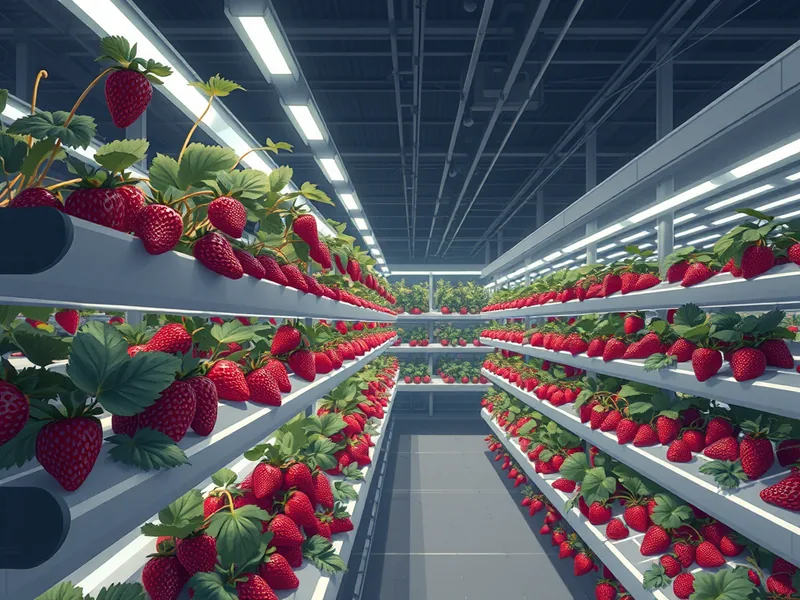
The farm is designed as a multi-story facility where strawberries are grown in stacked layers. This vertical setup allows for a much higher density of plants per square foot compared to traditional horizontal fields. AI plays a crucial role in optimizing the growing conditions, from monitoring soil moisture and nutrient levels to adjusting lighting and temperature.
Imagine a high-rise building where each floor is a garden. Sensors and cameras collect data on every plant, which is then analyzed by AI algorithms to make real-time adjustments. For example, if a sensor detects that certain plants are not receiving enough light, the system can automatically adjust the LED lights to ensure optimal growth. This level of precision helps to maximize yield while minimizing resource use.
One of the most significant advantages of vertical farming is its minimal land requirement. By growing crops vertically, farmers can produce the same amount of food on a fraction of the land needed for traditional farming. This not only preserves natural habitats but also reduces the need for deforestation and habitat destruction.
Water usage is another area where vertical farms excel. Traditional strawberry cultivation requires large amounts of water, much of which is lost to evaporation or runoff. In contrast, vertical farms use hydroponic systems that recirculate water, reducing consumption by up to 90%. Additionally, the controlled environment minimizes the need for pesticides and herbicides, further reducing chemical runoff into nearby ecosystems.
Beyond environmental benefits, vertical farming can also have positive economic impacts. By growing crops closer to urban centers, these farms can reduce transportation costs and carbon emissions associated with long-distance shipping. This can lead to fresher produce on store shelves and lower prices for consumers.
Moreover, the integration of AI technology creates new job opportunities in areas such as data analysis, system maintenance, and farm management. These roles require a mix of technical and agricultural skills, offering a pathway for workers to transition into more sustainable and innovative industries.
While vertical farming holds great promise, it is not without its challenges. The initial setup costs can be high, and the technology requires significant investment in infrastructure and personnel training. Additionally, the energy required to power the AI systems and maintain optimal growing conditions can be substantial, although this can be mitigated through the use of renewable energy sources.
As climate change continues to pose threats to traditional agriculture, innovative solutions like vertical farming will become increasingly important. By complementing nature with technology, these farms can help ensure a more sustainable and resilient food supply for future generations.
The world's first vertical strawberry farm is a testament to the potential of AI in revolutionizing agriculture. It demonstrates that by working in harmony with nature, we can create systems that are both productive and environmentally responsible.
Tags
Original Sources
About the author
Amara's entry point into AI was an epidemiology role at a London research hospital, where she spent five years studying how digital health tools reached — or conspicuously failed to reach — underserved communities. Watching early algorithmic systems in healthcare quietly entrench existing inequalities, she redirected her career toward the systemic consequences of AI at scale. She covers AI through an unflinching lens: who benefits, who bears the cost, and what evidence actually says versus what the press release claims. Her writing is calm and precise, but she doesn't mistake balance for neutrality.
More from The Steward →This Week's Edition
29 April 2026
29 articles
Related Articles

Nuclear Plants Are Squeezing Out More Power, But It Won't Be Enough to Meet AI's Demand
Environment & Climate · 5 min

The Hidden Environmental Price Tag of Artificial Intelligence
Environment & Climate · 5 min

Iambic Therapeutics Raises $150 Million in IPO to Fund AI-Designed Cancer Drugs
Finance & Markets · 5 min
Related Articles
Nuclear Plants Are Squeezing Out More Power, But It Won't Be Enough to Meet AI's Demand
Environment & Climate · 5 min
The Hidden Environmental Price Tag of Artificial Intelligence
Environment & Climate · 5 min
Iambic Therapeutics Raises $150 Million in IPO to Fund AI-Designed Cancer Drugs
Finance & Markets · 5 min
More Stories
© 2026 Cedar & Bloom. All rights reserved.
