The Drum · Weekly AI news, freeSubscribe →

Share
Parked electric vehicles hold enough stored energy to ease grid strain during peak demand, but cost, red tape and consumer wariness have kept the technology on the sidelines for years. Ford thinks it has a fix.
Think about how much time your car spends doing absolutely nothing. For most of us, that's the vast majority of the day: parked in a driveway, a garage, a work lot, sitting idle while a battery pack worth tens of thousands of dollars just sits there too. If that car is electric, that battery isn't just dead weight. It's a small power plant waiting for a job.
That idea, called vehicle-to-grid technology, or V2G, has been floating around the clean energy world for over a decade. The pitch is straightforward: EV batteries can soak up electricity when it's cheap and abundant, then feed some of it back when the grid is straining. Multiply that by millions of cars, and you've got a flexible, distributed reserve that could help utilities avoid blackouts without building another power plant.
It matters more now than ever. Electricity demand is climbing fast, driven by AI data centers, manufacturing growth and the broader push to electrify everything from heating to transportation. Grid operators across the country are warning of tighter margins in the years ahead. Parked EVs, in theory, could be one of the simplest tools for easing that pressure, lowering costs for everyone and keeping the lights on during the worst heat waves or cold snaps.
So why are we barely using them?
The honest answer is that V2G has been expensive, clunky and confusing, and that combination has kept it niche. Sending power from a car battery back into a home or the grid requires an inverter, a piece of equipment that converts the battery's stored energy into a form homes and the grid can actually use. Installing that hardware, on top of the charger itself, has historically cost thousands of dollars. Add in utility paperwork, permitting requirements and consumer uncertainty about draining a car battery meant to get them to work, and it's easy to see why adoption stalled.
Ford is betting it can change the math. The company's new Fathom electric pickup, due in 2027 and priced to start below $30,000, comes with a built-in inverter, which eliminates the need for that costly external box. Ford estimates its new home charging and backup-power system will run roughly $2,100, compared with about $5,200 for its current setup. Simpler installation could push those savings even further, though final pricing hasn't been locked in.
The financial case for owners is where this gets interesting. Picture charging your truck overnight when electricity is cheap, then drawing on that stored power to run your home during the afternoon rate spike. Ford estimates that kind of behavior could save an EV owner $30 to $60 a month. Layer on top of that the rewards some utilities pay for shifting charging times or sending power back during high-demand windows, and the numbers start to look like real household savings, not just a feel-good climate gesture.
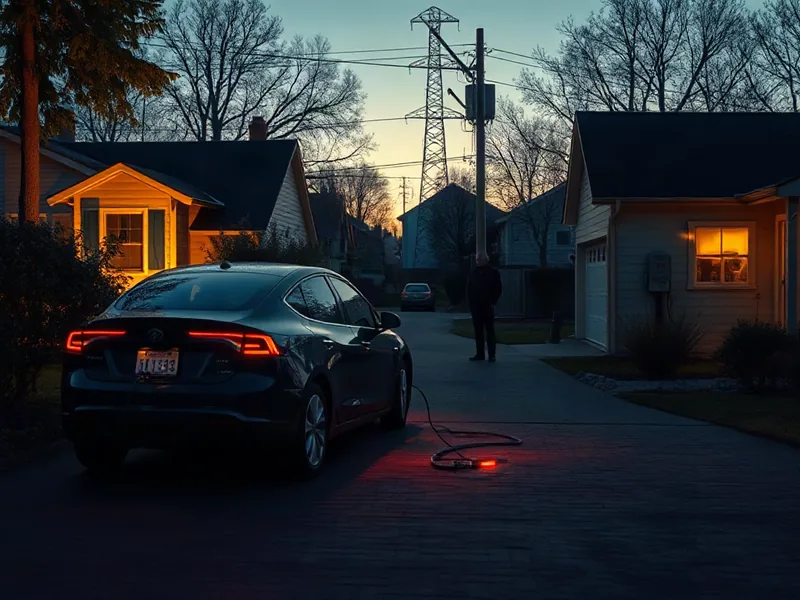
California's PG&E has gone furthest in testing this out. The utility says drivers enrolled in its pilot program could potentially earn up to $600 per season for supplying electricity during periods of peak demand, though actual payouts vary based on participation and conditions. To address the understandable fear of showing up to an empty battery, PG&E lets customers set limits on how much power the utility can pull, so your truck doesn't get drained the night before you need it most.
Here's the catch: despite being one of the earliest and most committed utilities to push this technology, PG&E has enrolled fewer than 70 customers in its V2G pilot, even with 19 eligible EV models on the market. Seventy. Out of a state with millions of electric vehicles already on the road.
Kristin Landry, who leads PG&E's program, points to three obstacles: availability, affordability and accessibility. Cheaper equipment and more compatible vehicles, which Ford's new truck is clearly aimed at, can chip away at the first two. The third is thornier. Every bidirectional charging system on the market is built a little differently, which means utilities face a messy, fragmented technical landscape every time they try to hook a new vehicle into their grid programs. "Each of these bidirectional charging products is wired differently," Landry told Axios, a complexity that adds friction at every level of rollout.
Then there's the classic chicken-and-egg problem that slows so many infrastructure shifts. Utilities need a critical mass of participating EVs before grid programs become worth the investment to manage. Drivers, meanwhile, need an enrollment process simple enough and incentives generous enough to justify spending money and time on equipment they might only use occasionally. Right now, neither side has quite enough to tip the other.
PG&E offers up to $4,000 in equipment incentives to help close that gap, which sounds generous on paper. But Landry acknowledges that cumbersome paperwork, like requiring an electrician's affidavit before approval, has discouraged customers who might otherwise have signed up. It's a reminder that technology problems are often really bureaucracy problems wearing a different hat. Ford says it's working with five major utilities to streamline that approval process, aiming to make sending power back to the grid feel less like a permitting ordeal and more like flipping a switch.
None of this is a minor convenience issue. The grid is under real strain, and the solutions on the table, building new power plants, expanding transmission lines, adding utility-scale battery storage, all take years and enormous sums of money. Millions of EV batteries sitting idle in driveways represent a resource that's already paid for, already distributed and already plugged in most of the time. Tapping even a fraction of that capacity could blunt the worst of future demand spikes and save ratepayers money in the process.
Ford's cheaper hardware is a genuine step forward, and it addresses a real cost barrier that's kept this technology out of reach for most buyers. But affordability alone won't solve the wiring inconsistencies across manufacturers, the permitting headaches utilities and customers both face, or the basic trust problem of convincing people their car will still start in the morning. Making bidirectional power cheap was the easy part. Making it feel normal, reliable and worth the hassle for millions of households is the harder work still ahead, and it will take utilities, automakers and regulators pulling in the same direction to get there.
Tags
Original Sources
Why EVs aren't powering America's electric grid yet
↗ https://www.axios.com/2026/10/27/electric-grid-vehicles-ev-ford-pge
About the author
Amara's entry point into AI was an epidemiology role at a London research hospital, where she spent five years studying how digital health tools reached — or conspicuously failed to reach — underserved communities. Watching early algorithmic systems in healthcare quietly entrench existing inequalities, she redirected her career toward the systemic consequences of AI at scale. She covers AI through an unflinching lens: who benefits, who bears the cost, and what evidence actually says versus what the press release claims. Her writing is calm and precise, but she doesn't mistake balance for neutrality.
More from The Steward →This Week's Edition
28 October 2026
30 articles
Related Articles

AI's Power Problem Is Also Spawning a Grid Modernization Market
Environment & Climate · 5 min

UT Austin Launches UT Dell Medicine, Plans AI-Native Hospital From the Ground Up
Products & Applications · 6 min

Artiva Halts Cell Therapy Program After Two Patient Deaths in Autoimmune Trial
Health & Science · 6 min
Related Articles
AI's Power Problem Is Also Spawning a Grid Modernization Market
Environment & Climate · 5 min
UT Austin Launches UT Dell Medicine, Plans AI-Native Hospital From the Ground Up
Products & Applications · 6 min
Artiva Halts Cell Therapy Program After Two Patient Deaths in Autoimmune Trial
Health & Science · 6 min
More Stories
© 2026 Cedar & Bloom. All rights reserved.
