The Drum · Weekly AI news, freeSubscribe →

Share
Behind the pageantry of the Xi-Trump summit, China is cementing dominance in solar, wind, and geothermal manufacturing while U.S. policy reversals threaten to push American clean energy competitiveness back a decade or more.
When Chinese President Xi Jinping sat down with President Donald Trump at the White House this week, the cameras captured the pageantry that state visits demand: welcome ceremonies, a formal dinner, the careful choreography of two superpowers managing a complicated relationship. But for anyone tracking the global energy transition, the more telling story was what got left off the agenda entirely.
According to reports from Chinese outlets including Xinhua and CGTN, the bilateral talks centered on critical mineral access, agricultural purchases, aircraft sales, tariff truces, artificial intelligence, semiconductors, and cybersecurity. Clean energy transformation barely registered. Both nations framed the relationship through the lens of strategic competition and geopolitical stability, prioritizing guardrails against military and economic friction over any joint climate ambition.
That absence matters more than it might seem. It reflects a deeper divergence that has been building for years and is now accelerating fast enough to reshape who controls the technologies that power homes, factories, and economies for decades to come.
Think of clean energy manufacturing like building a house. You cannot just decide one morning to have a finished home. Foundations need to cure. Framing needs to go up in sequence. Skipping steps or stopping mid-build does not just delay the project, it can compromise the whole structure. That is roughly what is happening to the American clean energy build-out right now, while China's construction crew keeps working around the clock with a detailed blueprint in hand.
China's 15th Five-Year Plan for Renewable Energy Development, covering 2026 through 2030, sets binding targets: 2.8 terawatts of combined wind and solar capacity, with 370 gigawatts concentrated across seven massive "mega-bases" in desert regions like Xinjiang and the Yellow River Bend. Beijing is pairing that solar push with advanced perovskite tandem cells, a next-generation technology that layers materials to squeeze more electricity from the same sunlight, and utility-scale concentrated solar power for thermal storage that keeps supply steady even when the sun goes down.
Onshore wind is being woven into the same desert mega-clusters, feeding ultra-high-voltage transmission lines that move power across provinces. China's plan even mandates that onshore wind maintain an 11 percent minimum "capacity credit," a technical way of guaranteeing the grid can count on wind power during peak demand rather than treating it as a bonus when conditions cooperate.
Offshore wind gets similar treatment. The National Energy Administration has mandated 100 gigawatts of new offshore projects between 2026 and 2030, with coastal provinces building deep-water floating farms supported by supply chains built close to home, which lowers installation costs. And geothermal, often overlooked in the American conversation, is being scaled to replace natural gas in urban district heating, with China converting depleted oilfields into geothermal wells and expanding direct-use heating beyond its current baseline of 1.65 billion square meters.
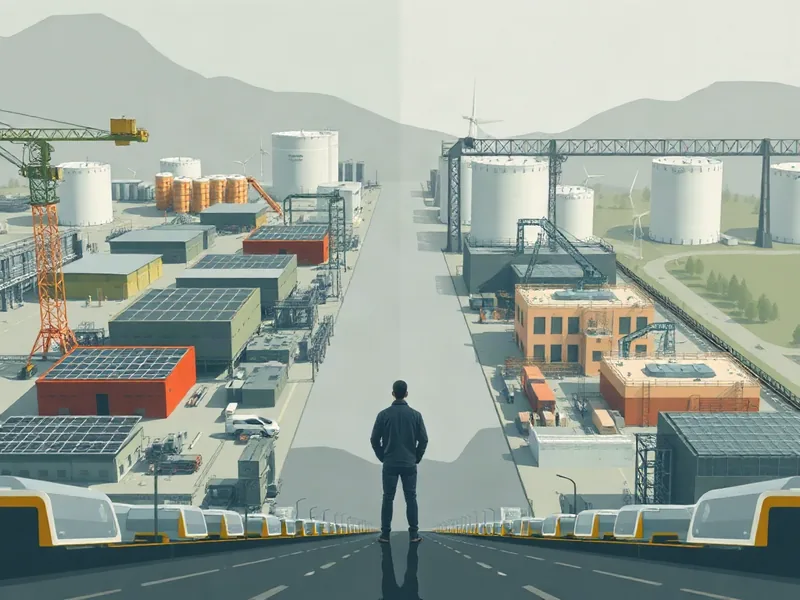
Meanwhile, the American picture looks like a construction site where the crew got sent home. Residential clean energy tax credits have been canceled. Unobligated Inflation Reduction Act grants have been rescinded. Trade tariffs have created supply chain bottlenecks. Domestic wafer and ingot manufacturing projects, the building blocks of solar panels, face capital freezes that could delay U.S. cost parity with Chinese producers by an estimated 10 to 15 years.
Onshore wind faces its own obstacles: permitting delays, slower federal land leasing, the expiration of production tax credits, and grid interconnection backlogs that keep stalling projects in wind-rich corridors across the Midwest. Offshore wind has arguably been hit hardest, with federal leasing freezes, legal challenges to existing permits, and rising capital costs pushing developers to cancel major commercial contracts along the Atlantic coast. Geothermal, despite significant untapped potential in Western states, has seen federal research funding cuts that leave developers leaning on private venture capital just to keep pilot projects alive.
Modeling from Princeton University's REPEAT Project and independent energy researchers puts numbers to this drift. Decarbonization goals are now projected to lag 5 to 10 years behind the original zero-emissions trajectory. Manufacturing supply chains could take 10 to 15 years to reach global cost parity with China. And on global market position, the researchers are blunt: the setback could last decades, or it could be permanent, as Chinese state-backed manufacturers lock in economies of scale across export markets in Europe, Latin America, and Southeast Asia.
Here is the uncomfortable truth about industrial policy: you can reverse it overnight with an executive order, but you cannot rebuild it that fast. A factory that loses its financing does not just pause, it often shuts down for good, and the workers, suppliers, and expertise scatter elsewhere. Capital that flees uncertainty tends to land somewhere more stable, and increasingly that somewhere is China.
This is not an abstract policy debate confined to think tanks and trade negotiators. The technologies at stake determine electricity prices, job creation in manufacturing regions, and whether the United States has any leverage over the infrastructure that will define energy security for the rest of this century. When a nation cedes ground in solar wafer production or offshore wind installation, it is not just losing a market segment. It is losing the ability to set terms for how that technology gets built, priced, and deployed everywhere else.
There is still time to change course, but the window narrows with each canceled contract and each stalled permit. Rebuilding domestic manufacturing scale requires the kind of sustained, patient capital that survives multiple election cycles and policy swings, not the stop-start funding that has characterized the last several years. China's plan runs through 2030 and appears designed to outlast any single American administration's priorities.
The people who will feel this most are not policymakers in Washington or Beijing. They are workers in wind-rich Midwestern states waiting on interconnection approvals, coastal communities that lost offshore wind jobs when contracts were canceled, and households who could have benefited from residential clean energy credits that no longer exist. The clean tech century is being decided now, in five-year plans and grant rescissions, whether or not it makes it onto a state dinner menu.
Tags
Original Sources
Op-Ed: How America Is Ceding the Clean Tech Century to China - CleanTechnica
↗ https://cleantechnica.com/2026/09/26/op-ed-how-america-is-ceding-the-clean-tech-century-to-china
About the author
Amara's entry point into AI was an epidemiology role at a London research hospital, where she spent five years studying how digital health tools reached — or conspicuously failed to reach — underserved communities. Watching early algorithmic systems in healthcare quietly entrench existing inequalities, she redirected her career toward the systemic consequences of AI at scale. She covers AI through an unflinching lens: who benefits, who bears the cost, and what evidence actually says versus what the press release claims. Her writing is calm and precise, but she doesn't mistake balance for neutrality.
More from The Steward →This Week's Edition
27 September 2026
18 articles
Related Articles
Related Articles
More Stories
© 2026 Cedar & Bloom. All rights reserved.